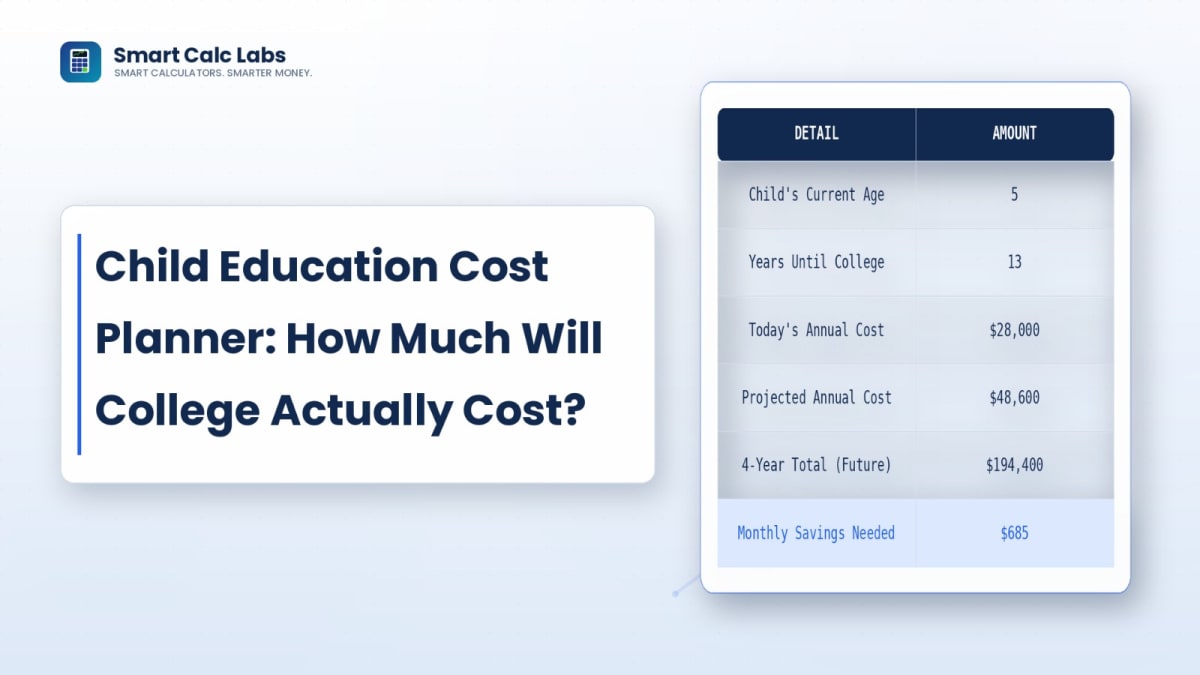
Planning for a child's future education is one of the most rewarding yet financially daunting goals a parent or guardian can undertake. With higher education costs historically escalating at nearly double the rate of headline Consumer Price Index (CPI) inflation, looking at today's university price tags and assuming they will remain unchanged in 10, 15, or 18 years is a recipe for severe underfunding.
Whether you are welcoming a newborn, planning for a toddler, or catching up on savings for a middle-schooler, this guide breaks down the mathematics of college cost inflation, examines the tax advantages of 529 plans, illustrates real-world cost trajectories, and helps you establish a realistic savings target using our interactive Child Education Calculator.
1. The Reality of Education Inflation: Why Future Costs Explode
Standard consumer inflation (groceries, energy, cars) historically averages between 2.0% and 3.0% per year. In contrast, higher education costs—which include tuition, mandatory institutional fees, textbook supplies, and campus room and board—have historically escalated at an annualized rate of 4.5% to 6.0%.
When compound inflation operates over an 18-year horizon between a child's birth and their freshman year of college, the resulting price multiplication is staggering:
| Institution Category | Current Total Cost / Yr (2024–2026) | Current 4-Yr Total | Projected Cost in 10 Yrs (5% Infl.) | Projected Cost in 18 Yrs (5% Infl.) |
|---|---|---|---|---|
| Public 4-Yr (In-State) | $29,910 | $119,640 | $194,880 | $287,930 |
| Public 4-Yr (Out-of-State) | $47,000 | $188,000 | $306,220 | $452,430 |
| Private Nonprofit 4-Yr | $62,990 | $251,960 | $410,410 | $606,370 |
| Elite / Ivy League | $88,500 | $354,000 | $576,620 | $851,940 |
A baby born today whose parents target a standard in-state public university will face an estimated $287,930 total four-year bill by age 18. If targeting a private university, that figure exceeds $600,000. Understanding these numbers is not intended to incite panic, but to establish mathematical clarity.
2. The "1/3 Rule" of College Funding Strategy
Few middle-class families can save 100% of an inflated $300,000+ college bill in cash ahead of time without severely compromising their own retirement security. To prevent burnout and maintain a balanced financial life, certified financial planners frequently advocate the 1/3 College Funding Framework:
Past Savings (529 Plan)
Funded through automated monthly contributions and family gifts during the child's pre-college years, benefiting from long-term compound growth.
Current Income & Cash Flow
Covered out of the parents' regular monthly salary during the 4 years the child is enrolled (tuition payment plans, tax credits like the AOTC).
Financial Aid & Manageable Loans
Covered by merit scholarships, federal student work-study, and modest federal Direct student loans within responsible borrowing thresholds.
Targeting 33% to 50% of the projected cost makes monthly savings targets manageable while providing an essential financial cushion that prevents heavy student loan burdens. You can customize your funding goal percentage directly in our Child Education Calculator.
3. The Cost of Delay: The Compounding Advantage of Starting Early
Time is the most valuable asset in education planning. When you start early, the majority of your college fund is paid for by investment returns rather than your personal wages. When you delay, you lose compounding time, forcing your monthly savings obligation to skyrocket.
Consider funding a $150,000 target education fund by age 18 in an investment portfolio averaging 7.0% annual returns:
| Starting Age | Years to Invest | Monthly Savings Needed | Your Out-of-Pocket Cost | Compound Growth Paid by Market |
|---|---|---|---|---|
| Birth (Age 0) | 18 Years | $351 / mo | $75,816 (50.5%) | $74,184 (49.5%) |
| Kindergarten (Age 5) | 13 Years | $598 / mo | $93,288 (62.2%) | $56,712 (37.8%) |
| Middle School (Age 10) | 8 Years | $1,168 / mo | $112,128 (74.8%) | $37,872 (25.2%) |
| High School (Age 14) | 4 Years | $2,714 / mo | $130,272 (86.8%) | $19,728 (13.2%) |
Starting at birth requires only $351/month, and compound investment returns pay nearly half the entire cost. Waiting until high school requires $2,714/month—nearly eight times as much—forcing parents to pay almost the entire balance out of pocket.
4. 529 College Savings Plans & 2024–2026 Modern Reforms
A 529 Qualified Tuition Plan is the gold standard savings vehicle for education in the United States. It operates similarly to a Roth IRA for education:
- 100% Tax-Free Growth: All dividends, capital gains, and interest accumulate completely free of federal and state taxes.
- Tax-Free Withdrawals: Distributions spent on qualified higher education expenses (tuition, fees, books, laptops, room, and board) are completely tax-free.
- State Income Tax Deductions: Over 30 states offer a state income tax deduction or tax credit for contributions to their state's 529 plan.
- K-12 Tuition Flexibility: You can withdraw up to $10,000 per year per student for private or religious elementary and high school tuition.
- Student Loan Payoff: Up to $10,000 lifetime per beneficiary can be used to pay down qualified student loan debt.
Major Regulatory Breakthrough: The SECURE 2.0 529-to-Roth Rollover
Historically, parents feared over-funding a 529 plan because non-qualified withdrawals incurred income tax plus a 10% penalty on earnings. Under the SECURE 2.0 Act, unused 529 funds can now be rolled over tax-free directly into a Roth IRA in the beneficiary's name, subject to the following rules:
- The 529 account must have been maintained for at least 15 years.
- Lifetime maximum rollover limit of $35,000 per beneficiary.
- Annual rollovers are subject to standard annual Roth IRA contribution limits (e.g., $7,000/yr).
- Contributions and earnings made in the preceding 5 years are ineligible for rollover.
Additionally, under updated FAFSA Simplification rules, distributions from grandparent-owned 529 plans no longer count as student income on the FAFSA, eliminating previous financial aid penalties and making grandparent contributions highly advantageous.
5. Step-by-Step Guide to Calculating Your Monthly Education Savings
- Select Target Institution Baseline: Research today's average cost of attendance (tuition, fees, housing, food) for your target school category ($30k for in-state public, $63k for private).
-
Project Future Inflated Cost: Use the formula:
Future Annual Cost = Current Annual Cost × (1 + Inflation Rate)Years to College. - Multiply by Degree Years: Multiply the inflated annual figure by 4 years (or 2/5 years depending on degree type).
-
Subtract Projected Growth of Existing Savings: Compound any existing 529 balance to the college entry date:
Future Value = Existing Balance × (1 + Return Rate)Years to College. - Solve for Monthly Contribution: Calculate the monthly annuity deposit needed to bridge the remaining shortfall.
6. Common Education Planning Mistakes Parents Make
Mistake 1: Sacrificing Retirement for College Savings
Your child can finance college with grants, scholarships, work-study, and low-interest loans; you cannot take out a loan for retirement. Secure your own 15%–20% retirement savings rate before aggressively funding education accounts.
Mistake 2: Leaving College Savings in Cash or Low-Yield Bank Accounts
Holding education funds in traditional savings accounts earning 0.05% guarantees purchasing power loss against 5% education inflation. Over a 10 to 18-year horizon, an age-based 529 portfolio (transitioning from equities to fixed income) provides essential growth.
Mistake 3: Planning Exclusively Around "Sticker Prices"
Private universities frequently offer generous institutional grants and merit aid that reduce net out-of-pocket costs to levels comparable with public universities. Always check a school's Net Price Calculator before ruling it out.
7. Frequently Asked Questions
How much does a 529 plan affect FAFSA financial aid eligibility?
Parent-owned 529 plans are treated as parental assets on the FAFSA, assessing at a maximum rate of only 5.64% of the account value toward the Student Aid Index (SAI). In contrast, assets held in a child's name (like UGMA/UTMA accounts) are assessed at a heavy 20% rate. A 529 plan has minimal negative impact on need-based aid.
Can I use a 529 plan for international universities?
Yes. Over 750 international universities (including prominent institutions in Canada, the UK, Europe, Australia, and New Zealand) are eligible for tax-free 529 distributions, provided they participate in the federal Title IV student aid program (possessing a Federal School Code).
What happens if my child receives a full scholarship?
If your child earns a scholarship, you can withdraw an amount equal to the scholarship from your 529 plan without incurring the 10% penalty (you only pay regular income tax on the earnings portion). Alternatively, you can transfer the beneficiary to another sibling or roll up to $35,000 into a Roth IRA.
8. Next Steps: Calculate Your Custom College Plan
Ready to see your exact numbers? Use our free Child Education Calculator to input your child's age, select your target college tier, test extra monthly contributions, and explore complete milestone accumulation schedules.