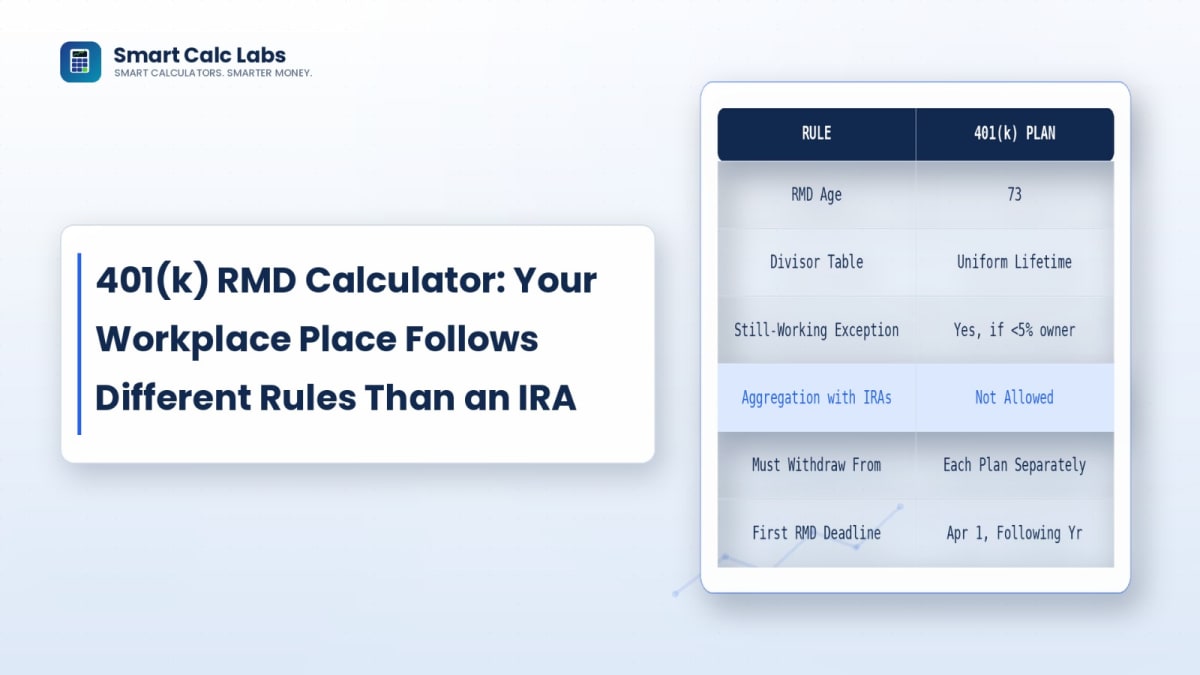
If you have both a 401(k) and an IRA, do not assume the RMD rules work the same way across them. They don't. The starting age, the excise tax, and the underlying divisor table are shared — but 401(k)s carry two rules that trip up even people who have carefully planned their IRA withdrawals: you cannot combine RMDs across multiple 401(k)s, and if you are still working, you may not owe one at all yet.
Our RMD Calculator handles both account types, but the mechanics behind a 401(k) figure deserve their own explanation. Here is what is actually different.
Rule One: No Aggregation, Ever
With traditional IRAs, the IRS lets you calculate an RMD for each account separately, then total them and withdraw the combined amount from just one IRA of your choosing. Many people assume 401(k)s work the same way. They do not. Each 401(k) requires its own separately calculated and separately withdrawn RMD. If you have three old 401(k)s sitting at former employers, you owe three distinct RMDs from three distinct accounts — you cannot satisfy all three by draining the largest one. This applies within the 401(k) category specifically; 403(b) plans have their own separate aggregation rule that only lets them combine with other 403(b)s, never with a 401(k) or an IRA.
This matters most for people who have changed jobs several times and left a trail of old employer plans behind. Each one needs to be tracked and calculated individually, every year, or you risk a missed-RMD penalty on the specific account you forgot about — even if you took plenty from your other accounts that year.
Rule Two: The Still-Working Exception
If you are still employed at the company that sponsors your 401(k) past your RMD age, you may be able to delay RMDs from that specific plan until the year you actually retire — not the year you turn 73. Three conditions have to hold:
- You must still be actively employed by the company sponsoring the plan.
- You cannot own more than 5% of that business (ownership by certain family members counts toward your share too).
- Your specific plan has to allow the exception — most do, but it is not automatic under the law, and it is worth checking your Summary Plan Description to confirm.
Crucially, this exception applies only to the 401(k) at your current employer. Old 401(k)s from previous jobs, and any IRAs you hold, still owe RMDs on the normal schedule regardless of whether you are still working somewhere else.
One genuinely tricky edge case: if your last day of work is December 31, did you retire in that calendar year or the next one? The IRS has never officially clarified this, but the general consensus among tax professionals is that a December 31 last day counts as retiring in that same year — worth confirming with a tax advisor if your timing falls right on that line, since it changes your first RMD deadline by a full year.
Roth 401(k)s: The Rule That Changed in 2024
This is a genuinely recent, genuinely favorable change. Before 2024, Roth 401(k) balances were subject to lifetime RMDs even though Roth IRAs never were — an inconsistency that caught a lot of savers off guard. Starting with the 2024 tax year, under SECURE 2.0, Roth 401(k) balances no longer require RMDs during the original participant's lifetime, bringing them in line with Roth IRA treatment. If your 401(k) balance is entirely Roth, you now have zero lifetime RMD obligation on it. If your 401(k) is split between traditional (pre-tax) and Roth contributions, only the traditional portion generates an RMD — the Roth portion is excluded from the calculation entirely.
A Worked Example
Say you are 74 in 2026, retired, with two accounts: a traditional 401(k) from your last employer worth $320,000, and a traditional IRA worth $180,000, both valued as of December 31, 2025. The divisor for age 74 is 25.5.
- 401(k) RMD: $320,000 ÷ 25.5 = $12,549, withdrawn from that specific 401(k)
- IRA RMD: $180,000 ÷ 25.5 = $7,059, withdrawn from that IRA
You cannot combine these two figures and take $19,608 from whichever account is more convenient — each has to be satisfied from its own account. If you also had a second old 401(k) worth $90,000, that would generate a third, entirely separate RMD of $3,529, again payable only from that specific plan.
Should You Roll Old 401(k)s Into an IRA?
Consolidating old 401(k)s into a single rollover IRA is a common strategy precisely because of the aggregation rule — once the money is in an IRA, it can be combined with your other IRA balances and withdrawn from whichever account you prefer, cutting down the number of separate RMD calculations and withdrawals you have to track every year. The trade-off: 401(k)s sometimes offer creditor protections or specific investment options an IRA does not, and if you are still working and using the still-working exception on your current employer's plan, rolling that particular account out would eliminate the delay you were relying on. Old plans from previous employers, however, do not benefit from the still-working exception at all, which is exactly why they are the accounts most commonly rolled over.
Common Mistakes and Pitfalls
- Assuming 401(k)s aggregate like IRAs. They never do — each plan needs its own calculation and withdrawal, every year.
- Forgetting about an old 401(k) at a former employer. The still-working exception does not apply to it, even if you are still employed elsewhere, and it still owes its own RMD on schedule.
- Assuming Roth 401(k) balances still trigger RMDs. This changed in 2024 — Roth 401(k)s are now RMD-free during the owner's lifetime, just like Roth IRAs.
- Not confirming your specific plan actually offers the still-working exception. It is optional for the plan sponsor to include, even though most do.
If you are managing RMDs across several account types, our RMD Calculator and Inherited IRA RMD Calculator are worth using alongside this guide to double-check every individual account's figure.
Disclaimer: The content on SmartCalcLabs is for educational and informational purposes only and does not constitute tax advice. 401(k) RMD rules referenced here reflect 2026 IRS guidance under SECURE 2.0, including the still-working exception and the 2024 Roth 401(k) change. Confirm your plan's specific rules with your plan administrator and a licensed tax professional.
Frequently Asked Questions
Does the still-working exception apply to 403(b) and 457(b) plans too?
Generally yes, the same still-working exception logic applies to most employer-sponsored plans, not just 401(k)s, subject to the same 5%-ownership limit and plan-adoption requirement. Rules can vary slightly by plan type, so confirm with your specific plan administrator.
What if I have a 401(k) and a 403(b)?
These are treated as separate categories for aggregation purposes. Your 403(b) balances can be aggregated with other 403(b)s, and your 401(k) balances cannot be aggregated with anything, but the two categories cannot be combined with each other.
Can I take my 401(k) RMD from my IRA instead?
No. Each account type's RMD must be satisfied from within that same account type — you cannot use an IRA withdrawal to cover a 401(k) RMD requirement, or vice versa.
If I roll my old 401(k) into an IRA mid-year, whose rules apply for that year's RMD?
Generally, you must take that year's 401(k) RMD before completing the rollover — RMD amounts cannot themselves be rolled over into an IRA. Once the remaining balance is in the IRA, it becomes subject to IRA aggregation rules for future years.
Conclusion
A 401(k) RMD is not just an IRA RMD with a different account label — the no-aggregation rule and the still-working exception are genuine, practical differences that change how much you owe and when. Run each of your accounts through the calculator above separately, confirm whether your current employer's plan actually offers the still-working exception, and consider consolidating old employer plans into an IRA if simplifying your annual RMD tracking is worth more to you than any plan-specific protections you would give up.