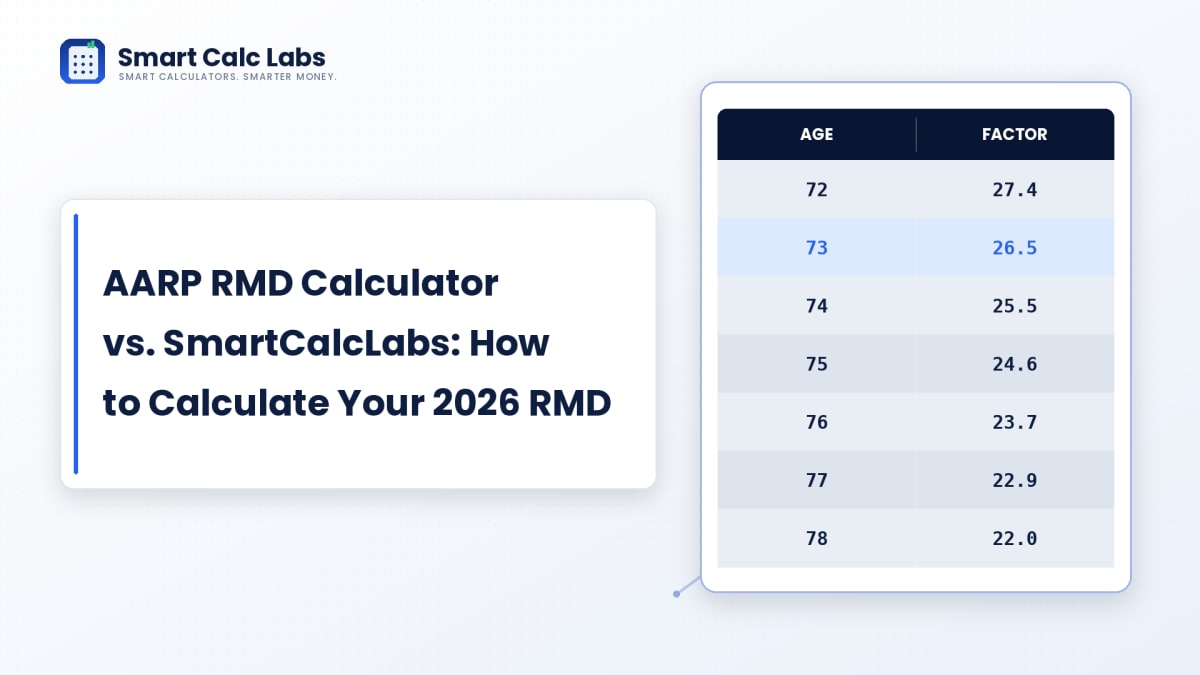
Navigating Mandatory Retirement Withdrawals in 2026
Reaching retirement age comes with tremendous freedom, but it also brings complex tax compliance obligations. Central among these is the Required Minimum Distribution (RMD)—the mandatory annual amount that owners of traditional retirement accounts must withdraw once they reach statutory age milestones established by the federal government.
For decades, retirees have turned to the widely recognized AARP RMD Calculator to obtain a fast baseline estimate of their required annual withdrawal. However, following the landmark passage of the SECURE 2.0 Act, retirement distribution rules underwent their most significant overhaul in a generation. With new starting ages (age 73 vs. age 75), updated life expectancy divisor tables, altered penalty structures, and nuanced tax withholding challenges, modern retirees require greater analytical precision than basic legacy tools provide.
This guide offers an honest, comprehensive comparison between the traditional AARP RMD calculator and the institutional-grade SmartCalcLabs RMD Calculator, helping you select the right tool for your specific financial planning needs.
How the IRS Calculates Your Minimum Required Distribution
Regardless of which digital calculator you choose or whether you calculate your distribution manually on IRS Form 5329, every RMD computation follows the standardized federal formula:
The Three Variables That Dictate Your Withdrawal:
- Prior Year-End Balance: The total fair market value (FMV) of your tax-deferred accounts on December 31 of the previous calendar year. For your 2026 RMD, this is your balance on December 31, 2025.
- Your Attained Age: Your age on December 31 of the current distribution year (not your age at the time you execute the withdrawal).
- The Applicable IRS Divisor Table: Most retirees use the IRS Uniform Lifetime Table (Table III). However, if your sole primary beneficiary is a spouse who is more than 10 years younger than you, you are legally required to use the Joint Life and Last Survivor Table (Table II), which yields a larger divisor and consequently a smaller required distribution.
SECURE 2.0 Starting Age Architecture: Age 73 vs. Age 75
Prior to 2020, RMDs began at age 70½. The SECURE Act of 2019 raised this to age 72, and SECURE 2.0 increased it further. Because many calculators still harbor legacy code or provide confusing inputs, it is vital to know your statutory starting milestone:
- Born 1950 or earlier: Already subject to RMDs under prior law (age 70½ or age 72).
- Born between 1951 and 1959: Your mandatory starting age is Age 73. (For example, individuals born in 1953 reach age 73 in 2026).
- Born in 1960 or later: Your mandatory starting age increases to Age 75 (taking effect in 2035 and beyond).
| Birth Year Window | Statutory Starting Age | First Applicable RMD Year | First Required Beginning Date |
|---|---|---|---|
| 1951 | Age 73 | 2024 | April 1, 2025 |
| 1952 | Age 73 | 2025 | April 1, 2026 |
| 1953 (Turning 73 in 2026) | Age 73 | 2026 | April 1, 2027 |
| 1954 – 1959 | Age 73 | 2027 – 2032 | April 1 of following year |
| 1960 or Later | Age 75 | 2035+ | April 1, 2036+ |
Feature-by-Feature Analysis: AARP vs. SmartCalcLabs
To understand which calculator best serves your planning workflow, we analyzed both tools across critical parameters:
| Evaluation Criteria | AARP RMD Calculator | SmartCalcLabs RMD Calculator |
|---|---|---|
| SECURE 2.0 Dynamic Age Logic | Standard Age 73 entry. Does not explicitly model the forward transition to Age 75 for younger savers. | Full birth-year matrix automatically routes users to Age 73 or Age 75 milestones. |
| Tax Withholding & Net Take-Home | Gross distribution only. Does not factor in federal or state tax withholding. | Integrated tax withholding slider calculates actual net take-home cash flow and estimated tax burden. |
| Younger Spouse Joint Life Table | Supported via checkbox if spouse is >10 years younger. | Fully supported with dynamic age delta inputs and Table II factor display. |
| Factor & Divisor Transparency | Displays final dollar figure without exposing the underlying IRS divisor used. | Displays exact IRS life expectancy factor, percentage of portfolio, and Uniform Table reference. |
| Multi-Year Projection Capability | Provides a basic future schedule based on flat growth assumptions. | Full year-by-year distribution table showing projected balances, rising divisors, and cumulative taxes. |
| Data Privacy & Tracking | Operates within a large commercial portal with analytics, third-party cookies, and ad tracking. | 100% client-side JavaScript execution. Zero financial data stored, logged, or shared. |
| Inherited & 401(k) Specific Modes | Focuses primarily on Traditional IRAs. | Dedicated tool ecosystem linking directly to Inherited IRA RMD and Workplace 401(k) engines. |
When to Use Which Tool
Use the AARP RMD Calculator If:
- You have a simple, single Traditional IRA balance and simply want a quick, 10-second check on your gross annual withdrawal requirement.
- You value the familiar branding of AARP and do not require detailed cash-flow planning or tax withholding estimates.
Use the SmartCalcLabs RMD Calculator If:
- You Need Net Take-Home Numbers: You budget on actual cash received in your bank account after federal and state income tax withholding, rather than theoretical gross numbers.
- You Value Absolute Data Privacy: You prefer a calculation engine where your balances, birth date, and financial numbers are processed purely in your browser's local memory and never transmitted to remote servers.
- You Are Planning Forward for Age 75: You are in your 50s or early 60s modeling future retirement cash flows and need SECURE 2.0 forward projections.
- You Manage Multiple Accounts: You need to evaluate which portion of your RMD to pull from specific IRAs while coordinating with 401(k) plans.
Critical Nuances Calculators Cannot Automate for You
While an online calculator provides the mathematical answer, retirees must adhere to several key administrative IRS rules:
1. The IRA Aggregation Rule
If you own multiple Traditional IRAs, SEP IRAs, and SIMPLE IRAs, the IRS allows you to aggregate your RMDs. You must calculate the RMD for each individual account, sum the totals together, and then withdraw that combined total from any one or combination of your IRAs. This allows you to liquidate poorly performing assets or consolidate accounts seamlessly.
2. The First Year "Double Tax" Grace Period Trap
Under IRS rules, you have until April 1 of the year following the year you reach your RMD age to take your very first distribution. For example, if you turn 73 in 2026, your first RMD deadline is April 1, 2027.
However, delaying your first RMD into early 2027 means you must also take your second RMD (for the 2027 tax year) by December 31, 2027. Packing two full RMD distributions into a single calendar year can dramatically elevate your Adjusted Gross Income, pushing you into higher federal tax brackets and triggering Medicare IRMAA premium spikes.
3. SECURE 2.0 Roth 401(k) Lifetime Exemption
Prior to 2024, designated Roth accounts in workplace 401(k) and 403(b) plans were strangely subject to lifetime RMDs, forcing retirees to roll them into Roth IRAs. Starting in 2024 under SECURE 2.0, Roth 401(k)s and Roth 403(b)s are completely exempt from lifetime RMDs, aligning them with the lifetime tax-free treatment of Roth IRAs.
Advanced Strategy: Qualified Charitable Distributions (QCDs)
If you do not need your full RMD for daily living expenses, consider utilizing a Qualified Charitable Distribution (QCD):
- Individuals age 70½ or older can transfer up to $105,000 (indexed for inflation in 2026) directly from a Traditional IRA to a qualifying 501(c)(3) charity.
- The distribution directly satisfies your annual RMD requirement.
- Crucially, the money is completely excluded from your Adjusted Gross Income (AGI). Unlike an itemized charitable deduction (which many retirees cannot use due to the high standard deduction), a QCD keeps your AGI lower, shielding Social Security benefits from taxation and avoiding Medicare IRMAA surcharges.
Calculate Your 2026 RMD With Full Tax Precision
Get your instant, 100% private calculation. Inspect your official IRS divisor factor, model net take-home pay after federal withholding, and ensure full SECURE 2.0 compliance.
Frequently Asked Questions (FAQs)
Can I withdraw more than my calculated RMD amount?
Yes. The RMD represents the statutory minimum you must withdraw to avoid IRS penalties. You can withdraw as much as you wish above the minimum. However, any excess distribution in the current year cannot be applied or "carried forward" to reduce your required distribution in future years.
What happens if I am still working at age 73?
If you are still employed at age 73 and do not own 5% or more of the company employing you, you can utilize the "still-working exception" to delay RMDs from your current employer's 401(k) or 403(b) plan until April 1 following the year you retire. However, this exception does not apply to Traditional IRAs or retirement plans from prior employers; RMDs from those accounts must still be taken on schedule.
Does my calculated RMD change if the stock market crashes during the year?
No. Your statutory RMD dollar figure is locked based on your account value on December 31 of the prior calendar year. If your portfolio loses value during the current year, your dollar RMD obligation does not decrease, which means the withdrawal will represent a higher percentage of your remaining assets.
How is an RMD taxed by federal and state authorities?
Distributions from tax-deferred accounts (like Traditional IRAs and pre-tax 401(k)s) are taxed as ordinary income at your regular marginal tax rates—not at preferential long-term capital gains rates. Most states also treat RMDs as taxable state income, although some states offer retirement income exemptions or have no state income tax.
What form do I receive from my custodian to report RMDs?
In January following the distribution year, your financial custodian will issue IRS Form 1099-R reporting the gross distribution in Box 1 and any federal and state income tax withheld in Boxes 4 and 12. You report these figures on IRS Form 1040 when filing your federal tax return.