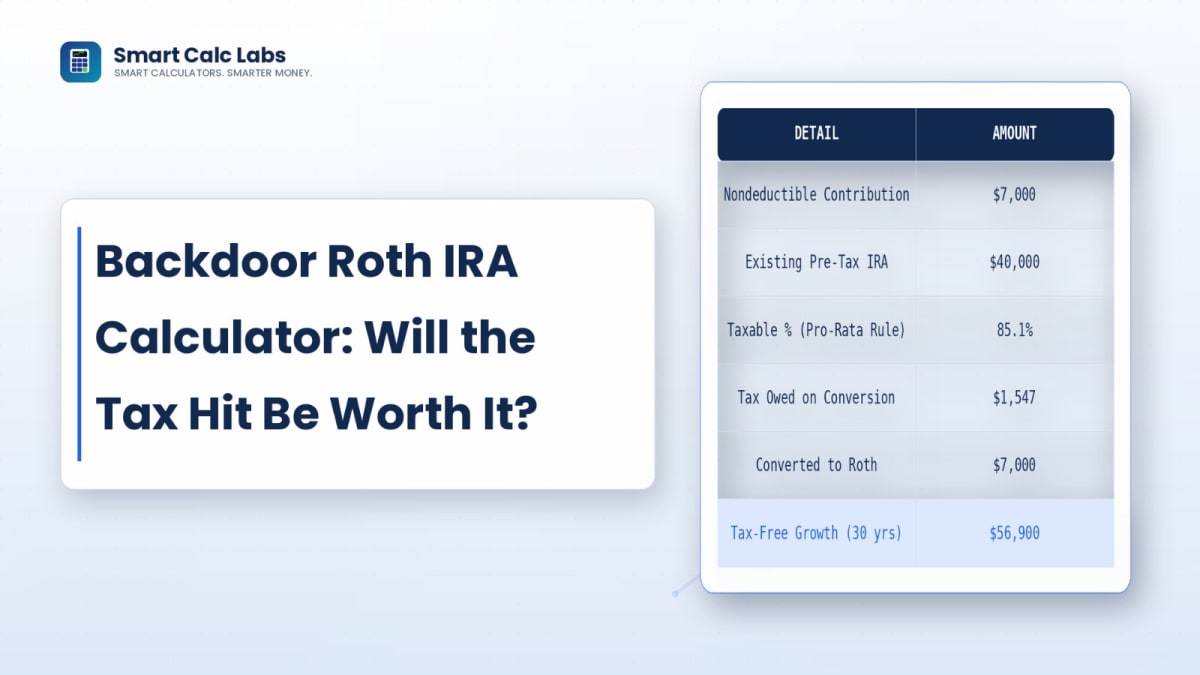
For 2026, direct Roth IRA contributions phase out completely once your MAGI hits $168,000 (single) or $252,000 (married filing jointly). The backdoor Roth exists precisely for people above that line — but one overlooked existing account balance can turn a "tax-free" conversion into a mostly-taxable one. Here's how to check before you convert.
Run your numbers through the Backdoor Roth IRA Calculator — the pro-rata mechanics are explained below.
The 2026 Numbers
- Contribution limit: $7,500 ($8,600 if you're 50 or older) for the combined total across Traditional and Roth IRAs.
- Direct Roth phase-out: begins at $153,000 (single) / $242,000 (married filing jointly) and fully phases out at $168,000 / $252,000. Above the top of the range, you cannot contribute to a Roth IRA directly at all.
- Backdoor conversions have no income limit — this is exactly why the strategy exists as a workaround.
The Pro-Rata Rule: Where This Strategy Goes Wrong
This is the single most common way a backdoor Roth turns into an unexpected tax bill. The IRS treats all of your Traditional IRA balances — not just the new contribution you're converting — as one combined pool when calculating how much of a conversion is taxable.
Example: You contribute $7,500 after-tax to a Traditional IRA specifically to convert it. But you also have $100,000 sitting in an old rollover IRA from a previous job. Your total IRA balance is $107,500, of which only $7,500 (about 7%) is after-tax money. When you convert, the IRS taxes the conversion proportionally — meaning roughly 93% of your "backdoor Roth" conversion gets taxed as ordinary income, not the 0% you were expecting.
This single detail is what turns a clean tax-free strategy into a costly mistake for people who have old 401(k) or IRA rollovers sitting around without realizing they'll be pulled into the calculation.
How to Avoid the Pro-Rata Trap
- Roll existing pre-tax IRA balances into a current employer's 401(k) first, if your plan accepts incoming rollovers. This empties your Traditional IRA balance (401(k)s aren't included in the pro-rata calculation), clearing the way for a clean backdoor conversion.
- Convert quickly after contributing. The shorter the gap between the non-deductible contribution and the conversion, the less time for investment growth to accumulate — growth on the contribution before conversion is itself taxable.
- Check your December 31 balance, not just your current one. The pro-rata calculation uses your total Traditional IRA balance as of December 31 of the conversion year — a mid-year rollover in either direction changes the math.
Is It Even Worth It for You?
If you have no existing pre-tax IRA balance, the backdoor Roth is close to a clean, no-cost way to get money into tax-free growth despite exceeding the direct income limits — the calculator will show minimal tax owed. If you do have a significant existing balance and can't roll it into a 401(k) (for example, if you're self-employed with no employer plan available), the pro-rata tax hit may be large enough that the strategy isn't worth executing that year — running the actual numbers before converting is essential rather than assuming it's automatically beneficial.
Common Mistakes
- Forgetting about an old rollover IRA when estimating the tax cost — this is the single biggest source of surprise tax bills with this strategy.
- Waiting too long to convert after contributing, letting investment gains accumulate in the Traditional IRA before conversion, which adds a small but avoidable taxable amount.
- Not checking whether their 401(k) plan accepts incoming IRA rollovers before assuming the pro-rata problem is unsolvable.
- Confusing the backdoor Roth with the mega backdoor Roth — the mega backdoor uses after-tax 401(k) contributions and can allow substantially more into Roth accounts each year (potentially tens of thousands more), but requires a specific 401(k) plan design that most employers don't offer.
Using the Calculator
- Enter your planned non-deductible contribution ($7,500 or $8,600 for 2026).
- Enter the total balance of all your existing Traditional, SEP, and SIMPLE IRAs as of December 31 — this is what triggers the pro-rata rule.
- See your estimated taxable percentage of the conversion, and the resulting tax cost at your marginal rate.
- Compare that cost against your long-term retirement plan to judge whether the tax-free growth is worth the upfront hit this year.
Before You Rely on This
This calculator estimates the pro-rata tax impact based on IRS rules as of 2026. Your actual tax owed depends on your full tax situation, including your marginal bracket and any state tax treatment of the conversion, which varies by state.
Disclaimer: The content provided on SmartCalcLabs is for educational and informational purposes only. We are not certified financial planners or tax advisors. You should always consult with a licensed professional before making significant financial decisions.
IRS Form 8606 Line-by-Line Guide: Reporting Non-Deductible Contributions and Conversions
Executing a Backdoor Roth IRA requires meticulous compliance documentation on IRS Form 8606 (Nondeductible IRAs) attached to your annual Form 1040. Because custodians report Roth conversions on Form 1099-R with Box 2b marked "Taxable amount not determined," failing to file Form 8606 causes the IRS computer matching system to automatically classify the entire conversion as taxable income, triggering CP2000 deficiency notices.
Here is how the calculation flows across Part I and Part II of Form 8606:
Part I: Nondeductible Contributions & Basis
• Line 1: Enter current-year nondeductible Traditional IRA contribution ($7,000, or $8,000 if age 50+).
• Line 2: Enter total basis from prior years (Line 14 of your most recent prior Form 8606; $0 for first-time backdoor contributors).
• Line 3: Sum of Lines 1 and 2 ($7,000).
• Line 6: Aggregate fair market value of ALL Traditional, SEP, and SIMPLE IRAs as of December 31 ($0 if fully converted or rolled into an employer 401(k)).
• Line 8: Net amount converted to a Roth IRA during the calendar tax year ($7,000).
• Line 10: Divide Line 5 by Line 9 (1.00000 non-taxable ratio).
• Line 13: Non-taxable portion of conversion ($7,000).
Part II: 2026 Roth Conversions
• Line 16: Total amount converted ($7,000).
• Line 17: Non-taxable amount from Line 13 ($7,000).
• Line 18: Taxable conversion portion ($0; transfers to Form 1040 Line 4b).
Tax Year Timing vs. Calendar Year Execution
A frequent compliance trap arises when an investor contributes to a Traditional IRA in March 2026 designated for tax year 2025, but converts the funds to a Roth IRA in April 2026. Non-deductible contributions are reported on Form 8606 for the designated tax year (2025 return), whereas Roth conversions are legally reported strictly in the calendar year they physically clear (2026 return filed in early 2027).
If this occurs, your 2025 Form 8606 records a $7,000 basis on Line 14 with no conversion. Your subsequent 2026 Form 8606 pulls that basis onto Line 2, matching it against the 2026 conversion to eliminate tax liability. Maintaining consecutive annual copies of Form 8606 is mandatory proof of basis for the IRS throughout your lifetime.
Frequently Asked Questions
Does the pro-rata rule apply to my spouse's IRA too?
No — the pro-rata calculation is done separately for each individual's own IRAs. A spouse's Traditional IRA balance does not affect your backdoor Roth conversion, even on a joint tax return.
Can I undo a backdoor Roth conversion if the pro-rata tax hit is too high?
No — Roth conversions can no longer be reversed ("recharacterized") under current tax law. This is exactly why running the calculation before converting matters so much.
Does a SEP or SIMPLE IRA count toward the pro-rata calculation?
Yes — SEP and SIMPLE IRA balances are included in the pro-rata pool along with Traditional IRAs, which self-employed people using these accounts often overlook.
Bottom Line
The backdoor Roth is a clean strategy only when there's no existing pre-tax IRA balance sitting in the pro-rata pool. Check your total Traditional, SEP, and SIMPLE IRA balances before converting — that single number determines whether this move is nearly tax-free or unexpectedly costly.