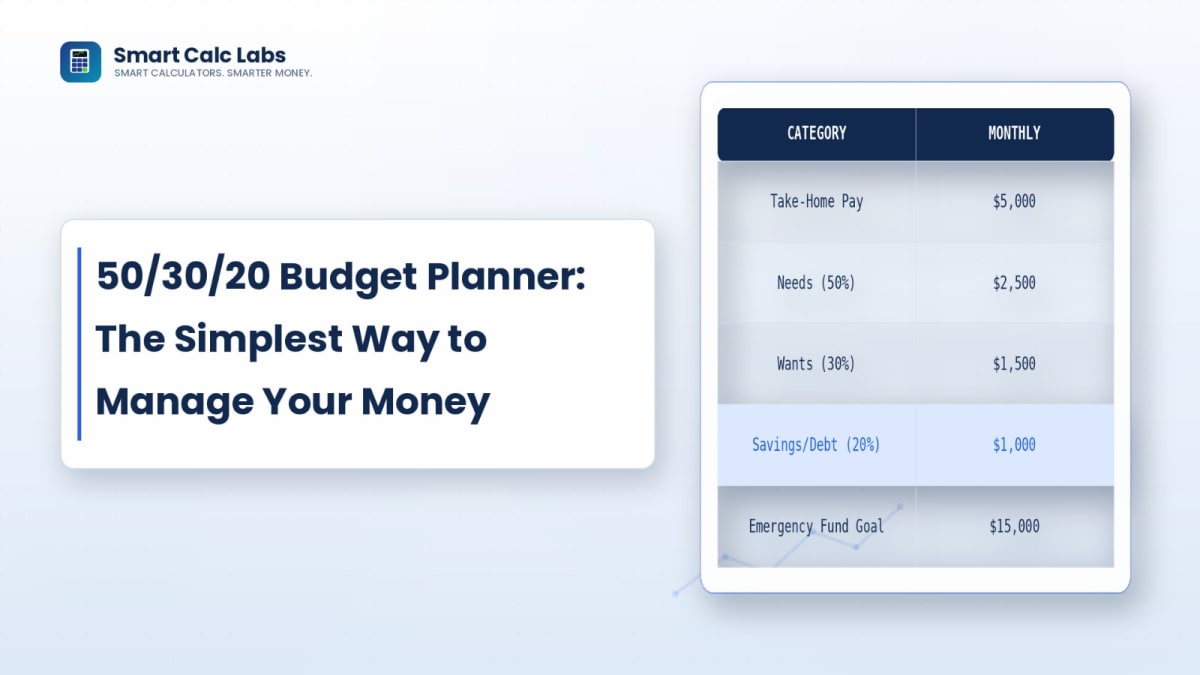
Most household budgets fail within the first 60 days. The reason isn't a lack of discipline or willpower—it is that traditional budgeting is designed like a crash diet. Tracking 45 micro-categories on a spreadsheet every time you buy a coffee creates cognitive fatigue, and the moment an unexpected car repair or dinner with friends disrupts the plan, the entire system is abandoned.
Sustainable personal finance is not about micro-managing every cent; it is about structural cash flow management. By establishing broad percentage boundaries for your take-home pay, you create a system where bills are paid on time, wealth builds automatically, and guilt-free spending is built directly into your routine.
Use our free 50/30/20 Budget Planner Calculator to calculate your exact monthly dollar targets, or read on to master the frameworks, adjustments, and automation steps below.
The 50/30/20 Budgeting Framework Explained
Popularized by Senator Elizabeth Warren and her daughter Amelia Warren Tyagi in All Your Worth: The Ultimate Lifetime Money Plan, the 50/30/20 framework simplifies your finances by dividing your net after-tax take-home pay into three core buckets:
| Bucket | Target % | What It Covers | The Acid Test |
|---|---|---|---|
| 1. Essential Needs | 50% | Rent/mortgage, groceries, utilities, health insurance, car payments, minimum debt payments. | Would you face severe legal, medical, or employment consequences if you stopped paying this? |
| 2. Discretionary Wants | 30% | Dining out, streaming subscriptions, weekend travel, gym memberships, clothing upgrades, hobbies. | Could you survive for 30 days without this expense without losing your home or health? |
| 3. Savings & Wealth | 20% | Emergency fund building, 401(k) / Roth IRA investing, and extra payments on high-interest debt. | Does this dollar increase your net worth or permanently eliminate future interest liability? |
Step 1: Always Calculate Off Net Take-Home Pay
A common error is budgeting against your gross base salary. If you earn an $80,000 annual salary, your gross monthly income is $6,667. However, after federal and state income taxes, FICA (Social Security & Medicare), and health insurance premiums, your actual take-home pay might be closer to $5,000.
If you budget 50% for needs using your gross salary ($3,333), you will be committing 67% of your real paycheck to fixed overhead, leaving zero room for savings. Use our Paycheck Calculator to identify your exact net deposit before setting your budget buckets.
Comparing the 4 Most Popular Budgeting Methods
While the 50/30/20 rule is the most balanced framework, different financial situations call for different budgeting philosophies:
| Method | Core Principle | Best Suited For | Maintenance Effort |
|---|---|---|---|
| 50/30/20 Rule | Proportional bucket allocation based on take-home pay. | General households, salaried professionals, couples. | Low (Review monthly) |
| Zero-Based Budgeting | Every single dollar is assigned a job (Income − Expenses = $0). | Aggressive debt payoff, tight cash flow, detailed planners. | High (Daily/weekly tracking) |
| Cash Envelope System | Physical cash envelopes for discretionary categories (dining, clothes). | Chronic impulse spenders, credit card overspenders. | Moderate (ATM cash handling) |
| Pay Yourself First (80/20) | Auto-save 20% on payday; spend the remaining 80% freely. | High earners, minimal debt, spreadsheet-haters. | Very Low (Fully automated) |
How to Adapt the 50/30/20 Rule for High-Cost Cities (HCOL)
If you live in New York, San Francisco, London, Toronto, or Sydney, spending only 50% of your income on necessities can feel mathematically impossible when housing costs alone consume 40% to 50% of your earnings.
Instead of abandoning budgeting altogether, adapt the formula using one of these realistic alternative ratios:
The HCOL Survival Split (70 / 15 / 15)
Allocates 70% to Needs (accommodating elevated rent and transit), while compressing Wants to 15% and preserving a vital 15% savings rate.
The Balanced Urban Split (60 / 20 / 20)
Allows 60% for Needs, trims Wants to 20%, and maintains the full 20% wealth-building commitment.
The 3-Account Automation Strategy: Put Your Budget on Autopilot
The most effective way to eliminate budgeting willpower is to separate your money physically into three distinct checking and savings accounts on payday:
-
Account #1: Bills & Fixed Overhead (50% Needs)
Deposit your paycheck here. Set all fixed recurring bills (rent/mortgage, utilities, car note, insurance, phone) on automated bill-pay. Never carry the debit card for this account in your wallet. -
Account #2: High-Yield Savings & Investment (20% Wealth)
Set up a recurring automatic transfer scheduled for the day after payday that moves 20% straight into your emergency fund, IRA, or brokerage. -
Account #3: Guilt-Free Spending (30% Wants)
Set an automated weekly transfer from Account #1 to this spending account. This is the only debit card you swipe for dining out, entertainment, and shopping. When the balance hits zero, discretionary spending stops until the next transfer.
5 Critical Budgeting Pitfalls to Avoid
- Classifying Minimum Debt Payments as Savings: Only extra payments above the minimum count as savings. The minimum payment is a mandatory legal obligation that belongs in Needs.
- Forgetting "Sinking Funds": Infrequent expenses (car registration, semi-annual insurance, holiday gifts) will blow up your budget if you don't set aside a small monthly amount in savings to cover them.
- Over-Restricting Discretionary Wants: Eliminating all fun spending creates budget burnout within 90 days. Budgeting 20–30% for guilt-free enjoyment ensures long-term adherence.
- Leaving Savings in Your Checking Account: Unallocated cash in your primary checking account will inevitably be spent. Transfer savings immediately on payday.
- Ignoring Your Safety Net First: Before investing aggressively, prioritize building a 3-to-6 month reserve with our Emergency Fund Calculator.
Frequently Asked Questions
Is the 50/30/20 rule calculated before or after tax?
The 50/30/20 rule is strictly calculated on your after-tax take-home pay. If you contribute to a pre-tax 401(k) through payroll, that contribution already counts toward your 20% savings goal.
What counts as a "Need" vs a "Want"?
A Need is an essential expense required for basic survival and employment (rent, basic groceries, electricity, commuter transit, minimum loan payments). A Want is anything discretionary that enhances comfort (restaurant dining, latte runs, streaming subscriptions, vacations).
How much of my income should go toward rent or housing?
Under standard financial guidelines, your housing cost (rent or mortgage principal, interest, taxes, and insurance) should not exceed 28% to 30% of your gross income (or roughly 35% of your net take-home pay).
How do I budget with irregular or freelance income?
Base your monthly baseline budget on your lowest-earning month of the previous 12 months. In high-earning months, route 100% of the surplus into an income-smoothing buffer account to cover leaner seasons.
Take Control of Your Cash Flow Today
Budgeting isn't about restriction—it is about giving every dollar a deliberate purpose. Use our interactive Budget Planner Calculator right now to map out your 50/30/20 targets and build financial security with confidence.