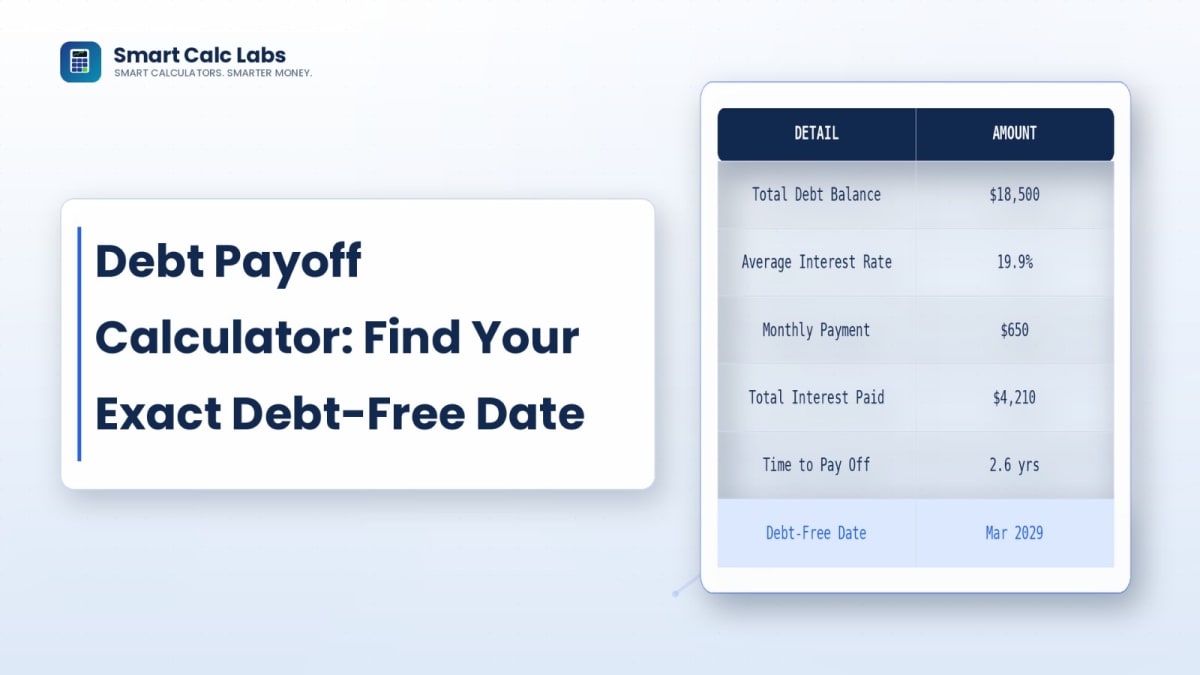
With average credit card interest rates (APRs) hovering between 20% and 25% in 2026, relying on minimum monthly payments is a guaranteed recipe for long-term financial entrapment. A $7,500 credit card balance paid strictly at the bank's minimum payment schedule can take over 17 years to clear and cost more than $9,800 in compound interest alone—more than doubling the cost of your original purchases.
Getting out of debt requires two things: a proven prioritization strategy and the deliberate acceleration of your cash flow. Whether you choose the psychological momentum of the Debt Snowball or the pure mathematical efficiency of the Debt Avalanche, having a clear debt-free milestone date changes everything.
Use our interactive Debt Payoff Calculator to model your exact timeline, or read on to master the strategies, comparison models, and acceleration frameworks below.
Debt Snowball vs. Debt Avalanche: Which Strategy Wins?
Both methods require making minimum payments on all outstanding accounts while channeling every extra dollar into a single target debt. The difference lies in how you order that target list:
| Strategy | Target Priority | Primary Advantage | Potential Drawback | Best Suited For |
|---|---|---|---|---|
| Debt Avalanche (Math-First) | Highest Interest Rate (APR) first, regardless of balance. | Minimizes total interest paid; mathematically fastest route. | If highest APR balance is large, first "win" may take months to achieve. | Analytical budgeters, high self-discipline, large APR spreads. |
| Debt Snowball (Behavior-First) | Smallest Balance first, regardless of interest rate. | Rapid psychological wins build unstoppable motivation. | May pay slightly more in total interest across the entire timeline. | Borrowers needing momentum, feeling overwhelmed by multiple accounts. |
| Minimum Payments Only | Equal distribution across bank minimums (1–3% of balance). | Lowest short-term monthly cash burden. | Maximizes interest paid to banks; extends payoff by 10–20 years. | Never recommended except during extreme emergencies. |
Worked Case Study: $18,000 Multi-Debt Portfolio Compared
To see how these strategies perform in the real world, consider Alex, who has 3 distinct consumer debts and commits a total budget of $650/month toward debt payoff:
- Credit Card A: $2,500 balance @ 24.99% APR (Min payment: $75/mo)
- Credit Card B: $6,500 balance @ 18.99% APR (Min payment: $150/mo)
- Auto Loan: $9,000 balance @ 6.50% APR (Min payment: $225/mo)
- Total Minimums Required: $450/month | Extra Acceleration Budget: $200/month
| Approach | Total Time to Debt Freedom | Total Interest Paid | Total Money Saved vs Minimums |
|---|---|---|---|
| Debt Avalanche | 32 Months (2.6 Years) | $2,410 | +$6,890 Saved |
| Debt Snowball | 33 Months (2.7 Years) | $2,580 | +$6,720 Saved |
| Minimum Payments Only | 148 Months (12.3 Years) | $9,300 | Baseline ($0 Saved) |
Key Takeaway: Adding $200/month in extra payments saves Alex almost 10 full years and nearly $7,000 in interest. Furthermore, the difference between Avalanche and Snowball is only $170 in total interest over nearly 3 years. This proves that the best strategy is simply the one you can sustain without quitting.
The Leverage of Daily Compounding: Why Extra Payments Cut Years
Unlike mortgages or installment loans that calculate interest monthly, credit card interest compounds daily. The credit card issuer divides your APR by 365 and multiplies that rate against your average daily balance every 24 hours.
Because of this daily compounding mechanic, every extra dollar paid directly reduces the principal balance subject to tomorrow's interest calculation. Making bi-weekly payments or adding an extra $100 on payday attacks the compounding engine at its source.
The 4-Tier Debt Priority Hierarchy
Before aggressively throwing every dollar at debt, ensure your financial foundation is protected by following this sequence:
-
Tier 1: Capture 100% of Employer 401(k) Match
An employer match (e.g., 50% or 100% on the first 4–6% contributed) is an instant guaranteed 50–100% return on your money. Never skip this. -
Tier 2: Build a Starter Emergency Fund ($1,000 to $2,500)
Without a cash buffer, any unexpected car repair or medical bill will immediately force you back onto credit cards. Use our Emergency Fund Calculator to establish this safety cushion. -
Tier 3: Attack Toxic High-Interest Debt (APR > 8%)
Credit cards, personal loans, high-interest auto loans, and private student loans belong here. Attack these aggressively using our Debt Payoff Calculator. -
Tier 4: Moderate-Interest Debt & Long-Term Investing (APR < 5–6%)
Low-interest federal student loans or fixed mortgages can be paid on standard amortization schedules while you invest surplus cash into index funds.
Debt Consolidation & 0% Balance Transfers: When Do They Work?
Consolidating multiple high-interest cards into a single personal loan or a 0% introductory APR balance transfer card can be a powerful accelerator under specific conditions:
✅ When Consolidation Works
- The new fixed APR is substantially lower (e.g., 10% loan vs. 24% cards).
- The 3–5% balance transfer fee is far smaller than the interest saved over the promotional window (typically 12–18 months).
- You have corrected the overspending habits that created the debt.
❌ When Consolidation Backfires
- You treat the zeroed-out credit cards as "available spending money" and run up new balances on top of the loan.
- You fail to clear the balance transfer card before the 0% promo expires and interest resets to standard rates.
5 Critical Mistakes That Keep You Trapped in Debt
- Paying Only the Minimum: Minimum payments are engineered by lenders to stretch out repayment over decades and maximize their interest earnings.
- Closing Paid-Off Accounts Prematurely: Canceling paid-off credit cards slashes your total available credit, which spikes your credit utilization ratio and can temporarily lower your credit score. Keep older accounts open with zero balance.
- Continuing to Use Cards While Paying Them Down: New purchases immediately begin accumulating interest with no grace period when carrying a revolving balance. Use cash or a debit card while in payoff mode.
- Ignoring Your Monthly Budget Allocation: Use our 50/30/20 Budget Planner to identify $150–$300 in non-essential wants that can be redirected toward debt acceleration.
- Relying on Mental Math Instead of Amortization: Daily compounding makes mental estimates dangerously optimistic. Always model exact figures using a validated payoff calculator.
Frequently Asked Questions
Which is better: Debt Snowball or Debt Avalanche?
Mathematically, the Debt Avalanche saves the most money by eliminating high-interest debt first. Psychologically, the Debt Snowball provides rapid initial wins by closing small accounts, which helps many people stick to their plan long enough to finish.
Does paying off debt hurt my credit score?
Paying off credit cards significantly improves your credit score by reducing your credit utilization ratio. Paying off an installment loan (such as an auto loan) may cause a minor, temporary 5–10 point dip due to reduced credit account mix, but the long-term financial benefit of eliminating debt far outweighs this.
How much interest do extra monthly payments actually save?
Because extra payments directly reduce principal, the interest savings are exponential. On a $10,000 credit card balance at 22% APR with $250 minimums, adding an extra $150/month cuts your payoff time from 68 months to 31 months and saves over $4,200 in total interest.
Should I pause 401(k) contributions to pay off debt?
Only contribute enough to capture your full employer match (free money). Beyond that match, pause additional retirement investing until toxic debt (APR > 8–10%) is completely eliminated.
Calculate Your Debt-Free Milestone Today
Every month you delay taking control of your debt is another month of interest paid to financial institutions. Enter your balances into our Debt Payoff Calculator now, choose your strategy, and set your exact debt-free date.