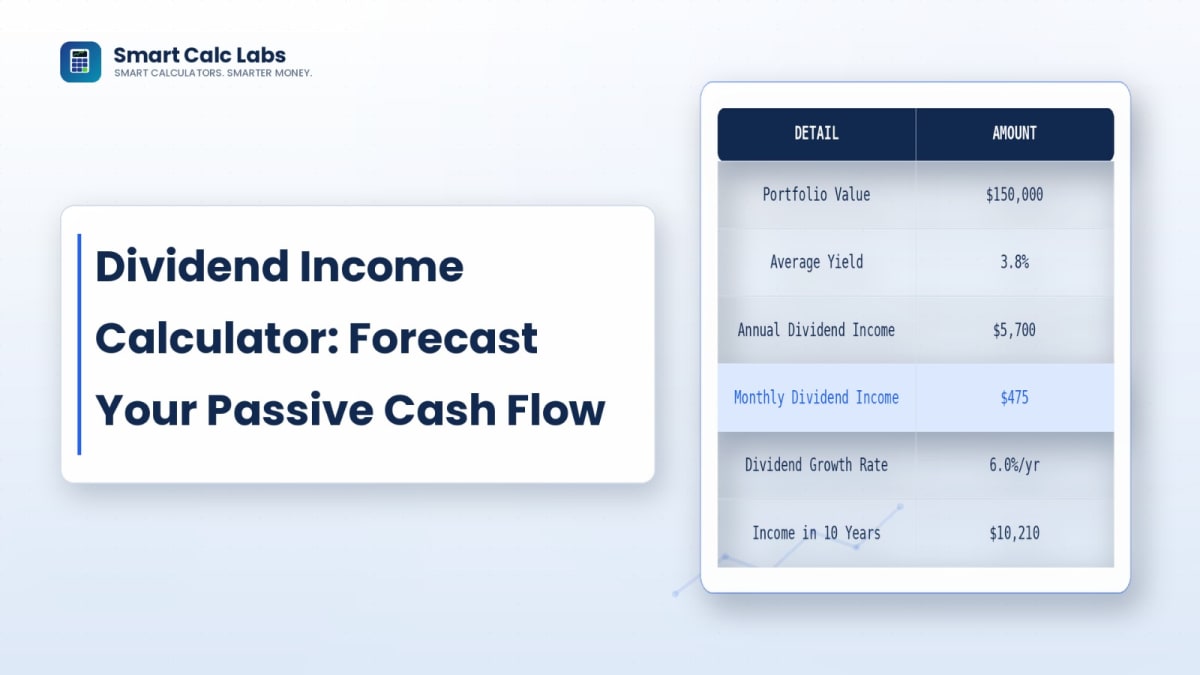
Two portfolios can hold the exact same dollar amount in dividend stocks and produce very different after-tax cash flow — the difference usually comes down to yield chasing and ignoring how dividends are actually taxed. Here's how to model this properly.
Plug your portfolio size and yield into the Dividend Income Calculator — the details below explain what the numbers really mean.
Yield Isn't Free Money — Watch for Yield Traps
A stock yielding 8-10% isn't automatically a better income source than one yielding 3%. Unusually high yields are frequently a warning sign: the stock price has dropped sharply (mathematically pushing yield up) because the market expects a dividend cut. A company paying out more in dividends than it earns in free cash flow cannot sustain that payout indefinitely. Before chasing yield, check the payout ratio — dividends paid as a percentage of earnings or free cash flow. A payout ratio consistently above 80-90% (outside REITs, which are structurally required to distribute most income) is a red flag.
How Dividend Taxes Actually Work in 2026
This is the part most dividend income projections skip entirely. Not all dividends are taxed the same way:
- Qualified dividends (from most U.S. stocks held more than 60 days around the ex-dividend date) get taxed at long-term capital gains rates: 0%, 15%, or 20%, depending on your taxable income. For 2026, single filers with taxable income under $49,450 (or $98,900 married filing jointly) pay 0% federal tax on qualified dividends.
- Ordinary (non-qualified) dividends — including most REIT dividends — are taxed at your regular income tax rate, which can run as high as 37%. A $10,000 qualified dividend taxed at 15% costs $1,500; the same $10,000 as an ordinary dividend at a 32% bracket costs $3,200 — more than double.
- High earners (MAGI over $200,000 single / $250,000 married) may owe an additional 3.8% Net Investment Income Tax on top of either rate.
This means a REIT yielding 6% and a dividend ETF yielding 4% can produce nearly identical after-tax income, depending on your bracket — the pre-tax yield alone doesn't tell the full story.
Where You Hold Dividend Stocks Matters
Dividends earned inside a Roth IRA grow and can be withdrawn completely tax-free in retirement. Inside a traditional IRA or 401(k), dividends grow tax-deferred, but withdrawals are taxed as ordinary income later regardless of whether the underlying dividends were "qualified." This makes tax-inefficient income — REITs, high-yield bond funds, actively managed funds with frequent turnover — a better fit for tax-advantaged accounts, while qualified-dividend stocks held long-term are relatively efficient even in a regular taxable brokerage account.
Common Mistakes
- Projecting income using pre-tax yield only. A 5% yield in a taxable account at a 24% marginal rate produces meaningfully less spendable income than the same yield inside a Roth IRA.
- Assuming dividend growth is guaranteed. Companies can and do cut dividends during downturns — projecting decades of steady 5-7% annual dividend growth without stress-testing a cut scenario overstates your reliability of income.
- Ignoring reinvestment vs. cash flow. If you're still years from needing the income, reinvesting dividends (DRIP) compounds your share count and future payout significantly faster than taking cash and spending it. Decide explicitly which phase you're in.
- Forgetting dividends are taxed the year they're paid, even if reinvested. A common surprise for new investors: reinvested dividends in a taxable account still generate a 1099-DIV and a tax bill, even though you never touched the cash.
Building Your Projection
- Enter your actual portfolio value and blended yield — not the yield of your single highest-paying holding, which overstates your real income.
- Choose a realistic dividend growth rate — historically, broad dividend-paying indexes have grown payouts in the low-to-mid single digits annually over long periods, though this varies significantly by holding.
- Run the calculator to see projected annual and monthly income at your current and future portfolio size.
- Apply your actual tax situation — qualified vs. ordinary, and your marginal bracket — to convert the projection into real, spendable after-tax cash flow.
Before You Rely on This
This projection assumes consistent yield and steady dividend growth — real dividend income fluctuates with company earnings, economic cycles, and individual business performance. It does not account for potential dividend cuts, stock price movement, or changes to tax law, all of which can meaningfully affect actual results.
Disclaimer: The content provided on SmartCalcLabs is for educational and informational purposes only. We are not certified financial planners or tax advisors. You should always consult with a licensed professional before making significant financial decisions.
Qualified vs. Ordinary Dividends: The 60-Day Holding Period Rule and Tax Drag
A primary error in dividend cash-flow forecasting is treating gross dividend yield as spendable income. Under the Internal Revenue Code, dividend distributions are categorized into two distinct tax classifications with radically different effective tax bites:
- Qualified Dividends: Subject to favorable long-term capital gains tax rates (0%, 15%, or 20% depending on your taxable income bracket, plus the 3.8% Net Investment Income Tax / NIIT if your Modified Adjusted Gross Income exceeds $200,000 single or $250,000 married filing jointly).
- Ordinary (Non-Qualified) Dividends: Taxed at your top marginal federal income tax bracket (ranging up to 37%), plus applicable state and municipal income taxes.
Internal Revenue Code Section 1(h)(11) Holding Period Mandate
To qualify for preferential 15% or 20% tax rates, an investor must satisfy IRC § 1(h)(11) holding period rules: you must hold the underlying stock unhedged for more than 60 days during the 121-day window that begins 60 days before the stock's ex-dividend date.
If an investor buys 500 shares of a blue-chip utility stock two days before the ex-dividend date to capture a $2,000 payout and sells the position 30 days later, the entire $2,000 distribution is disqualified from capital gains treatment and reclassified as ordinary income. In a 32% tax bracket, this oversight increases the federal tax bill from $300 to $640 on a single distribution.
REIT Distributions and the Section 199A QBI Deduction
Real Estate Investment Trusts (REITs) and Business Development Companies (BDCs) disburse substantial yields because they are legally obligated to distribute at least 90% of their taxable income to shareholders, thereby avoiding corporate-level taxation. Consequently, REIT dividends are classified as ordinary income rather than qualified dividends.
However, under Section 199A of the Tax Cuts and Jobs Act, individual investors receiving ordinary REIT distributions can claim a 20% Qualified Business Income (QBI) deduction on eligible Section 199A dividends. This deduction reduces the effective top federal tax rate on REIT distributions from 37.0% to 29.6%, providing meaningful tax relief when holding real estate assets inside taxable brokerage accounts.
Asset Location: Tax-Advantaged vs. Taxable Buckets
Maximizing long-term wealth requires rigorous asset location. High-yielding non-qualified dividend assets (REITs, BDCs, high-yield corporate bonds, and preferred stocks) are best sheltered inside tax-deferred accounts (Traditional IRA, 401(k)) or tax-free accounts (Roth IRA). Conversely, qualified dividend-growth equities and municipal bond funds should occupy taxable accounts, where foreign tax credits and capital gains brackets minimize tax drag.
Frequently Asked Questions
Why do REITs have such high yields compared to regular stocks?
REITs are legally required to distribute at least 90% of their taxable income to shareholders to maintain their tax status, which naturally pushes yields higher. The trade-off is that REIT dividends are typically taxed as ordinary income rather than at the lower qualified rate.
How long do I need to hold a stock for its dividend to be "qualified"?
Generally, you need to hold the stock for more than 60 days during the 121-day period that starts 60 days before the ex-dividend date. Frequent trading around dividend dates can accidentally disqualify dividends from the lower tax rate.
Can I actually live off dividend income alone?
It's mathematically possible with a large enough portfolio and a sustainable yield, but most financial planners caution against relying on a single high-yield strategy — diversifying across sectors and payout sources reduces the risk that one dividend cut derails your entire income plan.
Bottom Line
A dividend income projection is only useful if it reflects the yield you can sustainably rely on and the taxes you'll actually owe. Model realistic growth, check payout ratios before chasing high yields, and be deliberate about which accounts hold which type of dividend income.