Mastering the Canadian Registered Account Dilemma
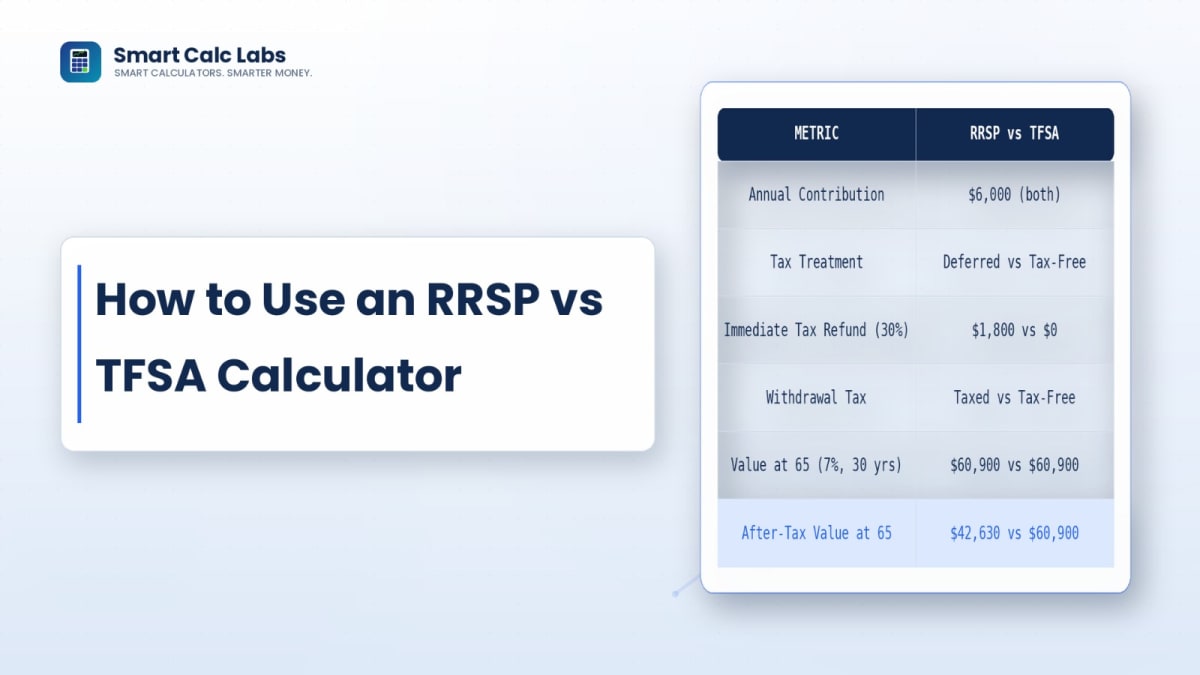
When it comes to building long-term wealth and funding retirement in Canada, few financial questions generate as much debate as RRSP vs. TFSA. The Registered Retirement Savings Plan (RRSP) and the Tax-Free Savings Account (TFSA) are the two flagship tax-sheltered accounts provided by the federal government through the Canada Revenue Agency (CRA). While both shield your investments from capital gains and dividend taxes while inside the account, their tax mechanics operate in completely opposite directions.
Because Canadian income tax brackets are steeply progressive—combining federal rates (15% to 33%) with provincial rates that push top marginal brackets beyond 53% in Ontario and Quebec—choosing the wrong account can cost an investor tens or even hundreds of thousands of dollars over a lifetime. Using a high-precision RRSP vs TFSA Calculator allows you to cut through generalized rules of thumb, model your personal tax scenario, and identify your exact mathematical tipping point.
This comprehensive guide walks you through the core mathematical formula, step-by-step input calibration, government benefit clawbacks, and advanced asset location strategies necessary to generate institutional-grade retirement projections.
The Core Mathematical Principle: Pre-Tax vs. After-Tax Parity
To use an RRSP vs. TFSA calculator effectively, you must understand the underlying mathematical formula that powers the calculation engine.
Consider an investor with an initial pre-tax dollar amount $C$, an investment compounding at annual rate $r$ over $n$ years, a marginal tax rate at contribution of $t_0$, and a marginal tax rate at withdrawal of $t_1$:
1. The Pure TFSA Formula
Because TFSA contributions are made with after-tax dollars, the initial deposit is reduced by the investor's current tax rate, but all future growth and withdrawals are completely tax-free:
2. The Pure RRSP Formula (With Reinvested Tax Refund)
An RRSP allows the investor to contribute the full pre-tax amount $C$ (or contribute the after-tax amount and immediately reinvest the tax refund). The entire balance compounds tax-deferred, but is fully taxed at rate $t_1$ upon withdrawal:
3. The Parity Proof & Tax Arbitrage
Notice that by the commutative property of multiplication, if your current tax rate equals your retirement tax rate ($t_0 = t_1$):
Under equal tax rates, the RRSP and TFSA produce the exact same net terminal wealth down to the penny. The true financial decision comes down to tax rate arbitrage:
- When $t_0 > t_1$ (Current tax rate is higher than retirement tax rate): The RRSP wins because you deduct at a high rate today and pay tax at a lower rate in retirement.
- When $t_0 < t_1$ (Current tax rate is lower than retirement tax rate): The TFSA wins because paying low tax upfront avoids paying higher tax later.
- When $t_0 = t_1$ (Tax rates are identical): The mathematical result is a tie, but the TFSA typically offers superior liquidity and zero clawback risk.
Step-by-Step Calculator Input Guide: Feeding Accurate Data
To obtain reliable projections from an RRSP vs. TFSA calculator, ensure your baseline data inputs match CRA realities:
Step 1: Input Gross Annual Taxable Income & Province
Do not enter your net take-home pay. Enter your total pre-tax earnings (T4 employment earnings, net self-employment income, or bonus structures). Selecting your exact province of residence is crucial because provincial tax brackets vary significantly:
- Ontario: Combines federal brackets with provincial tiers up to 13.16%, plus Ontario Health Premium and provincial surtaxes, creating a top marginal rate of 53.53%.
- Quebec: Incorporates the 16.5% federal tax abatement alongside provincial tax brackets reaching 25.75%, for a combined top bracket of 53.31%.
- British Columbia: Features graduated tiers topping out at 20.5% provincially (combined top rate of 53.50%).
- Alberta: Operates progressive rates from 10% to 15% (combined top rate of 48.00%).
Step 2: Enter Your Contribution Horizon and Annual Capital
Enter your current age, target retirement age, and the exact dollar amount you plan to save each year. Ensure you do not enter annual contributions exceeding the 2026 limits ($32,490 for RRSPs and $7,000 for TFSAs) unless modeling carried-forward room from prior years.
Step 3: Calibrate Expected Portfolio Returns
Avoid overly optimistic projections. Account for real-world market cycles by selecting return assumptions grounded in historical asset class performance:
- Conservative Fixed Income / GICs: 3.5% – 4.5% nominal return.
- Balanced Portfolio (60% Equities / 40% Bonds): 5.5% – 6.5% nominal return.
- All-Equity Global Index ETFs (e.g., VEQT, XEQT): 7.0% – 8.0% nominal return.
Step 4: Estimate Your Retirement Marginal Tax Bracket
This is where most users make fatal errors by assuming their retirement income will be zero. When estimating your retirement tax bracket, factor in all taxable cash flow streams:
- Canada Pension Plan (CPP): Up to ~$16,000+/year under enhanced CPP rules (fully taxable).
- Old Age Security (OAS): Basic pension payments (fully taxable).
- Employer Defined Benefit / Defined Contribution Pensions: 100% taxable as ordinary income.
- Mandatory RRIF Withdrawals: By age 71, RRSPs must be converted into a Registered Retirement Income Fund (RRIF). At age 72, you are legally required to withdraw a minimum percentage (starting at 5.28% and increasing each year), which is added to your taxable income.
Two Real-World Case Studies: How the Math Plays Out
Sarah, Senior Consultant (Ontario)
- Current Income: $130,000 / year
- Current Marginal Tax Rate: 43.41%
- Expected Retirement Income: $55,000 / year
- Projected Retirement Tax Rate: ~24.15%
- Annual Contribution: $10,000 over 25 years at 6.5% return
Liam, Graphic Designer (Alberta)
- Current Income: $48,000 / year
- Current Marginal Tax Rate: 25.00% (First bracket)
- Expected Retirement Income: $60,000 / year (pension + investments)
- Projected Retirement Tax Rate: 30.50%
- Annual Contribution: $5,000 over 30 years at 7.0% return
The Hidden Traps: Government Benefit Clawbacks
The most dangerous limitation of rudimentary online calculators is that they ignore the interaction between registered account withdrawals and income-tested Canadian government pensions:
1. The Old Age Security (OAS) Pension Recovery Tax
The federal government claws back Old Age Security pensions from higher-income seniors. For 2026, the OAS clawback threshold begins at approximately $90,997 of Net World Income. For every dollar of taxable income above this threshold, the CRA assesses a 15% recovery tax.
- RRSP/RRIF Withdrawals: Count as 100% taxable income, directly driving seniors into the OAS clawback zone and creating an effective marginal tax rate above 50% or 60%.
- TFSA Withdrawals: Do NOT count as income under the Income Tax Act. A retiree could withdraw $100,000 from a TFSA in a single year with zero impact on their OAS pension.
2. The Guaranteed Income Supplement (GIS) Disaster
For modest-income Canadian seniors relying on the Guaranteed Income Supplement, every dollar of non-OAS income reduces GIS benefits by 50 cents (a 50% clawback rate). A retiree who saved in an RRSP rather than a TFSA faces a devastating effective tax rate of 70% or more (income tax + GIS reduction) when drawing down their funds.
Advanced Strategy: Asset Location Optimization
Once you determine how much capital to allocate between accounts, optimize your investment returns by holding specific asset classes in the right account type:
| Asset Class | Optimal Account | Strategic Tax Reason |
|---|---|---|
| US-Listed Dividend Stocks & ETFs (e.g., VOO, SCHD) | RRSP | Under Article XXI of the US-Canada Tax Treaty, RRSPs are recognized as retirement accounts, exempting US dividends from the 15% US IRS Foreign Withholding Tax. TFSAs are not exempt. |
| High-Growth Equities / Crypto ETFs | TFSA | Assets with exponential capital gains potential belong in a TFSA, where 100% of the massive capital appreciation can be withdrawn tax-free without triggering tax brackets or clawbacks. |
| Bonds, Fixed Income & GICs | RRSP or TFSA | Interest income is taxed at 100% of marginal rates in taxable non-registered accounts, making sheltering inside either registered vehicle essential. |
Coordinating with the FHSA and Home Buyers' Plan (HBP)
If you are saving to purchase your first home, remember that the registered account hierarchy has evolved:
- First Home Savings Account (FHSA): Provides the tax deduction of an RRSP on the way in, and the 100% tax-free withdrawal of a TFSA on the way out ($8,000 annual limit, $40,000 lifetime limit). Eligible first-time buyers should max the FHSA before funding an RRSP or TFSA for a down payment.
- Home Buyers' Plan (HBP): The federal government expanded the RRSP Home Buyers' Plan withdrawal limit to $60,000 per individual ($120,000 for a couple), with a 15-year repayment schedule.
Run Your Personal RRSP vs. TFSA Comparison
Test your exact income and province. Model refund reinvestment versus spending, compare terminal wealth over 10 to 40 years, and visualize your optimal registered account breakdown.
Frequently Asked Questions (FAQs)
Can I claim an RRSP deduction in a future year instead of the year I contribute?
Yes. You can deposit money into your RRSP today to let it compound tax-sheltered immediately, and legally delay claiming the tax deduction on Schedule 7 of your tax return until a future year when your income is higher. However, financial planners caution against delaying deductions for more than 1–2 years, as the lost time value of the tax refund usually outweighs the marginal bracket difference.
Do TFSA contributions reduce my taxable income on my T1 return?
No. TFSA contributions provide zero upfront tax deductions and do not reduce your net taxable income or generate a tax refund. The financial advantage of a TFSA is entirely on the back end: zero tax on investment earnings and 100% tax-free withdrawals at any age.
Can I take money out of an RRSP and put it into a TFSA?
Yes, but withdrawing money from an RRSP is treated as taxable income subject to immediate withholding tax (10% to 30%), and the RRSP contribution room you used is permanently lost. This strategy only makes sense in rare low-income years where your marginal rate is near zero.
At what age must an RRSP be closed?
By December 31 of the calendar year you turn age 71, you must close your RRSP by either converting it to a Registered Retirement Income Fund (RRIF), purchasing an annuity, or withdrawing the entire balance in cash (which is disastrous for taxes). In contrast, a TFSA has no termination age and can remain open and compounding tax-free for your entire lifetime.
Can I hold foreign currencies like US Dollars inside an RRSP or TFSA?
Yes. Most Canadian discount brokerages (e.g., Questrade, Wealthsimple, TD Direct Investing, RBC Direct Investing) support dual-currency CAD/USD sub-accounts for both RRSPs and TFSAs, allowing you to hold US cash, stocks, and ETFs without forced currency conversion fees.