Inheriting an IRA sounds simple until you actually try to figure out what the IRS requires you to do with it. The rules changed sharply with the SECURE Act in 2019, then the IRS spent four more years issuing temporary penalty waivers while it figured out the fine print, before finally locking in the real rules in July 2024. If you inherited a traditional IRA from someone who died after 2019, one single fact now determines everything: had the original owner already started their own RMDs before they died?
Our Inherited IRA RMD Calculator applies the current rules to your specific situation. Here is exactly how they work.
Step One: Are You an "Eligible Designated Beneficiary"?
The 10-year rule does not apply to everyone. Five categories of beneficiary — called Eligible Designated Beneficiaries, or EDBs — get to skip it and instead stretch distributions over their own life expectancy, much like the old "stretch IRA" rules that applied before 2020:
- A surviving spouse
- A minor child of the account owner (only until they reach the age of majority, at which point the 10-year clock starts)
- A beneficiary who is disabled, as defined by IRS rules
- A beneficiary who is chronically ill
- A beneficiary who is not more than 10 years younger than the original owner (commonly a sibling close in age)
Everyone else — adult children, grandchildren, most other heirs — falls under the 10-year rule. That is the group this guide focuses on.
Step Two: Did the Owner Die Before or After Their RBD?
This is the question the IRS spent years clarifying, and it now has a definitive answer from the July 2024 final regulations (Treasury Decision 10001):
If the owner died before their Required Beginning Date (RBD)
You do not owe any annual RMDs during years 1 through 9. You can leave the account untouched and growing, take it out gradually, or withdraw it all in year 10 — the only hard requirement is that the account is fully empty by December 31 of the 10th year after death.
If the owner died on or after their RBD
You must take an annual RMD in each of years 1 through 9, calculated using your own single life expectancy, in addition to fully emptying the account by the end of year 10. The IRS reasoning is straightforward: distributions were already legally required and in progress at the time of death, so they cannot simply pause for nine years.
The RBD itself is April 1 of the year after the owner turned 73 (for owners who reached that age in 2023 or later, under SECURE 2.0). So if your parent died at 76, they had already passed their RBD, and you fall into the annual-RMD group.
A Worked Timeline
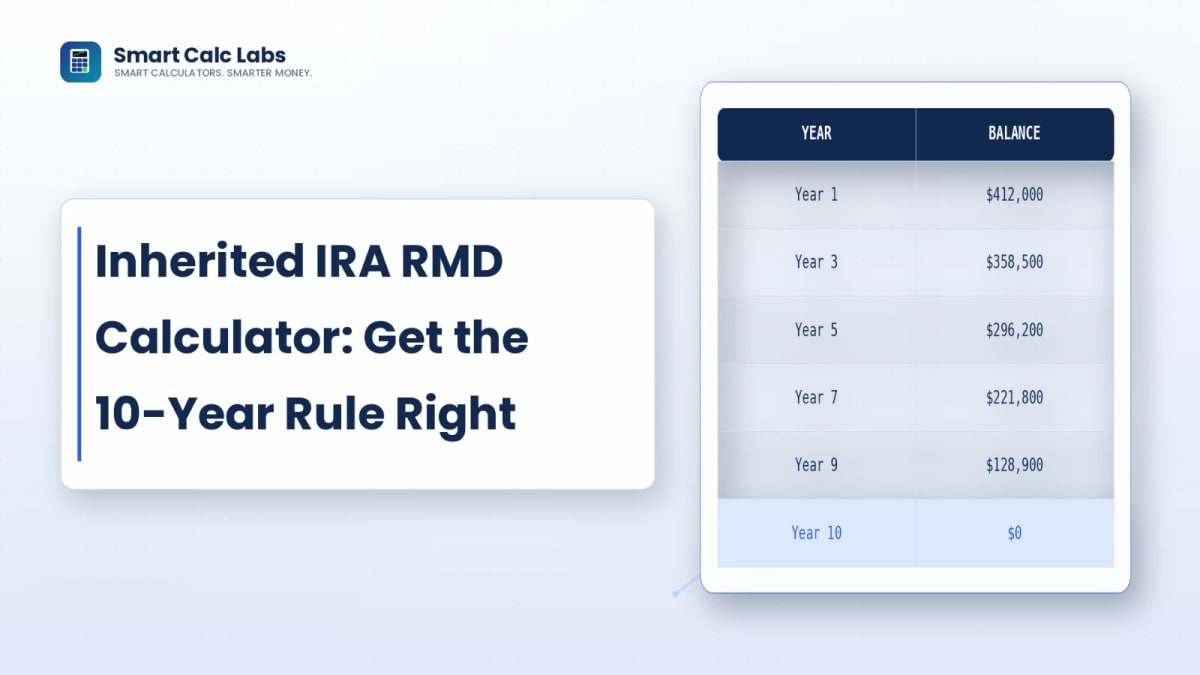
Say your father passed away in 2024 at age 78, meaning he had already started his own RMDs. You inherited his $400,000 traditional IRA as an adult child (not an EDB). Here is what that actually means:
- Years 1–9 (2025–2033): You owe an annual RMD each year, calculated using the IRS Single Life Expectancy Table based on your age in the year following his death, reduced by one each subsequent year.
- Year 10 (by December 31, 2034): The account must be fully emptied, regardless of how much you have withdrawn in the prior nine years.
If instead your father had died before his RBD — say at age 70, before ever taking an RMD himself — you would owe nothing in years 1 through 9, and could simply withdraw the full $400,000 (plus growth) any time before the end of year 10, including waiting until the very last month if you chose to.
The Penalty Waiver Is Over
Here is what makes 2026 a genuinely important year for this topic specifically. Because the rules were unsettled for so long, the IRS issued repeated relief through Notice 2024-35, waiving the 25% excise tax penalty for beneficiaries who skipped annual RMDs from 2021 through 2024, even when the final regulations later confirmed they technically owed one. That waiver period has ended. Starting with the 2025 distribution year and continuing into 2026, beneficiaries subject to the annual-RMD requirement who fail to take it face the standard penalty: 25% of the amount that should have been withdrawn, reduced to 10% if corrected within two years using Form 5329. If you inherited an IRA from someone who had started their RMDs and you have not taken a distribution since 2024, this is worth checking immediately, not at tax time.
Your Spousal Options Are Genuinely Different
A surviving spouse has choices non-spouse beneficiaries do not:
- Roll it into your own IRA. Usually the better move if you are older than 59½, since it lets you follow the standard RMD rules based on your own age rather than the decedent's.
- Keep it as an inherited IRA. This can be the smarter choice if you are under 59½, because distributions from an inherited IRA are always penalty-free regardless of your age — whereas withdrawing from your own IRA before 59½ normally triggers a 10% early withdrawal penalty. A common strategy: stay in inherited status until 59½, then roll it into your own IRA once early withdrawals are no longer an issue.
What About Inherited Roth IRAs?
Roth IRAs never require RMDs during the original owner's lifetime, but that protection does not carry over to beneficiaries. Inherited Roth IRAs are still subject to the 10-year rule for non-EDB beneficiaries. The genuine upside: because Roth accounts have no Required Beginning Date, there is never an annual-RMD requirement in years 1 through 9 for an inherited Roth — you can let it grow completely untouched and withdraw the entire balance tax-free at the end of year 10, no matter when the original owner died.
Common Mistakes and Pitfalls
- Assuming the 10-year rule means "no distributions required until year 10." This was a reasonable assumption before 2024, but it is only correct if the original owner died before their RBD.
- Missing the 2025/2026 annual RMD after resting on the expired waiver years. The Notice 2024-35 relief covered 2021–2024 specifically — it does not extend automatically to 2025 or 2026.
- A surviving spouse rolling into their own IRA too early when they are under 59½ and might need penalty-free access to the funds first.
- Treating an inherited Roth IRA like it has no rules at all. It still must be emptied by year 10 for non-EDB beneficiaries, even without annual RMDs along the way.
If you are managing this alongside your own retirement accounts, our RMD Calculator for your own IRA and Net Worth Calculator are useful companions to this one.
Disclaimer: The content on SmartCalcLabs is for educational and informational purposes only and does not constitute tax or legal advice. Inherited IRA rules referenced here reflect the SECURE Act, SECURE 2.0, and the July 2024 final IRS regulations (T.D. 10001) as applied to the 2026 distribution year. These rules are genuinely complex and fact-specific — always confirm your exact obligations with a licensed tax professional or estate attorney.
Frequently Asked Questions
How do I know if the original owner had reached their Required Beginning Date?
Compare their age at death to the RBD rules in effect for their birth year under SECURE 2.0 — generally April 1 of the year after they turned 73. If they were already taking RMDs (check their most recent tax return or ask the account custodian), they had reached their RBD.
Can I take more than the required annual RMD in years 1–9?
Yes, there is no upper limit — you can withdraw more than the minimum in any given year, which can be useful for spreading the tax impact more evenly rather than facing one enormous distribution in year 10.
What happens if I inherited the IRA from someone who was not my parent?
The same 10-year rule and EDB categories apply regardless of the relationship, with one exception: the "not more than 10 years younger" EDB category is based purely on age difference, not family relationship, so it can apply to a sibling or even an unrelated beneficiary close in age.
Does the 10-year clock reset if I inherit the account from someone who had also inherited it?
No. A "successor beneficiary" who inherits an already-inherited IRA generally must continue the original 10-year window rather than restarting a fresh one, with the deadline based on the first owner's date of death.
Conclusion
The single most important question for any inherited IRA right now is whether the original owner had reached their Required Beginning Date — it determines whether you owe annual distributions for nine years or can wait until the very end. Run your details through the calculator above, and if you have not taken a distribution since the penalty waiver years ended, check your specific situation now rather than at tax season.