Every dollar you put into a traditional IRA or 401(k) came with a deal: you skipped the tax on the way in, and the IRS collects on the way out. A Required Minimum Distribution (RMD) is how it collects. Once you hit the required age, you are legally forced to withdraw a minimum amount every year and pay ordinary income tax on it — whether you need the money that year or not. Miss the deadline, and the penalty is steep enough to notice: up to 25% of whatever you should have withdrawn.
Our RMD calculator works out your exact required withdrawal for the year in seconds, whether you are running the numbers for a traditional IRA, a SEP or SIMPLE IRA, or an old 401(k). This guide covers what feeds into that number and the deadlines that actually matter.
Who Has to Take an RMD, and From What Age
Thanks to the SECURE 2.0 Act, the starting age depends on when you were born, not a single fixed number anymore:
- Born 1951–1959: your RMDs begin at age 73.
- Born 1960 or later: your RMDs begin at age 75.
This applies to traditional IRAs, SEP and SIMPLE IRAs, and most employer plans like 401(k)s and 403(b)s. Roth IRAs have never required RMDs during the original owner's lifetime, and as of 2024, Roth 401(k) and Roth 403(b) accounts no longer require them either — a genuinely useful SECURE 2.0 change if you have been funneling money into a Roth workplace account.
How an IRA RMD Calculator Actually Works Behind the Scenes
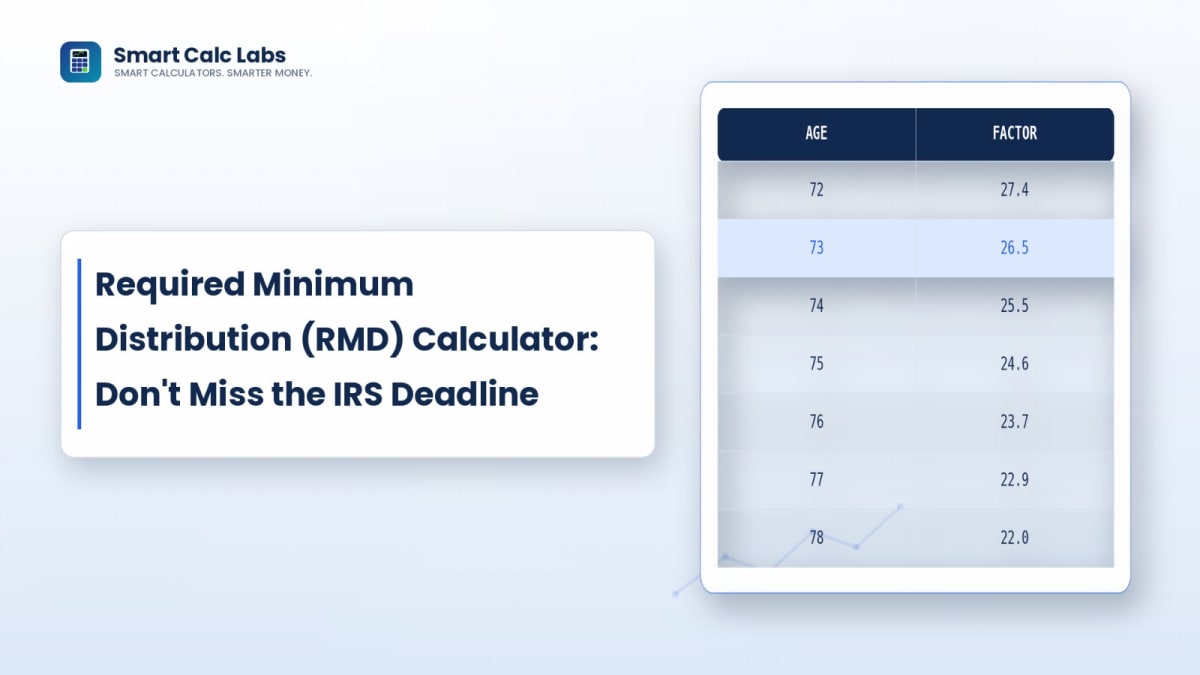
Whether you search for an RMD calculator, an IRA RMD calculator, or specifically a traditional IRA RMD calculator, they are all solving the exact same equation. Your RMD is not a guess or a flat percentage you pick. The formula is: your account balance as of December 31 of the previous year, divided by an IRS life expectancy factor from the Uniform Lifetime Table in IRS Publication 590-B. For your 2026 RMD, that means your December 31, 2025 balance is what matters, not today's balance.
The life expectancy factor shrinks as you age, which means the percentage of your balance you are required to withdraw climbs every year — roughly 3.8% at age 73, rising into the double digits by your mid-90s. A quick worked example: if your traditional IRA held $500,000 on December 31, 2025, and your life expectancy factor at age 73 is 26.5, your 2026 RMD is $500,000 ÷ 26.5 ≡ $18,868.
One detail that trips people up: if you hold multiple traditional IRAs, you calculate an RMD for each one but can aggregate the total and withdraw it from a single IRA. 401(k)s do not work the same way — you must calculate and withdraw the RMD from each 401(k) separately, you cannot combine them.
The Deadline Trap: Your First RMD Year
Every RMD after your first is due by December 31 of that year, full stop. Your very first RMD, however, comes with a special rule: you can delay it until April 1 of the year after you reach your starting age. That sounds like a benefit, and it can be — but it comes with a catch that surprises a lot of people. If you delay your first RMD to April 1, you still owe your second RMD by December 31 of that same year, meaning you take two taxable distributions in a single tax year.
Say you turn 73 in 2026. You can delay your 2026 RMD until April 1, 2027 — but you would still need to take your 2027 RMD by December 31, 2027. That stacks two years of taxable income into 2027 at once, which can push you into a higher tax bracket, increase how much of your Social Security is taxed, and even raise your Medicare Part B and D premiums the following year through IRMAA surcharges. For most people, taking the first RMD in the actual year you turn 73 (rather than delaying) avoids this stacking problem entirely.
The Penalty for Getting It Wrong
If you miss the deadline or withdraw less than required, the IRS charges an excise tax of 25% of the shortfall. If you catch and correct the mistake within two years — by withdrawing the missed amount and filing Form 5329 — that penalty drops to 10%. Either way, this is not a fee worth risking: on a missed $20,000 RMD, the standard penalty alone is $5,000.
Common Mistakes That Cost Real Money
- Using today's balance instead of last year-end's. Your RMD is always based on the December 31 balance of the previous year, not the current market value.
- Combining 401(k) RMDs across different plans. Unlike traditional IRAs, each 401(k) requires its own separate withdrawal — you cannot take the combined total from just one of them.
- Delaying the first RMD without checking the tax impact. Pushing your first distribution to the following April often means two taxable withdrawals landing in the same tax year.
- Assuming your custodian will always catch it. Most brokerages calculate the figure for you, but you remain personally, legally responsible for taking the correct amount on time — not the custodian.
Reducing the Tax Bite Before RMDs Start
If you are still in your early 60s and not yet subject to RMDs, the years between retirement and your RMD start age are often your lowest-income years — and a good window for Roth conversions. Converting traditional IRA funds to a Roth means paying tax now at your current rate, but it shrinks the balance that will generate RMDs later and eliminates RMDs on that money entirely going forward. This tends to make the most sense for people who expect RMDs, Social Security, and any pension income to push them into a higher bracket later in retirement.
If you are weighing this kind of pre-retirement tax planning more broadly, our Inflation Impact Calculator and Net Worth Calculator are useful to run alongside your RMD projections.
401(k) RMDs and Inherited Accounts Follow Different Rules
This RMD calculator and the walkthrough above cover your own traditional IRA and workplace plan withdrawals. Two related situations follow meaningfully different rules and deserve their own dedicated tools: if you are drawing from an old employer 401(k) specifically, aggregation and the still-working exception work differently than they do for an IRA — see our 401(k) RMD Calculator for that breakdown. If you inherited an IRA rather than saved into your own, a stricter 10-year rule applies, with annual RMDs sometimes required depending on whether the original owner had already started theirs — covered in full in our Inherited IRA RMD Calculator.
Disclaimer: The content on SmartCalcLabs is for educational and informational purposes only and does not constitute tax or financial advice. RMD rules referenced here reflect 2026 IRS guidance under the SECURE 2.0 Act and are subject to change. Always confirm your specific RMD amount and deadline with a licensed tax professional or your account custodian.
Frequently Asked Questions
Do I still owe an RMD if I don't need the money?
Yes. RMDs are mandatory regardless of your financial need. You can always withdraw more than the minimum, but you cannot withdraw less, and the IRS does not accept "I didn't need it" as a reason to skip one.
Are Roth IRAs ever subject to RMDs?
Not during the original owner's lifetime. However, beneficiaries who inherit a Roth IRA are subject to RMD rules, even though the original account never required them.
What if I am still working past my RMD age?
If you are still employed and participate in your current employer's workplace plan, you may be able to delay RMDs from that specific plan until the year you retire — unless you own 5% or more of the business. This exception does not apply to IRAs or to plans from previous employers.
Can the IRS waive the penalty?
Yes, in cases of reasonable error, the IRS can waive the excise tax if you correct the shortfall and file Form 5329 with a letter explaining the reasonable cause. It is not automatic, but it is worth pursuing if the miss was a genuine mistake rather than neglect.
Conclusion
RMDs are one of the few parts of retirement that are not optional or flexible — the age, the calculation, and the deadline are all set by the IRS, and the penalty for missing one is real money. Run your numbers through the RMD calculator above using your prior year-end balance, understand whether delaying your first RMD actually helps or hurts your tax situation, and if you are years away from RMD age, use the time to think about whether Roth conversions make sense for you.