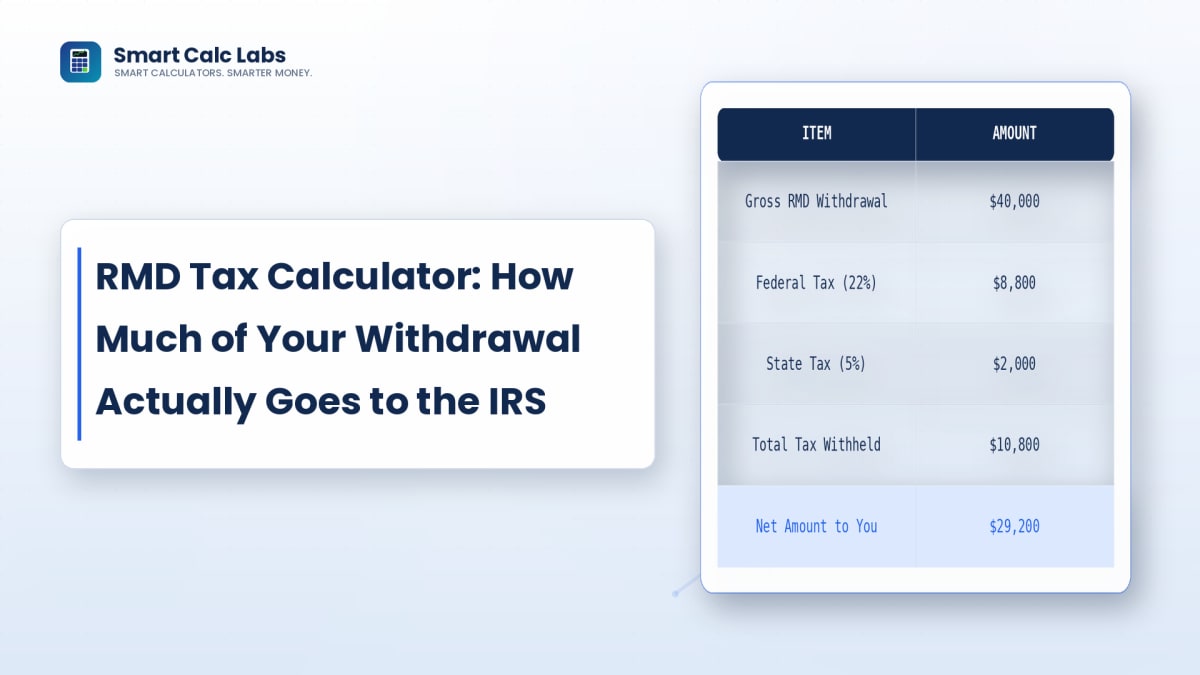
Knowing your RMD amount is only half the equation. The other half is what actually lands in your bank account after tax — and unlike a paycheck, nobody automatically withholds the right amount for you. Get the withholding wrong, and you either hand the IRS an interest-free loan all year or get hit with an underpayment penalty the following April.
Our RMD Tax Calculator estimates the real tax owed on your distribution and how much to withhold. Here is the mechanics behind that number.
The Default Is 10%, and It Is Rarely the Right Number
Under IRS rules, a traditional IRA distribution that is not an eligible rollover — which includes your RMD — defaults to 10% federal withholding unless you elect otherwise on Form W-4R. That 10% is not calculated based on your actual tax bracket; it is simply the government's flat default. Depending on your total income, that can be far too little (leaving you owing a large balance in April) or more than enough (giving the IRS an interest-free loan of your money for months). You can adjust this anywhere from 0% to 100% by filing Form W-4R with your custodian.
One important distinction: a 401(k) RMD taken as part of an eligible rollover distribution defaults to a mandatory 20% withholding if paid directly to you rather than transferred custodian-to-custodian — a meaningfully higher default than the 10% IRA rate.
Your RMD Is Taxed as Ordinary Income, Stacked on Top of Everything Else
An RMD from a traditional account is not taxed at a special "retirement" rate — it is added to your other income (Social Security, pension, part-time work, investment income) and taxed at your ordinary marginal rate for that bracket. This is exactly why a large RMD can push you into a higher bracket for the year, or increase how much of your Social Security benefit becomes taxable, even if your day-to-day spending needs did not change at all.
A Worked Example
Say you are a single filer with $30,000 in Social Security and a $40,000 traditional IRA RMD, no other significant income. Roughly 85% of your Social Security may become taxable once combined with the RMD, pushing your total taxable income into the 22% marginal bracket for part of the RMD. If you rely on the flat 10% default withholding ($4,000) rather than actually estimating your marginal tax impact, you could easily under-withhold by several thousand dollars — a gap that shows up as a balance due (and potentially an underpayment penalty) the following April, not as a surprise you can plan around after the fact.
The "December Withholding Strategy"
This is one of the more useful, underused tricks in retirement tax planning. The IRS generally treats federal tax withheld from any source as if it were paid evenly across all four quarters of the year, regardless of when it was actually withheld — unlike estimated tax payments, which are only credited on the date you actually send them. That means you can wait until December, take your full RMD, elect a high withholding percentage (even 100% if needed), and it retroactively counts as if you had paid your estimated taxes evenly all year. This lets your money stay invested for the rest of the year instead of being sent to the IRS in quarterly estimated payments, while still satisfying the underpayment safe harbor.
Withholding vs. Quarterly Estimated Payments
You generally have two ways to cover the tax on an RMD: elect withholding directly from the distribution, or send quarterly estimated payments using Form 1040-ES. Withholding is simpler — the custodian handles it, and (per the timing rule above) it counts as paid evenly across the year no matter when in the year it happens. Estimated payments require more active tracking of due dates (mid-April, mid-June, mid-September, and mid-January) but can be useful if you prefer to keep more control over cash flow throughout the year rather than having a lump sum withheld at once.
Don't Forget State Withholding
Several states require mandatory withholding on retirement distributions unless you specifically opt out, and the rates vary meaningfully — some flat, some tied to the federal withholding amount. If you live in a state with income tax, checking your state's specific default withholding requirement on retirement distributions is worth doing separately from the federal calculation, since assuming "no federal withholding needed" also means "no state withholding needed" is not always accurate.
A QCD Reduces the Tax Bill Before Withholding Even Matters
If part of your RMD is being satisfied through a Qualified Charitable Distribution, that portion is excluded from taxable income entirely — it never generates a tax bill to withhold against in the first place. A $80,000 RMD with $20,000 routed as a QCD only produces $60,000 of taxable income, which changes your entire withholding calculation before you even get to the withholding percentage question.
Common Mistakes and Pitfalls
- Assuming the 10% default is calibrated to your actual bracket. It is a flat rate, not personalized — it can leave you significantly under-withheld if your combined income pushes you into a higher bracket.
- Forgetting that a rollover-eligible 401(k) distribution defaults to 20%, not 10%, if paid directly to you rather than transferred between custodians.
- Not accounting for how the RMD affects Social Security taxation. The RMD itself may be taxed at a moderate rate, but it can also push a larger share of your Social Security benefit into taxable territory, compounding the total tax impact.
- Ignoring state withholding requirements because the federal side feels handled.
Before you finalize your withholding election, our RMD Calculator and QCD Calculator help you confirm the exact amount you are working with first.
Disclaimer: The content on SmartCalcLabs is for educational and informational purposes only and does not constitute tax advice. Withholding rules referenced here reflect 2026 IRS guidance under Form W-4R and IRC §3405. Always confirm your specific withholding election and estimated tax obligations with a licensed tax professional, particularly around state-specific requirements.
Frequently Asked Questions
Can I elect 0% withholding on my RMD?
Yes, for IRA distributions you can elect not to have any federal tax withheld at all, as long as you cover the liability another way, such as quarterly estimated payments, to stay within the underpayment safe harbor.
Does withholding change how much RMD I have to take?
No. Withholding only affects how the tax on your RMD gets paid — it does not change the required distribution amount itself, which is based purely on your account balance and the applicable life expectancy divisor.
Is a QCD affected by withholding rules at all?
No, because a QCD transfers directly from the IRA to the charity, it is never treated as a distribution to you, so there is nothing to withhold tax from on that portion.
What happens if I under-withhold significantly?
You may owe an underpayment penalty in addition to the tax itself, unless you meet one of the IRS safe harbor thresholds (generally paying at least 90% of the current year's tax or 100-110% of the prior year's tax, depending on income level) through some combination of withholding and estimated payments.
Conclusion
The 10% default withholding on an RMD is a starting point, not a personalized estimate — running your real numbers through the calculator above, especially if you are combining Social Security, a pension, or other income with your RMD, is the only way to know if you are actually covering your tax bill. Consider the December withholding strategy if you want to keep funds invested longer while still meeting the safe harbor, and don't forget to check your state's specific withholding rules separately from the federal calculation.