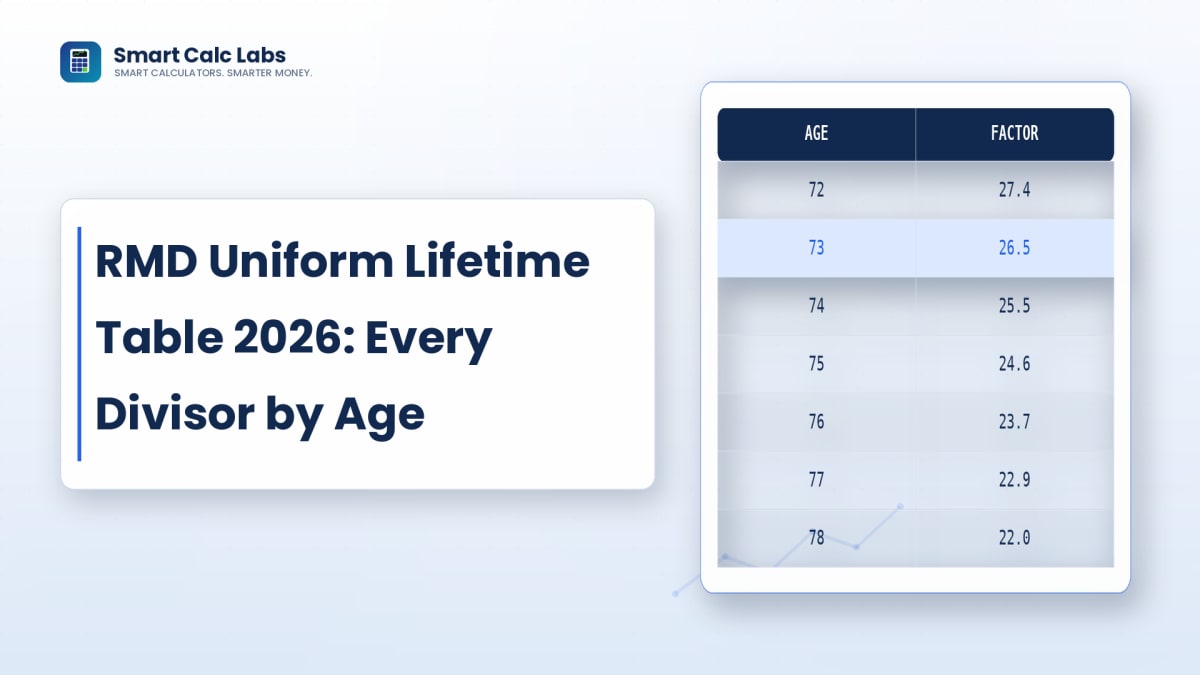
Every RMD calculation comes down to one division problem: your account balance divided by a number the IRS assigns to your age. That number is called the distribution period, or divisor, and it comes from the Uniform Lifetime Table — the table nearly every retirement account owner uses. Look up the wrong table, or the wrong year's balance, and your RMD is wrong.
Our RMD Calculator applies this table automatically. Below is the full table itself, in case you want to see exactly where your number comes from.
The Full 2026 Uniform Lifetime Table
This table has been unchanged since 2022 — the same divisors apply for 2024, 2025, and 2026 distributions, sourced from IRS Publication 590-B, Appendix B, Table III.
| Age | Divisor | Age | Divisor |
|---|---|---|---|
| 72 | 27.4 | 89 | 12.9 |
| 73 | 26.5 | 90 | 12.2 |
| 74 | 25.5 | 91 | 11.5 |
| 75 | 24.6 | 92 | 10.8 |
| 76 | 23.7 | 93 | 10.1 |
| 77 | 22.9 | 94 | 9.5 |
| 78 | 22.0 | 95 | 8.9 |
| 79 | 21.1 | 96 | 8.4 |
| 80 | 20.2 | 97 | 7.8 |
| 81 | 19.4 | 98 | 7.3 |
| 82 | 18.5 | 99 | 6.8 |
| 83 | 17.7 | 100 | 6.4 |
| 84 | 16.8 | 101 | 6.0 |
| 85 | 16.0 | 102 | 5.6 |
| 86 | 15.2 | 103 | 5.2 |
| 87 | 14.4 | 104 | 4.9 |
| 88 | 13.7 | 105+ | 4.6 and declining |
How to Actually Use It
The formula is: account balance on December 31 of the previous year ÷ the divisor for your age this year. Two details trip people up constantly:
- The balance is last year-end's, not today's. For your 2026 RMD, use your December 31, 2025 balance — not what the account is worth right now.
- The age is the age you turn in the distribution year, not your age at the start of the year or your age when you actually withdraw the money.
Worked example: You turn 75 in 2026, and your traditional IRA held $500,000 on December 31, 2025. The divisor for age 75 is 24.6. $500,000 ÷ 24.6 = $20,325, or about 4.07% of the balance. Compare that to age 73, where the divisor of 26.5 on the same balance produces $18,868 (3.77%) — the required percentage climbs every year as the divisor shrinks.
Not Everyone Uses This Table
The Uniform Lifetime Table (officially Table III) is the default for the overwhelming majority of retirement account owners, but two other IRS tables exist for specific situations:
- Joint Life and Last Survivor Table (Table II): Used only when your spouse is your sole beneficiary for the entire year and is more than 10 years younger than you. Because it factors in both spouses' life expectancies, it produces a larger divisor — and therefore a smaller required RMD — than the Uniform Lifetime Table would for the same owner age.
- Single Life Expectancy Table (Table I): Used by beneficiaries of inherited retirement accounts, not by original account owners. If you inherited an IRA, this is the table that applies to you, not the one on this page.
Aggregating Across Multiple Accounts
If you hold more than one IRA, you calculate a separate RMD for each account using its own December 31 balance and the same age-based divisor, but the IRS allows you to total those individual RMDs and withdraw the combined amount from just one of your IRAs, in any proportion you choose. This does not work the same way for 401(k)s: each employer plan requires its RMD to be calculated and withdrawn from that specific plan, and you cannot aggregate 401(k) RMDs across different accounts the way you can with IRAs.
The Divisor Only Moves in One Direction
Because the divisor shrinks every year you age, your required withdrawal represents a growing percentage of your balance over time — roughly 3.7% at 73, climbing past 6% by your late 80s, and well over 15% by your late 90s. This is worth planning around: a portfolio invested entirely in growth assets can be forced to sell into unfavorable market conditions in a bad year, purely because the RMD percentage keeps rising regardless of what the market is doing.
If you want to see how this compounds across your full retirement timeline, our RMD Calculator and Inherited IRA RMD Calculator (for accounts you inherited rather than saved into yourself) both build on the tables covered here.
Disclaimer: The content on SmartCalcLabs is for educational and informational purposes only and does not constitute tax advice. Table figures are sourced from IRS Publication 590-B, Appendix B, Table III, in effect since 2022 and unchanged through the 2026 distribution year. Always confirm your exact divisor and RMD with a licensed tax professional or your account custodian.
Frequently Asked Questions
Does this table change every year?
Not automatically. The current Uniform Lifetime Table has been in effect since 2022 and has not changed for 2024, 2025, or 2026. The IRS can update it, but it does not happen on a predictable annual schedule the way tax brackets do.
What if I don't know my December 31 balance exactly?
Your account custodian is required to report this figure to you and to the IRS on Form 5498, typically issued by late May of the following year, but most custodians also show the prior year-end balance directly in your online account statements well before that.
Do Roth IRAs use this table?
No. Roth IRAs never require RMDs during the original owner's lifetime, so the Uniform Lifetime Table does not apply to them at all while the original owner is alive.
My spouse is 12 years younger than me and is my sole beneficiary — which table do I use?
The Joint Life and Last Survivor Table (Table II), not the Uniform Lifetime Table on this page. Because the age gap exceeds 10 years, Table II applies and will generally produce a smaller required RMD than Table III would for the same balance and age.
Conclusion
The Uniform Lifetime Table divisor is the single number your entire RMD calculation depends on, and it is easy to look up incorrectly if you use the wrong year's balance or the wrong table entirely. Find your age in the table above, divide your prior year-end balance by that number, and double-check whether the Joint Life table applies to you instead before you finalize your withdrawal for the year.