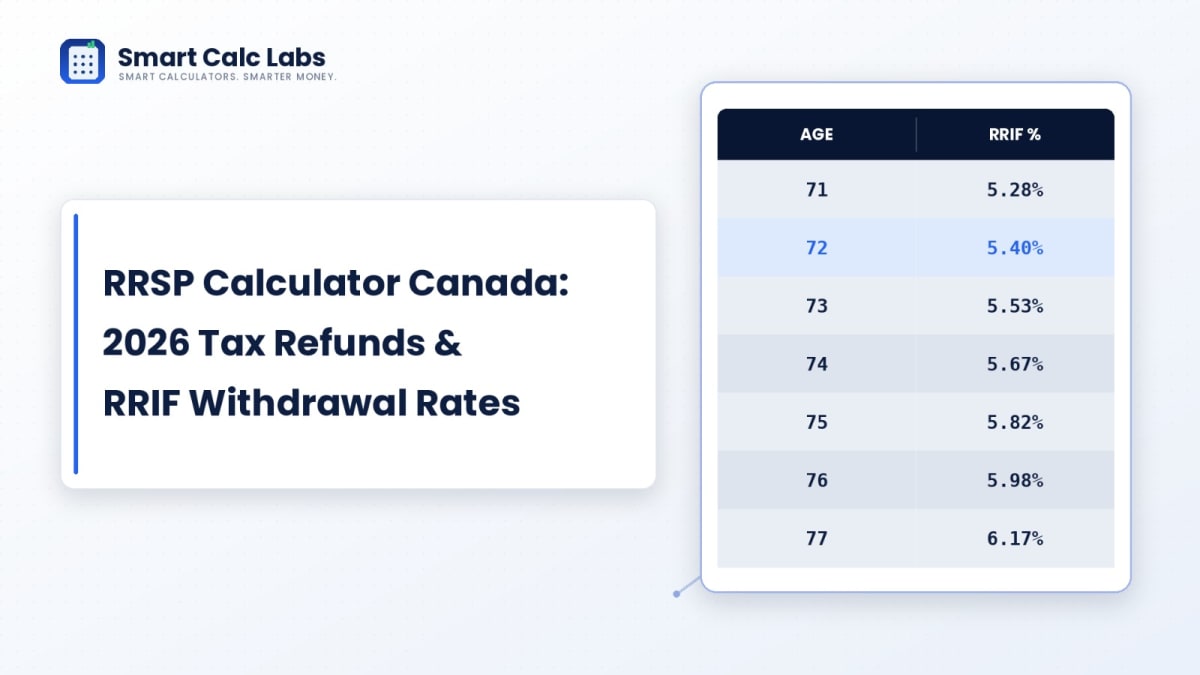
Introduction: Maximizing Canada's Core Retirement Engine
The Registered Retirement Savings Plan (RRSP) remains one of the most potent wealth-building vehicles for Canadian taxpayers. Designed by the federal government to encourage private retirement savings, the RRSP offers an immediate, high-impact tax deduction today while allowing your portfolio to compound completely tax-sheltered until retirement.
However, extracting maximum value from your RRSP requires understanding exact Canada Revenue Agency (CRA) calculation mechanics, provincial tax bracket thresholds, and future conversion obligations.
How RRSP Contribution Room is Calculated
Your allowable RRSP deduction limit for any tax year is determined by three specific factors:
- 18% of Prior Year Earned Income: Calculated from your previous calendar year's T4 employment income, self-employment net earnings, and rental income (subject to the annual CRA ceiling).
- Unused Contribution Room: Any unused room accumulated since you began filing Canadian tax returns carries forward indefinitely with no expiration.
- Pension Adjustments (PA): If you participate in an employer-sponsored Defined Benefit (DB) or Defined Contribution (DC) pension plan, your available annual RRSP room is reduced by a Pension Adjustment reported on Box 52 of your T4 slip.
| Tax Year | CRA Annual Dollar Cap | Income Required to Maximize |
|---|---|---|
| 2024 | $31,560 | $175,333 |
| 2025 | $32,490 | $180,500 |
| 2026 | $33,810 | $187,833 |
How the Instant RRSP Tax Refund Works (Provincial Examples)
When you contribute to an RRSP, you receive a dollar-for-dollar deduction against your top marginal income tax bracket. The higher your income, the larger your percentage tax savings:
Example Scenario: An Ontario resident earning $110,000 has a combined federal/provincial marginal tax rate of ~43.41%. If they contribute $10,000 to their RRSP:
- Gross RRSP Contribution: $10,000
- CRA Tax Refund Generated: $10,000 × 43.41% = $4,341
- True Out-of-Pocket Cost: $10,000 - $4,341 = $5,659
Calculate Your Exact Provincial RRSP Refund
Estimate your instant CRA cash refund and retirement nest egg with our dedicated tool:
Strategic RRSP Programs: Home Buyers' Plan & Lifelong Learning
While RRSP withdrawals are generally taxed as regular income, the CRA allows two special tax-free loan provisions:
- Home Buyers' Plan (HBP): First-time Canadian homebuyers can withdraw up to $60,000 tax-free from their RRSP to purchase or build a qualifying principal residence. The amount must be repaid back into an RRSP in equal installments over a 15-year period.
- Lifelong Learning Plan (LLP): You can withdraw up to $10,000 per calendar year (up to a $20,000 lifetime total) tax-free to finance full-time training or post-secondary education for yourself or your spouse.
The Spousal RRSP: Legal Income Splitting
If one spouse earns significantly more than the other, contributing to a Spousal RRSP is one of Canada's most effective legal tax reduction strategies:
- The contributing spouse uses their own RRSP contribution room and claims the tax deduction at their higher marginal tax bracket today.
- The account is registered in the lower-earning spouse's name. In retirement, withdrawals are taxed in the lower-earning spouse's hands at lower marginal rates.
- The 3-Year Attribution Rule: To prevent abuse, contributions must remain in the spousal RRSP for at least three calendar years before withdrawal; otherwise, the withdrawal income is attributed back to the contributing spouse.
Mandatory Conversion at Age 71: RRIF & Annuity Rules
You cannot hold an RRSP indefinitely. By December 31 of the calendar year in which you turn 71, you must choose one of three options:
- Convert to a Registered Retirement Income Fund (RRIF): The most common choice. Assets transfer tax-free, and you must withdraw a minimum statutory percentage each year (e.g. 5.28% at age 71).
- Purchase a Registered Annuity: Exchange your balance with an insurer for guaranteed lifetime monthly income.
- Lump-Sum Cash Withdrawal: The entire balance is deregistered and taxed in a single year (rarely advisable due to massive tax bracket acceleration).
Pros and Cons of Contributing to an RRSP
Advantages (Pros)
- Immediate upfront CRA tax refund.
- 100% tax-sheltered compound growth.
- Exempt from US 15% dividend withholding tax on US stocks (e.g. VOO).
- Tax-free HBP ($60k) and LLP withdrawals.
Disadvantages (Cons)
- All withdrawals are 100% taxable income.
- Withdrawn contribution room is lost forever.
- Large withdrawals can trigger OAS recovery clawbacks.
- Mandatory RRIF conversion by age 71.
Common RRSP Mistakes to Avoid
- Over-contributing Beyond the $2,000 Lifetime Buffer: The CRA allows a cumulative lifetime over-contribution buffer of $2,000. Any excess beyond this amount is penalized at 1% per month.
- Treating Your Tax Refund as Disposable Windfall: If you spend the refund rather than reinvesting it, your total after-tax wealth will lag behind a TFSA.
- Withdrawing Early for Non-Emergency Consumption: Financial institutions are required to withhold CRA tax at source (10% on up to $5k, 20% on $5k–$15k, 30% over $15k outside Quebec), and the room cannot be restored.
CRA Notice of Assessment Decoded: Deduction Limits vs. Contribution Room
The Canada Revenue Agency (CRA) issues Form T1028—Your RRSP/PRPP Deduction Limit Statement—with every annual Notice of Assessment (NOA). Failing to parse the critical legal distinction between your RRSP Deduction Limit and your Unused RRSP Contributions is the most frequent cause of double taxation and Part XI.01 penalty assessments under the Income Tax Act.
- RRSP Deduction Limit for the Current Year: The maximum allowable dollar figure you can deduct against earned income on Line 20800 of your T1 General tax return for that specific taxation year.
- Unused RRSP Contributions (Undeducted Pools): Contributions remitted in previous calendar years for which you deliberately deferred the tax deduction. These must be reported annually on Schedule 7 to maintain legal tracking with the CRA.
- Available Cash Contribution Room: Your current year deduction limit minus any previously contributed, undeducted sums. Depositing cash in excess of this margin by more than $2,000 triggers a mandatory 1% per month cumulative penalty under Section 204.1 of the ITA.
The Pension Adjustment (PA) Offset on T4 Slips
Canadian employees enrolled in employer-sponsored Registered Pension Plans (RPPs)—whether Defined Benefit (DB) or Defined Contribution (DC)—receive a Pension Adjustment (PA) in Box 52 of their annual T4 slip. The PA calculates the accrued economic value of your workplace retirement benefits and reduces your subsequent year's RRSP contribution room dollar-for-dollar:
Next Year's RRSP Room = Lesser of (18% of Prior Year Earned Income, $32,490) - Box 52 Pension Adjustment
For example, a municipal employee earning $92,000 whose defined benefit pension generates a $9,800 PA will receive only $6,760 in net new RRSP room ($16,560 earned room minus $9,800 PA). Consulting your NOA prevents overcontributions caused by assuming the full 18% limit is available in cash.
Multi-Year Tax Bracket Arbitrage: Contributing vs. Deducting
Under Section 146(5) of the Income Tax Act, you are not legally required to deduct an RRSP contribution in the year you make the deposit. If your earned income is temporarily lower—for instance, during parental leave, sabbatical, or early career stages—you can deposit funds to shelter compounding growth from annual taxation, while carrying forward the deduction claim indefinitely.
Consider an environmental consultant in Ontario earning $68,000 (taxed at a combined 29.65% marginal rate) who contributes $12,000. Claiming the deduction immediately yields a $3,558 refund. However, if they anticipate a confirmed contractual salary jump to $120,000 in two years (crossing into the 43.41% marginal bracket), carrying forward the deduction generates a $5,209 tax refund—an incremental $1,651 in risk-free government tax savings through strategic bracket timing.
Frequently Asked Questions (FAQs)
Where do I find my exact RRSP contribution limit?
Your official RRSP deduction limit is printed on your latest CRA Notice of Assessment (NOA) after filing your annual tax return, or accessible online through your CRA My Account portal under "RRSP Deduction Limit".
What is the RRSP contribution deadline?
Contributions made within the first 60 days of the calendar year (usually by March 1 or March 2) can be deducted on your prior year's tax return.
Can I claim a deduction in a future year?
Yes. You can contribute money to your RRSP today to start tax-sheltered compounding, but defer claiming the tax deduction on Schedule 7 to a future tax year when your income is higher.