Executive Summary: The Canadian Registered Account Dilemma
If you earn income in Canada, deciding whether to park your hard-earned savings into a Registered Retirement Savings Plan (RRSP) or a Tax-Free Savings Account (TFSA) is one of the most critical financial decisions you will make. Both accounts offer formidable tax advantages created by the Canada Revenue Agency (CRA), yet they function on opposite tax timelines:
- RRSP: You contribute with pre-tax dollars (or receive an upfront tax deduction), your investments compound 100% tax-sheltered, but all withdrawals in retirement are fully taxed as ordinary income.
- TFSA: You contribute with after-tax dollars (no upfront tax deduction), your investments compound 100% tax-free, and every dollar you withdraw is completely exempt from income tax and means-tested government benefit clawbacks.
Quick Comparison Table: RRSP vs TFSA at a Glance
| Feature | RRSP (Registered Retirement Savings Plan) | TFSA (Tax-Free Savings Account) |
|---|---|---|
| Tax Deduction on Contribution | Yes – Generates an immediate CRA tax refund | No – Funded with after-tax earnings |
| Investment Growth Taxation | Tax-Deferred (no capital gains or dividend tax while inside) | 100% Tax-Free for life |
| Withdrawal Taxation | 100% Taxable as regular income in the withdrawal year | 100% Tax-Free (Never counts as taxable income) |
| Contribution Room Restored on Withdrawal? | No – Room is lost permanently (except HBP/LLP) | Yes – Full withdrawal amount is restored on Jan 1 of following year |
| Impact on OAS & GIS Clawbacks | Counts towards Net World Income (triggers OAS clawback over $90,997) | Zero impact – Does not affect OAS, GIS, or Canada Child Benefit |
| Mandatory Conversion / Wind-down | Must convert to RRIF or Annuity by end of year turning 71 | No age limit – Can hold and grow indefinitely for estate planning |
The Golden Rule of Canadian Tax Arbitrage
The mathematical outcome between an RRSP and a TFSA hinges almost entirely on the comparison between your current marginal tax rate today ($MTR_{now}$) and your effective tax rate upon withdrawal in retirement ($MTR_{retire}$):
1. If Current Tax Rate > Retirement Tax Rate → RRSP Wins
If you are in your peak earning years (e.g., earning $110,000+ in Ontario or British Columbia with a marginal tax rate around 43%–48%) and expect to withdraw an income of $50,000/year in retirement (facing an average tax rate of 20%–25%), the RRSP delivers superior wealth accumulation due to tax rate arbitrage.
2. If Current Tax Rate < Retirement Tax Rate → TFSA Wins
If you are early in your career, a university graduate, working part-time, or currently earning below $55,000 (placing you in the lowest provincial/federal tax bracket around 20%–25%), your RRSP tax refund is small. As your career grows or private pension income stacks up, withdrawing from an RRSP later could push you into a higher bracket. In this scenario, maximizing your TFSA first is mathematically optimal.
3. If Current Tax Rate == Retirement Tax Rate → It is a Dead Heat (With One Catch!)
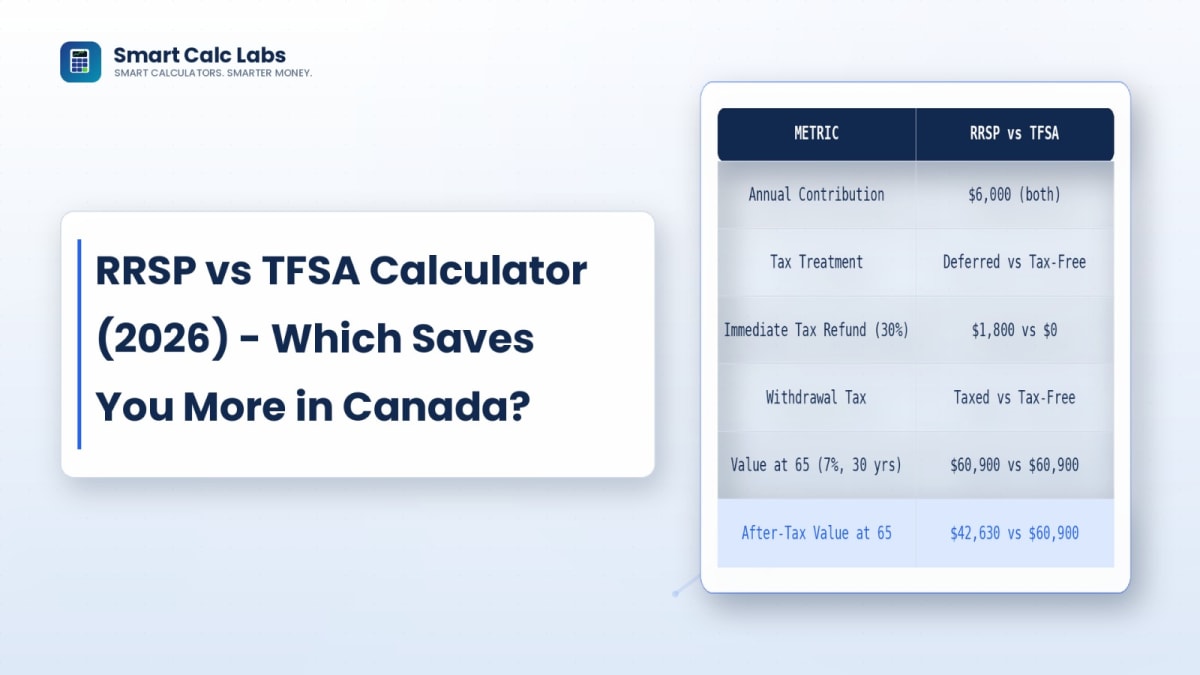
If your tax rate at contribution and retirement are identical (say 30%), and you faithfully reinvest 100% of your RRSP tax refund, the net after-tax payout of an RRSP and TFSA is exactly identical down to the cent. However, if you spend the tax refund on consumer goods or a vacation, the TFSA wins by a wide margin.
The Critical Trap: The RRSP Tax Refund is NOT "Free Money"
Many Canadians make the psychological error of treating an RRSP tax refund as a bonus windfall. In financial reality, the refund is a temporary loan from the CRA representing the government's future tax claim on your account.
When you put $10,000 into an RRSP at a 40% tax rate, you receive a $4,000 refund. If you spend that $4,000, you have effectively only committed $6,000 of real capital to your retirement. If you reinvest the $4,000 back into your RRSP or TFSA, your total compounded capital keeps pace with a pure tax-free TFSA.
Retirement Benefits & The OAS Clawback Risk
One overlooked factor when comparing RRSP vs TFSA is the impact of means-tested Canadian government benefits in retirement:
- Old Age Security (OAS) Pension Recovery Tax: For 2026, if your individual net world income exceeds $90,997, every dollar of additional income triggers a 15% clawback on your OAS pension. Because RRIF/RRSP withdrawals count dollar-for-dollar as taxable income, large mandatory minimum withdrawals after age 71 can drastically diminish your OAS benefits.
- Guaranteed Income Supplement (GIS): Low-income seniors relying on GIS face clawbacks of up to 50% to 75% on taxable income. RRSP withdrawals will eviscerate GIS payments, whereas TFSA withdrawals have zero clawback impact.
How to Strategize Your Canadian Savings Stack
For most Canadian investors, optimal wealth building follows a structured waterfall:
- Employer RRSP Match: Always contribute enough to capture 100% of employer group RRSP or DPSP matching funds (instant 50% to 100% guaranteed return).
- First Home Savings Account (FHSA): If saving for a first home purchase, the FHSA combines tax-deductible contributions (like an RRSP) with tax-free qualifying withdrawals (like a TFSA) up to $8,000/yr ($40,000 lifetime).
- TFSA vs RRSP Allocation: Allocate based on your current marginal tax bracket. If earning > $100k, prioritize RRSP; if earning < $65k, prioritize TFSA.
- Non-Registered (Taxable) Account: Only after your FHSA, TFSA, and RRSP limits are fully maximized.
Run Your Personalized Calculation
Test your exact provincial tax brackets, planned savings rate, and refund reinvestment assumptions:
Frequently Asked Questions (FAQs)
Can I hold both an RRSP and a TFSA at the same time?
Yes! In fact, most financially savvy Canadians use both accounts simultaneously. You can use your TFSA for flexible mid-term goals or emergency reserves, while using your RRSP for long-term locked-in retirement wealth.
What happens if I over-contribute to my RRSP or TFSA?
The CRA imposes a stiff penalty tax of 1% per month on the excess contribution amount for both RRSP and TFSA accounts until the excess is withdrawn or absorbed by new contribution room.
Can I withdraw from my RRSP to buy a house or go back to school?
Yes. Under the Home Buyers' Plan (HBP), eligible first-time home buyers can withdraw up to $60,000 tax-free from an RRSP, repayable over 15 years. Under the Lifelong Learning Plan (LLP), you can withdraw up to $20,000 tax-free for full-time training or post-secondary education.