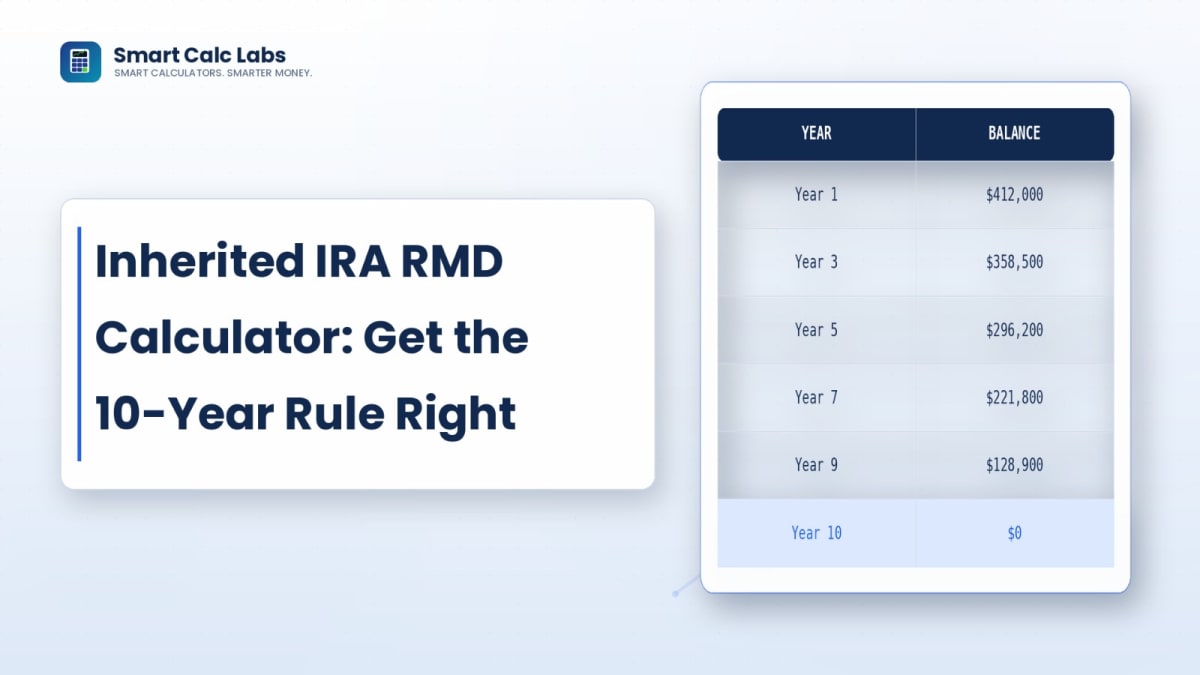
Inheriting an IRA in 2026: The New Regulatory Landscape
Inheriting an Individual Retirement Account (IRA) from a parent, relative, or loved one was once relatively straightforward. Prior to recent legislative overhauls, non-spouse beneficiaries could take advantage of the "stretch IRA" strategy, spreading required distributions across their entire lifetime to minimize income tax impact. However, the passage of the SECURE Act and the SECURE 2.0 Act, followed by the landmark IRS Final Treasury Regulations (Treasury Decision 10001) issued in July 2024, fundamentally reshaped distribution mandates for inherited retirement assets.
If you hold an inherited IRA at major brokerage custodians like Charles Schwab, Fidelity Investments, or Vanguard, the rules for 2026 are stricter than ever. After four consecutive transition years where the IRS provided penalty relief (via Notices 2022-53, 2023-54, and 2024-35), the grace period has ended. In 2026, non-spouse beneficiaries subject to annual distributions must calculate and withdraw their required minimum distributions (RMDs) or face severe tax penalties under Internal Revenue Code § 4974.
The 10-Year Rule Explained: Before vs. After Required Beginning Date (RBD)
The central pillar of the SECURE Act is the 10-year rule. Under this rule, the entire balance of an inherited IRA must be completely liquidated by December 31 of the tenth year following the year of the account owner's death. However, whether you must also take annual withdrawals during Years 1 through 9 depends on a single critical factor: Did the original account owner die before or on/after their Required Beginning Date?
1. If the Original Owner Died BEFORE Their Required Beginning Date (RBD)
Under SECURE 2.0, the Required Beginning Date is April 1 of the year following the year the owner reaches age 73 (or age 75 for individuals born in 1960 or later). If the original owner died prior to reaching this milestone:
- No Annual RMDs Required: You are not required to take distributions in Years 1 through 9.
- Year 10 Liquidation Deadline: The entire account must be liquidated to a $0 balance by December 31 of the 10th year following the owner's death.
- Withdrawal Flexibility: You may take distributions at any time in any amount during the 10-year window, giving you full tactical control over which tax years absorb the income.
2. If the Original Owner Died ON OR AFTER Their Required Beginning Date (RBD)
If the original owner had already begun taking their lifetime RMDs (or had reached their RBD), the IRS applies the "at least as rapidly" rule under IRC § 401(a)(9)(B)(i):
- Mandatory Annual RMDs (Years 1–9): You must calculate and withdraw an annual RMD for each year following the year of death, using your own single life expectancy factor from IRS Table I.
- Full Liquidation by Year 10: Regardless of previous annual distributions, all remaining assets must be completely distributed by December 31 of Year 10.
- Penalty Exposure: Failing to withdraw the annual RMD in any year triggers an IRS excise tax on the shortfall.
| Deceased Owner's Status | Annual RMDs (Years 1–9) | Year 10 Full Depletion | IRS Calculation Table |
|---|---|---|---|
| Died Before RBD (Under Age 73) | None Required | Mandatory by Dec 31 | N/A (Discretionary) |
| Died On or After RBD (Age 73+) | Mandatory Annually | Mandatory by Dec 31 | IRS Table I (Single Life) |
The Three Beneficiary Categories: Where Do You Stand?
The IRS categorizes beneficiaries into three distinct tiers, each with completely different distribution obligations:
1. Eligible Designated Beneficiaries (EDBs)
Eligible Designated Beneficiaries are granted special statutory exemptions from the strict 10-year rule. They are permitted to "stretch" distributions across their lifetime using IRS Single Life Expectancy tables. EDB status applies exclusively to:
- Surviving Spouses: Can treat the account as their own (spousal rollover) or remain a beneficiary with delayed RMD privileges.
- Minor Children of the Deceased: May stretch distributions until reaching the age of majority (age 21 under IRS rules), at which point the 10-year countdown begins, requiring full depletion by age 31.
- Disabled Individuals: Qualifying individuals who meet strict IRS disability definitions under IRC § 72(m)(7).
- Chronically Ill Individuals: Beneficiaries with severe long-term care needs as defined under IRC § 7702B(c)(2).
- Individuals Not More Than 10 Years Younger: Beneficiaries (such as siblings, partners, or friends) whose age is within 10 years of the deceased account owner.
2. Non-Eligible Designated Beneficiaries (NEDBs)
This is the category where the vast majority of beneficiaries fall. It includes adult children, grandchildren, nieces, nephews, and friends who are more than 10 years younger than the deceased. Non-eligible designated beneficiaries are fully bound by the 10-year rule and the post-RBD annual distribution mandates.
3. Non-Designated Beneficiaries (NDBs)
If an IRA is left to an estate, a non-qualified charity, or a non-see-through trust that does not pass "look-through" provisions, the account is subject to either the 5-year rule (if the owner died before their RBD) or distributions based on the deceased owner's remaining hypothetical single life expectancy (if the owner died on or after their RBD).
Inherited Traditional IRA vs. Inherited Roth IRA
One of the most frequently misunderstood aspects of the SECURE Act is how it applies to inherited Roth IRAs versus inherited Traditional IRAs:
- Inherited Traditional IRAs: Every dollar distributed (excluding any non-deductible basis) is treated as ordinary taxable income. If the original owner was age 73+, annual RMDs in Years 1–9 are mandatory.
- Inherited Roth IRAs: Under IRS regulations, the original Roth IRA owner is never deemed to have reached a Required Beginning Date during their lifetime because Roth IRAs do not have lifetime RMDs. Therefore, an inherited Roth IRA has NO annual RMDs in Years 1 through 9. However, the account must still be fully liquidated by the end of Year 10. Every penny withdrawn from a qualified inherited Roth IRA is 100% federal income tax-free.
Brokerage Custodian Comparison: Schwab, Fidelity & Vanguard
While the Internal Revenue Code sets the legal framework, your actual day-to-day execution occurs through your brokerage firm. Charles Schwab, Fidelity Investments, and Vanguard each offer proprietary tools, but they operate with subtle differences that beneficiaries must understand.
| Brokerage Firm | Key Strengths & Distribution Center Features | Automation Reality & Limitations |
|---|---|---|
| Charles Schwab | Schwab features an intuitive online Inherited IRA Distribution Rules Calculator. Offers clear separation between Eligible Designated Beneficiaries and 10-year non-spouse accounts. Excellent guidance on proper account titling (e.g., "John Doe, Dec'd, FBO Jane Doe, Beneficiary"). | Schwab will calculate your estimated RMD factor, but does not automatically disburse cash unless you enroll in a recurring scheduled withdrawal plan. Beneficiaries must monitor cash balances to avoid selling assets prematurely. |
| Fidelity Investments | Fidelity provides a robust Retirement Distribution Center dashboard that tracks both lifetime and inherited accounts. Automatically incorporates IRS Table I single life factors and provides clear breakdowns of tax withholding options (federal and state). | While Fidelity shows your annual RMD amount on account dashboards, it places full legal responsibility on the account holder to execute trades and transfer funds before the December 31 deadline. |
| Vanguard | Vanguard offers clean integration for mutual fund and ETF investors. Its online Beneficiary RMD Service allows beneficiaries to model annual drawdowns and set up automatic sales of mutual fund shares proportionally across asset classes. | Vanguard's legacy interface can be rigid when handling complex non-spouse trusts. Custodial customer service will confirm rules, but requires beneficiaries to verify if the decedent passed before or after RBD. |
How to Calculate Your Annual Inherited RMD: The Mathematical Steps
If you are required to take annual RMDs in Years 1 through 9, your distribution is calculated using the official IRS formula:
Step 1: Obtain the Prior Year-End Balance
Your RMD for 2026 is based on the fair market value (FMV) of the inherited IRA on December 31, 2025. Do not use your current account balance, as market fluctuations throughout the year do not alter your statutory RMD baseline.
Step 2: Determine Your Starting Life Expectancy Factor
Consult IRS Publication 590-B, Table I (Single Life Expectancy). Look up your age on your birthday in the calendar year immediately following the year of the owner's death. This is your initial divisor.
Step 3: Apply the Non-Recalculation Method
Unlike original IRA owners who look up a new divisor on the Uniform Lifetime Table every single year, non-spouse beneficiaries must use the non-recalculation method: in each subsequent year, you simply subtract 1.0 from the previous year's factor.
Real-World Numerical Example:
Suppose Mark (age 52 in 2025) inherited a Traditional IRA from his father, who passed away in 2024 at age 78 (after his RBD). On December 31, 2024, the account balance was $350,000. On December 31, 2025, due to market growth, the account balance is $375,000.
- Year 1 (2025): Mark was 52. IRS Table I gives a divisor of 34.3.
2025 RMD = $350,000 ÷ 34.3 = $10,204.08. - Year 2 (2026): Rather than looking up age 53 in Table I (which is 33.4), Mark applies the non-recalculation rule: 34.3 - 1.0 = 33.3.
2026 RMD = $375,000 (Dec 31, 2025 balance) ÷ 33.3 = $11,261.26. - Years 3 through 9: Mark continues reducing the divisor by 1.0 each year.
- Year 10 (2034): Mark must liquidate 100% of whatever balance remains in the account by December 31, 2034.
Strategic Tax Optimization: Navigating the 10-Year Window
Because distributions from inherited Traditional IRAs are taxed at ordinary income tax rates, managing your withdrawals strategically across the 10-year timeline can save tens of thousands of dollars in taxes.
1. Income Smoothing vs. The Year 10 Tax Bomb
Many beneficiaries take only the bare minimum in Years 1–9, leaving a massive balance in Year 10. Forcing a $400,000 liquidation into a single tax year can easily push you into the top 37% federal tax bracket, trigger the 3.8% Net Investment Income Tax (NIIT), and dramatically inflate state income taxes. Spreading withdrawals evenly minimizes bracket creep.
2. Coordinating with Low-Income Gap Years
If you anticipate career sabbaticals, early retirement, business losses, or lower compensation years during the 10-year window, schedule larger distributions during those specific low-bracket windows. Taking larger distributions when your marginal rate is 12% or 22% is far superior to taking distributions during peak earnings years.
3. Protecting Against Medicare IRMAA Surcharges
For beneficiaries who are 63 or older, large inherited IRA distributions will increase Modified Adjusted Gross Income (MAGI), potentially triggering the Medicare Income-Related Monthly Adjustment Amount (IRMAA) two years later. Surcharges on Medicare Part B and Part D premiums can add thousands in unexpected healthcare expenses.
Penalties for Non-Compliance: The SECURE 2.0 Relief Structure
Under pre-2023 law, the penalty for failing to take a required minimum distribution was a draconian 50% excise tax on the undistributed amount. SECURE 2.0 significantly lowered this burden:
- Standard Penalty: The excise tax for a missed RMD is now 25% of the shortfall (Internal Revenue Code § 4974).
- Reduced Penalty (Correction Window): If you discover the error and submit a corrected distribution within the statutory "correction window" (generally before the IRS notices the deficiency or issues a Notice of Deficiency), the excise tax drops to 10%.
- Requesting a Full Penalty Waiver: You can file IRS Form 5329 with a statement of reasonable cause, demonstrating that the shortfall occurred due to reasonable error and that reasonable steps are being taken to remedy it. The IRS frequently waives the excise tax for taxpayers who promptly withdraw the shortfall and self-report.
Model Your Inherited IRA Drawdown & 10-Year Countdown
Don't leave your distribution schedule to guesswork. Use our institutional-grade calculator to compute your exact single life expectancy factor, model Year 1–10 tax brackets, and verify SECURE 2.0 compliance across Schwab, Fidelity, and Vanguard accounts.
Frequently Asked Questions (FAQs)
Can I aggregate RMDs from multiple inherited IRAs?
Only if you inherited multiple IRAs from the exact same deceased owner. In that case, you can calculate the RMD for each account separately and withdraw the total amount from one or any combination of those accounts. However, if you inherited IRAs from different individuals (e.g., one from your father and one from an aunt), you cannot aggregate them; each inherited account must satisfy its own RMD independently.
What happens if the original owner died before taking their final year RMD?
If the decedent passed away in a year they were required to take an RMD and had not yet taken it prior to death, the beneficiary is responsible for taking that "year-of-death RMD" by December 31 of that same calendar year. This year-of-death distribution is calculated using the decedent's Uniform Lifetime Table divisor, not the beneficiary's factor.
Does Charles Schwab, Fidelity, or Vanguard withhold federal taxes automatically?
By default, custodians typically apply a statutory 10% federal income tax withholding unless you explicitly elect out or choose a higher percentage. Because inherited IRA distributions are added to your existing earned income, a 10% withholding rate may result in an underpayment penalty if your true marginal tax bracket is 24%, 32%, or higher. Always adjust your withholding percentage to match your anticipated marginal bracket.
Can I convert an inherited Traditional IRA into an inherited Roth IRA?
No. Under federal tax law, non-spouse beneficiaries are strictly prohibited from converting an inherited Traditional IRA into an inherited Roth IRA. Only a surviving spouse who performs a spousal rollover into their own personal IRA has the legal authority to execute a Roth conversion.
Can I contribute newly earned income into an inherited IRA?
No. An inherited IRA cannot accept new contributions or rollovers from other personal accounts. It is strictly a distribution account intended to liquidate the decedent's tax-advantaged estate over time.