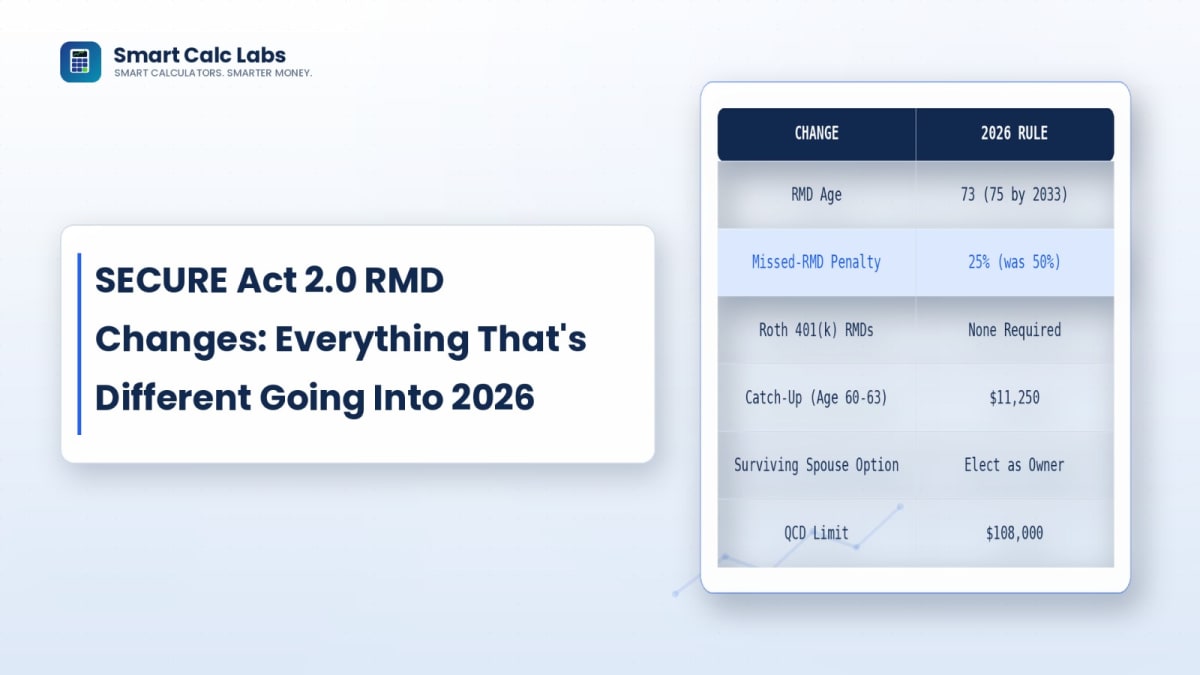
If the RMD rules you remember are from more than a few years ago, they are probably wrong now. Between the original SECURE Act (2019), SECURE 2.0 (signed December 2022), and a set of IRS final regulations issued in July 2024 that finally settled years of ambiguity, almost every part of how RMDs work has shifted. This is a single reference for what changed, so you are not piecing it together from six different rules scattered across six different sources.
Our RMD Calculator already applies all of the current rules automatically. Here is what each one actually changed and why it matters.
1. The Starting Age Moved Twice, and Now Depends on Birth Year
RMDs used to start at 70½ for everyone. That is long gone. The current schedule, phased in across two separate pieces of legislation:
- Age 72 — set by the original 2019 SECURE Act, replacing 70½.
- Age 73 — for anyone born 1951–1959, effective starting in 2023 under SECURE 2.0.
- Age 75 — for anyone born 1960 or later, scheduled to take effect in 2033.
This means two people just a year or two apart in age can face genuinely different RMD start dates, which matters for anyone doing multi-year retirement income planning around a specific birth year.
2. The Missed-RMD Penalty Was Cut in Half, Then Cut Again for Quick Fixes
Before 2023, missing an RMD triggered a flat 50% excise tax on the shortfall — one of the harshest penalties in the entire tax code for a paperwork-style mistake. SECURE 2.0 dropped that to 25%, and further down to 10% if you correct the shortfall and file Form 5329 within two years of the missed deadline. This is arguably the most retiree-friendly change in the whole package, turning what used to be a potentially devastating error into something meaningfully more forgivable if caught quickly.
3. Roth Workplace Accounts No Longer Have Lifetime RMDs
Roth IRAs have never required lifetime RMDs. Roth 401(k)s and Roth 403(b)s, oddly, did — until SECURE 2.0 fixed that inconsistency starting with the 2024 tax year. If your workplace retirement account is entirely Roth, you now have zero required withdrawals during your lifetime, matching Roth IRA treatment exactly. If your 401(k) mixes traditional and Roth contributions, only the traditional portion still generates an RMD.
4. Inherited IRAs Got a Four-Year-Long Clarification
The original SECURE Act replaced the "stretch IRA" with a 10-year rule for most non-spouse beneficiaries in 2019, but left one huge question unanswered: did you owe annual RMDs during that 10-year window, or just have to empty the account by the end of it? The IRS spent years issuing temporary penalty waivers while it decided, before finally settling the question in July 2024 final regulations (Treasury Decision 10001): if the original owner had already reached their Required Beginning Date before death, the beneficiary must take annual RMDs in years 1–9, not just empty the account by year 10. The penalty waiver covering 2021–2024 expired after the 2024 tax year — beneficiaries subject to this rule who skip an annual RMD in 2025 or 2026 face the standard penalty, with no automatic relief remaining.
5. The QCD Limit Now Rises With Inflation
Qualified Charitable Distributions — direct IRA-to-charity transfers that satisfy your RMD without ever counting as taxable income — had a flat $100,000 annual limit for over a decade. SECURE 2.0 indexed that limit to inflation starting in 2024. For 2026, the limit is $111,000 per person (up from $108,000 in 2025), meaning the ceiling on this tax-free giving strategy now quietly grows each year rather than staying frozen.
6. A New Repayment-Style Framework Reshaped Federal Student Loans (Indirectly Related)
While not an RMD rule itself, it is worth flagging that 2026 also brought sweeping changes to federal student loan repayment following the SAVE Plan's discontinuation — relevant context for anyone doing comprehensive retirement-adjacent tax planning that spans multiple accounts and obligations. This falls outside RMD rules specifically but is part of the same broader wave of 2026 federal financial-planning changes.
7. Still-Working Exception and Aggregation Rules Remain, But Are Easy to Misapply
These rules did not change under SECURE 2.0, but they are worth restating because so much else did: if you are still employed past your RMD age at the company sponsoring your 401(k), and do not own more than 5% of the business, you may be able to delay that specific plan's RMDs until you retire. Separately, traditional IRA RMDs can be aggregated and withdrawn from a single IRA, while 401(k) RMDs cannot be combined across different plans — each one requires its own separate withdrawal.
What This Means If You Haven't Reviewed Your Plan Since Before 2023
If the last time you seriously mapped out your RMD strategy was before 2023, at least three things you planned around have likely changed: your actual start age may be different than you assumed, any missed-RMD exposure is now a smaller (but still real) penalty, and if you are managing an inherited IRA, you may owe annual distributions you were not expecting under the pre-2024 understanding of the rules. This is worth a genuine re-check, not just an assumption that your old plan still applies.
For the specific mechanics behind each of these, our RMD Calculator, Inherited IRA RMD Calculator, 401(k) RMD Calculator, and QCD Calculator each walk through one piece of this in full detail.
Disclaimer: The content on SmartCalcLabs is for educational and informational purposes only and does not constitute tax or legal advice. This overview reflects the SECURE Act (2019), SECURE 2.0 Act (2022), and July 2024 IRS final regulations (T.D. 10001) as understood for the 2026 tax year. Retirement account rules are genuinely complex and fact-specific — confirm your exact obligations with a licensed tax professional.
Frequently Asked Questions
Is there another RMD age increase coming after 75?
Not currently scheduled. The age-75 threshold for those born 1960 or later, effective 2033, is the final phase written into SECURE 2.0 as of now — though Congress could pass further changes in the future.
Do these changes apply to Roth IRAs?
Roth IRAs already had no lifetime RMDs before any of this legislation, so most of these changes do not directly affect them during the original owner's lifetime. Inherited Roth IRAs, however, are affected by the same 10-year rule and beneficiary clarifications as inherited traditional IRAs.
What is the single most important change for most retirees?
For people currently taking RMDs from their own accounts, the penalty reduction from 50% to 25%/10% is the most broadly impactful change. For anyone managing an inherited IRA, the July 2024 annual-RMD clarification is the one most likely to catch you off guard if you have not revisited it since.
Where can I confirm these rules haven't changed further?
IRS Publication 590-B is updated annually and is the most authoritative source for current-year RMD rules. Given how much has shifted in just a few years, it is worth checking before assuming last year's rules still apply exactly as written.
Conclusion
SECURE 2.0 and the 2024 final regulations touched nearly every part of how RMDs work — the age, the penalty, Roth workplace accounts, inherited IRAs, and QCD limits all shifted within just a few years of each other. Run your specific numbers through the calculator above using the current rules, and if your retirement plan was built around pre-2023 assumptions, treat this as a genuine prompt to revisit it rather than assuming nothing has changed.