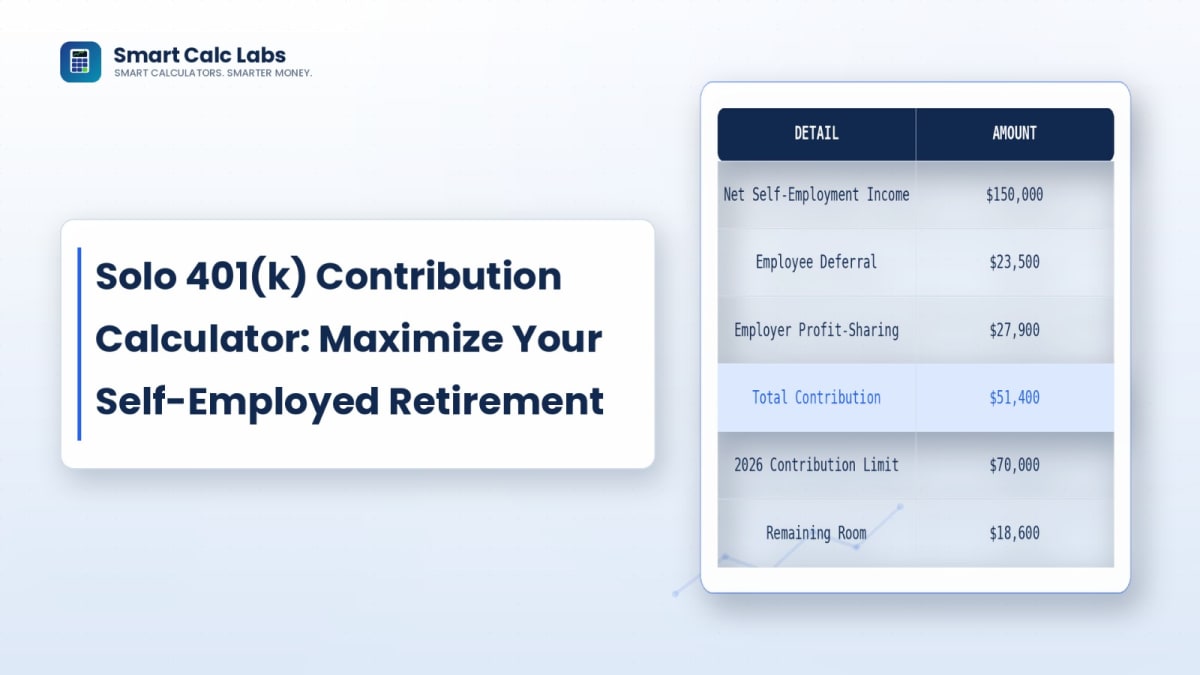
When you are self-employed, nobody is matching your 401(k) contributions or auto-enrolling you into a plan. But there is a trade-off: a Solo 401(k) lets you wear both hats — employee and employer — which pushes your contribution ceiling far above what a regular workplace 401(k) or even a SEP IRA allows. For 2026, that combined ceiling is $72,000 if you are under 50, and it climbs higher with age-based catch-up contributions.
Our Solo 401(k) Contribution Calculator works out your exact limit based on your income, age, and business structure. Here is what actually drives that number.
Two Contributions, One Combined Cap
A Solo 401(k) has two separate pieces that stack together:
- Employee deferral: up to $24,500 for 2026, the same limit that applies to any 401(k) participant, self-employed or not.
- Employer profit-sharing contribution: up to 25% of compensation, contributed by "your business" on your behalf.
Combined, the overall 2026 limit is $72,000 for anyone under 50. Add catch-up contributions and it climbs to $80,000 for those aged 50–59 or 64 and older, and to $83,250 for the 60–63 age band, which gets a larger "super catch-up" of $11,250 under SECURE 2.0 instead of the standard $8,000.
The Math Depends on How Your Business Is Structured
This is where most online calculators get sloppy, and it is worth getting right because the difference is not small.
If you are a sole proprietor or single-member LLC
You do not simply take 25% of your net income. The 25% rate is applied to compensation calculated after your own contribution and half your self-employment tax are deducted — which mathematically works out to an effective rate of roughly 20% of your net self-employment earnings, not 25%. IRS Publication 560 confirms this directly: a stated plan rate of 25% converts to an effective self-employed rate of 20% (0.25 ÷ 1.25 = 0.20).
Worked example: Say your net self-employment income after deducting half your self-employment tax is $150,000. Your maximum employer contribution is roughly 20% of that, or about $30,000. Add the full $24,500 employee deferral, and your total contribution reaches $54,500 — comfortably inside the $72,000 combined cap.
If you run an S-corporation and pay yourself W-2 wages
The math is more straightforward: the employer contribution is a flat 25% of your W-2 wages, no conversion factor needed. If your S-corp pays you $150,000 in W-2 wages, your employer contribution can be up to $37,500. Combined with the $24,500 employee deferral, that reaches $62,000 — still under the $72,000 overall cap, and notably higher than the sole-proprietor version on the same income, because W-2 wages skip the self-employment tax adjustment.
Catch-Up Contributions, and a New Rule for High Earners
Catch-up contributions sit in a separate bucket from the $72,000 combined limit, so they are pure additional room, not a slice of the same pie:
- Age 50–59 or 64+: an extra $8,000, bringing your possible total to $80,000.
- Age 60–63: a larger "super catch-up" of $11,250, bringing your possible total to $83,250. This replaces the standard $8,000 catch-up for these four ages specifically, it does not stack on top of it.
New for 2026: if you had FICA wages above $150,000 in the prior year, SECURE 2.0 now requires your catch-up contributions to be made as Roth (after-tax) rather than pre-tax. For most Solo 401(k) owners who are genuinely self-employed rather than drawing FICA wages, this mandate typically does not apply — but S-corp owners paying themselves W-2 wages above that threshold should check it carefully.
Doubling Your Household Limit With a Spouse
If your spouse earns eligible compensation from the same business and is a genuine participating employee, each spouse gets their own separate Solo 401(k) limit. That means a couple both under 50 could potentially reach $144,000 combined for 2026, or up to $160,000 if both qualify for catch-up contributions — a meaningful way to shelter income if the business supports it and both spouses have documented, reasonable compensation.
Deadlines: Two Different Dates for Two Different Pieces
The employee deferral election has to be made in writing by your business's year-end — you cannot decide in April of the following year to have deferred income you already took as a distribution in December. The employer profit-sharing contribution, however, can be made up until your business's tax filing deadline, including extensions. This gives sole proprietors real flexibility to fund the employer side after they know their final numbers for the year, but the employee deferral decision has to be locked in earlier.
Mistakes That Trigger Excess Contributions
- Applying 25% directly to gross self-employment income instead of net earnings after the self-employment tax deduction — this overstates your allowed employer contribution and can trigger an excess contribution penalty.
- Forgetting the annual additions limit applies to compensation too. Your total contribution can never exceed 100% of your compensation, even if the dollar limit would otherwise allow more — this mainly bites lower-income self-employed workers.
- Missing the employee deferral election deadline by treating it the same as the employer contribution deadline, which is later.
- Not accounting for a workplace 401(k) you also participate in. The $24,500 employee deferral limit applies across all 401(k)s you contribute to combined, not per plan — if you have a day job with a 401(k) too, that eats into your Solo 401(k) employee deferral room.
If you are comparing this against other self-employed retirement options, our Freelancer Tax Estimator and Self-Employment Tax Calculator are worth running first, since your net self-employment income is the exact figure this calculators math depends on.
Disclaimer: The content on SmartCalcLabs is for educational and informational purposes only and does not constitute tax or financial advice. Contribution limits referenced here reflect 2026 IRS figures under SECURE 2.0 and are subject to annual cost-of-living adjustments. Always confirm your exact limits with a licensed tax professional, particularly around the self-employment tax conversion and S-corp compensation rules.
Frequently Asked Questions
Can I open a Solo 401(k) if I have any employees other than my spouse?
Generally no. Solo 401(k) plans are designed for business owners with no full-time employees other than a spouse. If you hire eligible employees, you typically need to convert to a standard 401(k) plan that covers them too.
Is a Solo 401(k) better than a SEP IRA?
For most self-employed people with moderate income, yes — a Solo 401(k) usually allows a higher total contribution at the same income level, because the employee deferral is on top of the employer contribution, whereas a SEP IRA only offers the employer-side contribution. SEP IRAs remain simpler to administer, with no annual filing requirement, which appeals to some solopreneurs despite the lower ceiling.
Do I have to contribute the maximum every year?
No. There is no minimum contribution requirement. Many self-employed people contribute a smaller amount in leaner years and increase it when income allows, as long as they stay within that year's limit based on actual net earnings.
What happens if I accidentally over-contribute?
Excess contributions need to be withdrawn, along with any earnings on them, generally before your tax filing deadline to avoid a 6% excise tax on the excess amount for each year it remains in the account.
Conclusion
The Solo 401(k) is one of the most generous retirement tools available to self-employed workers, but the 25%-that-is-really-20% conversion for sole proprietors trips up more people than any other part of it. Run your real net self-employment income through the calculator above, double-check whether you are structured as a sole proprietor or an S-corp, and if you are close to the combined limit, get the employee deferral election in writing before your business year-end.