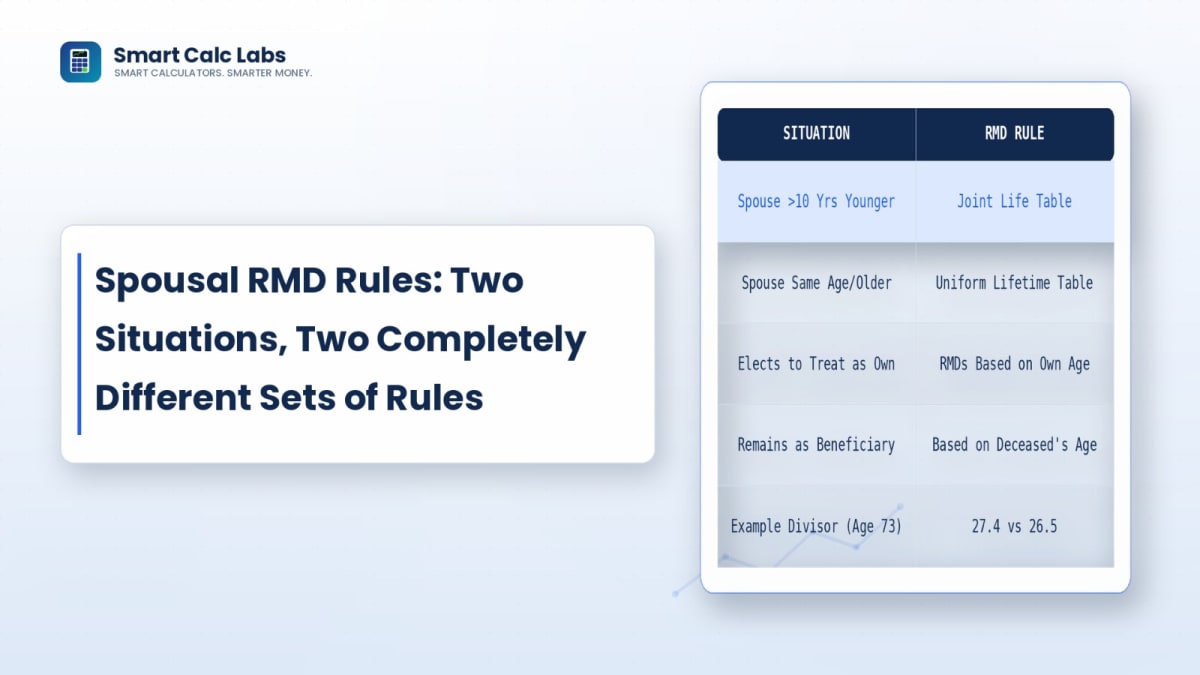
"Spousal RMD" actually covers two unrelated situations, and mixing them up leads to the wrong calculation entirely. One is about a living IRA owner whose spouse is significantly younger and named as sole beneficiary — which can shrink your own RMD every year. The other is about what a surviving spouse does with an IRA after their partner has passed away — a completely different set of choices with its own tax consequences. This guide covers both, clearly separated.
Once you know which situation applies to you, use our RMD Calculator to run the actual numbers — the sections below explain which divisor and rules apply to your specific case.
Situation One: You Are Alive, and Your Spouse Is More Than 10 Years Younger
Most IRA owners calculate their RMD using the Uniform Lifetime Table (Table III), which assumes a hypothetical beneficiary exactly 10 years younger than you, regardless of who your actual beneficiary is. But if your spouse is genuinely your sole designated beneficiary for the entire year, and is more than 10 years younger than you, the IRS lets you switch to the Joint Life and Last Survivor Table (Table II) instead.
Because Table II factors in both of your life expectancies rather than the generic 10-year assumption, it produces a longer divisor — and a smaller required RMD — than the standard table would for the same balance and age. The younger your spouse relative to you, the bigger the gap becomes.
A Worked Example
You turn 75 in 2026 with a $600,000 traditional IRA. Under the standard Uniform Lifetime Table, the divisor for age 75 is 24.6, producing an RMD of $600,000 ÷ 24.6 = $24,390. If your spouse is your sole beneficiary and is 55 years old — 20 years younger — the Joint Life Table divisor jumps to roughly 30.5, producing an RMD of $600,000 ÷ 30.5 = $19,672. That is nearly a 20% smaller required withdrawal on the exact same balance, purely from the beneficiary structure.
The Catch: "Sole Beneficiary" Has to Hold for the Whole Year
This is where people lose the benefit without realizing it. If you add a contingent beneficiary, split the beneficiary designation with anyone else, or your spouse's status changes at any point during the year, you may not qualify for Table II for that tax year. The determination is generally made as of January 1 of the distribution year, based on your beneficiary designation — so a mid-year change to your beneficiary form can affect the following year's calculation, not necessarily the current one. Keep your beneficiary designation clean and confirm it annually if you are relying on this strategy.
Situation Two: Your Spouse Has Passed Away, and You Inherited Their IRA
A surviving spouse has more flexibility than any other type of beneficiary, with three genuinely different paths:
Option A: Spousal Rollover (Treat as Your Own)
Move the inherited funds into your own IRA, or elect to treat the inherited IRA as your own. Your RMDs then follow the rules that apply to you personally — based on your own age and starting date, using the standard Uniform Lifetime Table. This is usually the better choice if you are already past 59½, since it avoids the earlier RMD trigger described in Option B below and lets the account behave exactly like an IRA you always owned.
Option B: Keep It as an Inherited IRA
You can also choose to keep the account titled as an inherited IRA rather than rolling it into your own. The key advantage: distributions from an inherited IRA are always penalty-free, regardless of your age — unlike your own IRA, where withdrawals before 59½ normally trigger a 10% early withdrawal penalty. This makes Option B the better fit if you are under 59½ and might need access to the funds before then. RMDs from an inherited IRA held this way are generally based on the deceased spouse's age or your own, depending on specific circumstances and which option you elect — a detail worth confirming with a tax professional given how fact-specific it is. Our Inherited IRA RMD Calculator can walk through this option in detail.
Option C: The SECURE 2.0 "Hypothetical RMD" Spousal Election
SECURE 2.0 added a newer, more nuanced option for surviving spouses: elect to be treated as the deceased spouse for RMD purposes without a full rollover, which can delay when your own RMDs must begin, particularly useful if your late spouse was younger than you and had not yet reached their Required Beginning Date. This calculation compares a "hypothetical RMD" the deceased spouse would have owed against what you would owe under your own age, and can shift the more favorable outcome depending on the age gap between you. This option is genuinely complex and benefits significantly from professional guidance to model correctly for your specific ages and account values.
Which Spousal Option Actually Saves the Most?
When both spouses are close in age, the difference between a spousal rollover and the inherited-account election is often negligible. The gap widens significantly when there is a meaningful age difference — particularly when the surviving spouse is younger than the deceased, since delaying the RMD start date by treating the account differently can mean several additional years of tax-deferred growth before any withdrawals are required at all. There is no universally correct choice; it depends on your age, the age gap with your late spouse, and whether you need penalty-free access to the funds before 59½.
Common Mistakes and Pitfalls
- Assuming Table II applies just because you are married. It only applies when your spouse is your sole beneficiary and more than 10 years younger — both conditions have to be true.
- Rolling a deceased spouse's IRA into your own while under 59½ without considering that this exposes future withdrawals to the 10% early withdrawal penalty, which an inherited IRA would not.
- Not revisiting the beneficiary designation annually if relying on the younger-spouse Joint Life Table strategy — a change partway through the year can affect eligibility.
- Assuming all surviving spouses face the same RMD rules as other beneficiaries. Spousal beneficiaries have meaningfully more flexibility than the 10-year rule that applies to most non-spouse heirs.
If you inherited an IRA from someone other than a spouse, the rules are different — see our Inherited IRA RMD Calculator for the 10-year rule that applies to most other beneficiaries. Our RMD Calculator is the right tool once your own RMDs are underway — just apply the Joint Life Table divisor manually if Situation One applies to you.
Disclaimer: The content on SmartCalcLabs is for educational and informational purposes only and does not constitute tax or legal advice. Spousal RMD rules referenced here reflect 2026 IRS guidance under Publication 590-B and SECURE 2.0 provisions effective for deaths after December 29, 2022. These situations are genuinely fact-specific — confirm your exact options with a licensed tax professional or estate attorney before electing a path.
Frequently Asked Questions
Does the Joint Life Table apply to 401(k)s too, or just IRAs?
The same underlying rule (spouse as sole beneficiary, more than 10 years younger) can apply to employer plans as well, though plan-specific rules and administration can vary — confirm with your plan administrator whether this option is supported.
Can I switch from the inherited IRA option to a spousal rollover later?
Generally yes, a surviving spouse can typically elect a spousal rollover at a later date if they initially kept the account as an inherited IRA, though the reverse (unwinding a completed rollover back to inherited status) is generally not possible.
What if my spouse and I are the same age?
If there is no meaningful age gap, the Joint Life Table strategy for living owners provides little to no benefit, since the standard Uniform Lifetime Table already assumes a hypothetical beneficiary 10 years younger — an actual same-age spouse doesn't change the calculation favorably.
Is the "hypothetical RMD" spousal election worth pursuing for a smaller account?
It is generally more worthwhile for larger accounts or significant age gaps, where the extra years of tax-deferred growth meaningfully outweigh the added complexity. For smaller accounts, a straightforward spousal rollover is often simpler with comparable outcomes.
Conclusion
Whether "spousal RMD" applies to you as a living IRA owner with a much younger spouse, or as a surviving spouse deciding what to do with an inherited account, the rules genuinely diverge from the standard RMD calculation — and the option you choose can meaningfully change how much you owe and when. Run your specific ages and situation through the calculator, and if you are a surviving spouse weighing the SECURE 2.0 hypothetical RMD election, get professional guidance before committing, since it is one of the more complex corners of current RMD rules.