Introduction: The Power of 100% Tax-Free Compounding
Since its launch by the Canadian federal government in 2009, the Tax-Free Savings Account (TFSA) has revolutionized personal wealth building in Canada. Despite its name containing the word "savings," the TFSA is not merely a high-interest cash deposit account — it is arguably the most powerful investment vehicle available to Canadian residents. Inside a self-directed TFSA, capital gains, equity dividends, and interest compound completely free of Canadian income tax for life.
Unlike an RRSP, which defers income tax until retirement, a TFSA provides true tax exemption: you contribute with after-tax dollars, and you never pay a single cent of Canadian tax on investment growth or withdrawals. Furthermore, TFSA withdrawals do not count as income under the Income Tax Act, protecting seniors and families from clawbacks on income-tested federal benefits like Old Age Security (OAS), the Guaranteed Income Supplement (GIS), and the Canada Child Benefit (CCB).
How Cumulative TFSA Contribution Room Accumulates
Unlike an RRSP (which requires earned employment or business income reported on a T4), every Canadian resident aged 18 or older with a valid SIN automatically generates TFSA contribution room every January 1, regardless of employment status, student enrollment, or income level.
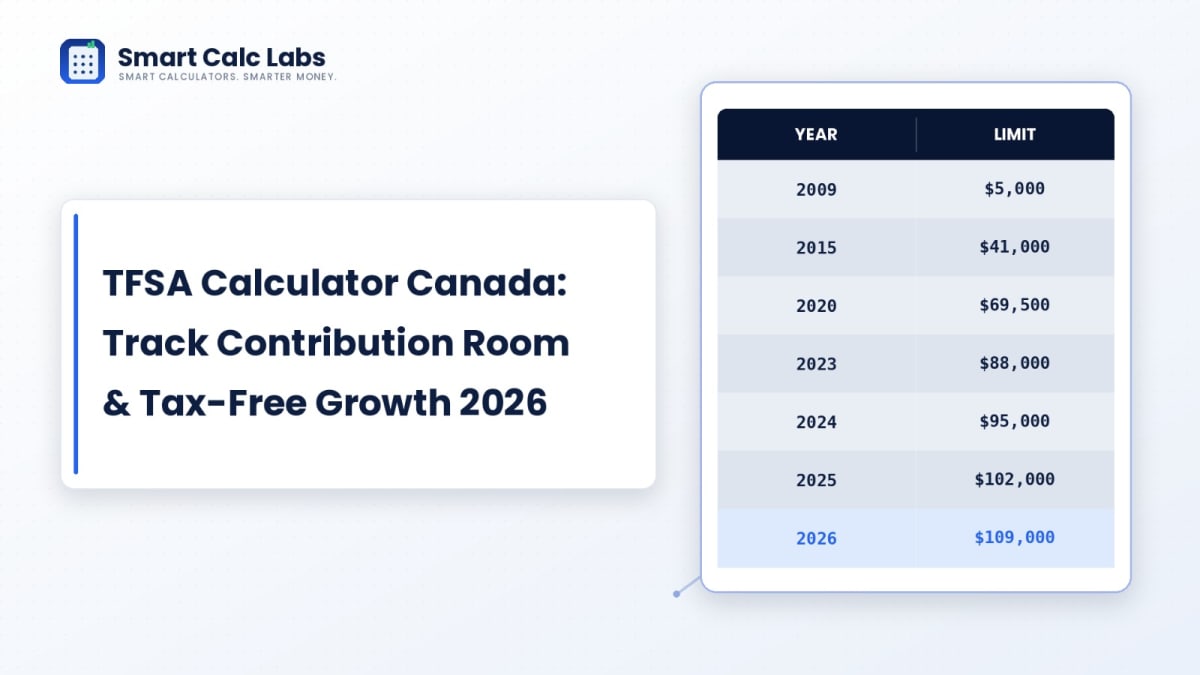
If you do not contribute in a given year, your unused contribution room carries forward indefinitely. The table below outlines the historical annual limits and cumulative lifetime progression since the program began in 2009:
| Calendar Year(s) | Annual CRA Dollar Limit | Cumulative Lifetime Limit |
|---|---|---|
| 2009 – 2012 | $5,000 / year | $20,000 |
| 2013 – 2014 | $5,500 / year | $31,000 |
| 2015 | $10,000 | $41,000 |
| 2016 – 2018 | $5,500 / year | $57,500 |
| 2019 – 2022 | $6,000 / year | $81,500 |
| 2023 | $6,500 | $88,000 |
| 2024 | $7,000 | $95,000 |
| 2025 | $7,000 | $102,000 |
| 2026 | $7,000 | $109,000 |
What If You Turned 18 After 2009?
If you were born in 1992 or later, you did not begin accumulating contribution room until the calendar year you reached age 18. For example:
- Turned 18 in 2016: Your cumulative room spans 2016 through 2026 ($5,500×3 + $6,000×4 + $6,500 + $7,000×3) = $68,000.
- Turned 18 in 2020: Your cumulative room spans 2020 through 2026 ($6,000×3 + $6,500 + $7,000×3) = $45,500.
- Turned 18 in 2026: Your starting contribution room is $7,000.
The Official CRA Contribution Room Formula
To determine your exact available contribution room for the current tax year, the Canada Revenue Agency uses the following equation:
The Golden Rule of TFSA Withdrawals: The January 1 Reset
One of the most unique advantages of the TFSA is that withdrawals restore contribution room dollar-for-dollar. However, timing is everything. Thousands of Canadians receive unexpected penalty notices from the CRA every year because of a fundamental misunderstanding of this mechanism:
Real-World Calendar Scenario: The Danger of Intra-Year Re-Contributions
Consider David, who has maximized his TFSA with $0 of unused room remaining in 2026:
- June 15, 2026: David withdraws $15,000 from his TFSA to help cover a home renovation.
- September 10, 2026: The renovation finishes under budget, and David has $15,000 in cash. Thinking he is merely "putting his money back," David deposits $15,000 back into his TFSA.
- The CRA's Assessment: Because David had $0 of unused room in 2026, the $15,000 withdrawal is not restored until January 1, 2027. His September deposit is classified as a $15,000 excess contribution!
- The Financial Penalty: The CRA assesses a 1% per month penalty tax on the excess amount for September, October, November, and December (4 months × 1% × $15,000 = $600 penalty).
The Cost of Over-Contributing: CRA 1% Monthly Penalty Tax
Under Section 207.02 of the Income Tax Act, the CRA levies a penalty tax of 1% per month on the highest excess contribution amount for each month the excess remains in the account:
- The penalty runs for each full or partial calendar month that the excess funds remain inside the account.
- You are required to file CRA Form RC243 (TFSA Return) along with Schedule RC243-SCH-A by June 30 of the following year to report the excess and remit the penalty tax.
- How to Request Penalty Relief: Under subsection 207.06(1) of the Act, the Minister of National Revenue has discretionary power to waive the penalty tax if the taxpayer can prove the over-contribution occurred due to a reasonable error and that the excess amount was promptly withdrawn from the account.
TFSA vs. Non-Registered Taxable Account: The 30-Year Compounding Multiplier
To grasp why maximizing your TFSA is so critical, compare its growth against a standard taxable non-registered investment account subject to annual tax drag:
| Investment Income Type | Tax Treatment in Non-Registered Account | Tax Treatment Inside TFSA |
|---|---|---|
| Interest & GIC Income | 100% taxed at your full marginal tax rate every year (up to 53.5% in ON/QC). | 0% Tax (100% Tax-Free) |
| Canadian Eligible Dividends | Subject to 38% gross-up and federal/provincial dividend tax credits. | 0% Tax (100% Tax-Free) |
| Realized Capital Gains | 50% inclusion rate (or 66.67% inclusion rate for gains exceeding $250k). | 0% Tax (100% Tax-Free) |
The 30-Year Wealth Gap Simulation
Assume an investor deposits $7,000 per year for 30 years into an equity index portfolio yielding a 7.0% annual nominal return (with a 40% marginal tax bracket):
- In a TFSA: Total contributions of $210,000 grow to over $707,000 completely tax-free. The investor can withdraw the entire sum in retirement without paying a single dollar of tax.
- In a Taxable Account: Annual dividend taxation and capital gains taxes reduce the effective compounded return to ~5.2%. The final after-tax portfolio equals approximately $515,000.
- The TFSA Advantage: The TFSA delivers nearly $200,000 in pure tax savings directly into the investor's pocket!
Advanced CRA Rules: Day Trading & Non-Residency
1. CRA Day Trading Audits (Section 146.2(6))
Under the Income Tax Act, TFSAs are designed for passive investing. If the CRA determines you are "carrying on a business of trading" inside your TFSA, they will strip the account of its tax exemption and tax all realized gains as 100% business income. Audit triggers include extreme transaction frequency, short holding durations (minutes or hours), extensive use of options, and specialized market knowledge.
2. Non-Resident Contribution Pitfall
If you leave Canada and become a non-resident for tax purposes, you do not lose your existing TFSA investments, and investment growth remains tax-free in Canada. However, you cannot make any contributions while a non-resident, nor do you accumulate new room. Any contribution made while a non-resident triggers a 1% per month penalty tax.
3. The US Foreign Withholding Tax Drag
Under the US-Canada Tax Treaty, RRSPs are recognized as retirement accounts and exempt from the 15% US withholding tax on US dividends. TFSAs are not recognized under this treaty. Holding US dividend payers (e.g., Apple, Microsoft, VOO) inside a TFSA results in a 15% dividend haircut at source that cannot be claimed as a Foreign Tax Credit.
Estate Planning: Successor Holder vs. Beneficiary
When opening a TFSA, naming the correct designation on your beneficiary form has massive estate and tax implications for your family:
1. Successor Holder (Spouse or Common-Law Partner Only)
If you designate your spouse as Successor Holder, upon your death, your spouse seamlessly takes over ownership of your TFSA without the account losing its tax-sheltered status. This transfer has zero impact on your surviving spouse's own TFSA contribution room! They can maintain both their own account and the inherited account, doubling their tax-free shelter.
2. Beneficiary Designation (Non-Spouse or Estate)
If you name a child, relative, or charity as beneficiary, the fair market value of your TFSA at death passes to them tax-free. However, any investment growth that occurs between the date of death and the final distribution of funds is fully taxable. Furthermore, the beneficiary cannot deposit the funds into their own TFSA unless they have sufficient unused room of their own.
Calculate Your Exact Lifetime TFSA Room & Tax-Free Growth
Track your personal contribution room based on your age, calculate remaining space after withdrawals, and compare 30-year compounding against a taxable account with our free interactive tools.
Frequently Asked Questions (FAQs)
How do I check my official CRA TFSA contribution room?
You can check your official contribution room by logging into the CRA My Account online portal or calling the Tax Information Phone Service (TIPS) at 1-800-267-6999. However, be aware that financial institutions only submit TFSA transaction reports to the CRA once a year (by the end of February). Any contributions or withdrawals made in the current calendar year will not reflect in your CRA portal until the following spring.
Can I have multiple TFSA accounts at different financial institutions?
Yes. You can hold as many TFSA accounts across as many banks, robo-advisors, and discount brokerages as you wish (e.g., Questrade, Wealthsimple, TD, RBC). However, your cumulative contribution room is combined across all accounts. Depositing into multiple accounts without tracking the collective sum is one of the most common causes of accidental CRA over-contributions.
What happens to my contribution room if my investments lose money?
If you deposit $7,000 into your TFSA and the investment drops to $2,000, that $5,000 loss is permanently forfeited. You cannot claim a capital loss against other taxable income, nor is the lost contribution room restored if you withdraw the remaining $2,000. For this reason, highly speculative penny stocks or options that carry high risk of total loss are poorly suited for a TFSA.
Can I transfer funds between TFSA accounts at different banks without using contribution room?
Yes, provided you execute a direct institution-to-institution transfer (via CRA Form T2033 equivalent) initiated by your receiving financial institution. If you manually withdraw cash from Bank A and deposit it into Bank B yourself, it counts as a withdrawal and a new deposit, which requires sufficient unused contribution room until the January 1 reset.
Do TFSA withdrawals impact federal tax credits or child benefits?
No. Under the Canadian Income Tax Act, withdrawals from a TFSA are completely excluded from net income calculations. They do not affect the Age Amount tax credit, the Canada Child Benefit (CCB), the GST/HST credit, or income-tested benefits like OAS and GIS.