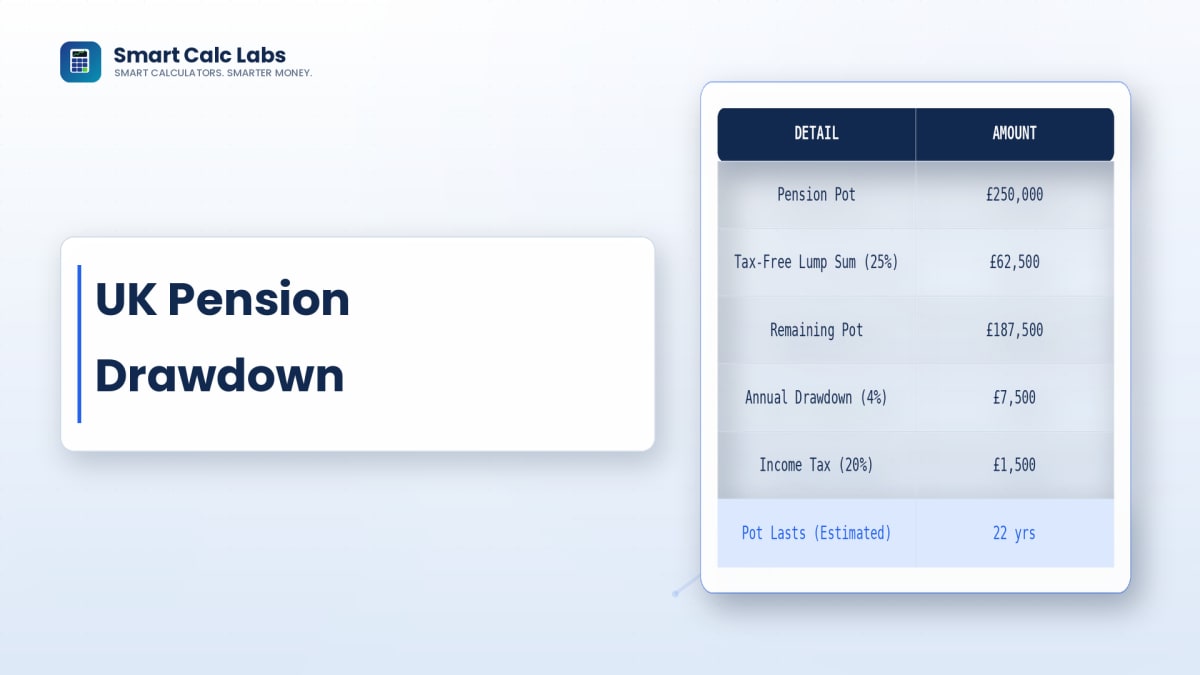
Since the introduction of the UK Pension Freedoms, retirees with defined contribution (DC) pensions are no longer forced to buy an annuity at retirement. Instead, you can keep your pension pot invested in the financial markets and withdraw income flexibly whenever you choose. This strategy—known as flexi-access pension drawdown—has become the overwhelming choice for modern UK retirements.
However, complete freedom brings complete responsibility. In drawdown, you bear both investment risk (market volatility) and longevity risk (the danger of outliving your money). A poorly planned withdrawal strategy, an unexpected HMRC emergency tax deduction, or accidentally triggering the Money Purchase Annual Allowance (MPAA) can permanently impair your retirement lifestyle.
Use our free UK Pension Drawdown Calculator to simulate your pot's exact runway, or read on to master the tax rules, withdrawal strategies, and legal allowances governing UK pension drawdown in 2026/27.
How UK Pension Drawdown Actually Works (PCLS vs. UFPLS)
When you reach the minimum pension access age (currently 55, rising to 57 on 6 April 2028), you can access your defined contribution pension through two primary drawdown mechanisms:
1. Flexi-Access Drawdown (FAD)
You "crystallise" your pension pot. You take up to 25% completely tax-free as a Pension Commencement Lump Sum (PCLS) upfront. The remaining 75% moves into a drawdown account, remaining invested in funds, shares, or bonds. Any subsequent withdrawals from the 75% pot are taxed as ordinary income at your marginal tax rate.
2. Uncrystallised Funds Pension Lump Sum (UFPLS)
You leave your entire pension uncrystallised. Each time you make a withdrawal, 25% of that specific payment is tax-free and the remaining 75% is taxable income. The rest of your pot stays untouched and continues to grow. This is ideal for phased retirements and ad-hoc capital needs.
⚠️ The Lump Sum Allowance (LSA) Cap (£268,275):
Following the abolition of the Lifetime Allowance (LTA) in April 2024, the total amount of tax-free cash you can withdraw across all your pensions in your lifetime is capped at the Lump Sum Allowance (LSA) of £268,275 (unless you hold valid HMRC Lifetime Allowance protection). Any lump sums taken beyond this limit are subject to standard income tax.
2026/27 UK Income Tax Bands on Pension Withdrawals
Taxable pension withdrawals (the 75% portion) are treated as earned income by HMRC and added to your other income sources—including the State Pension, salary from part-time work, rental profits, and taxable savings interest.
| Tax Band | England, Wales & Northern Ireland | Scotland (Scottish Rates) | Tax Rate |
|---|---|---|---|
| Personal Allowance | Up to £12,570 | Up to £12,570 | 0% |
| Basic / Starter Rate | £12,571 to £50,270 (20%) | £12,571 to £14,876 (19%) / £14,877 to £26,561 (20%) | 19% – 20% |
| Intermediate / Higher | £50,271 to £125,140 (40%) | £26,562 to £43,662 (21%) / £43,663 to £75,000 (42%) | 21% – 42% |
| Additional / Top Rate | Over £125,140 (45%) | £75,001 to £125,140 (45%) / Over £125,140 (48%) | 45% – 48% |
For every £2 your total annual income exceeds £100,000, you lose £1 of your £12,570 Personal Allowance. This creates an effective 60% marginal tax rate on taxable income between £100,000 and £125,140 in England and Wales (67.5% in Scotland). Carefully pacing drawdown withdrawals across multiple tax years prevents triggering this trap.
The Money Purchase Annual Allowance (MPAA) Trap
The single most expensive surprise for working retirees is the Money Purchase Annual Allowance (MPAA). Under normal circumstances, you can contribute up to £60,000 per year into your pension with tax relief.
However, the instant you take your first taxable withdrawal from a flexi-access drawdown pot (or take a taxable UFPLS payment), your annual pension contribution allowance drops permanently from £60,000 to £10,000 per year, and you lose the ability to carry forward unused allowances from previous years.
| Action Taken | Does it Trigger the £10k MPAA? | Impact on Future Savings |
|---|---|---|
| Taking only 25% Tax-Free Cash (PCLS) | ❌ NO | Full £60,000 allowance & carry-forward retained. |
| Taking taxable income from Flexi-Access Drawdown | ✅ YES (Triggered) | Allowance slashed to £10,000/yr; carry-forward lost forever. |
| Taking an UFPLS withdrawal (25% tax-free + 75% taxable) | ✅ YES (Triggered) | Allowance slashed to £10,000/yr; carry-forward lost forever. |
| Purchasing a Lifetime Annuity | ❌ NO | Standard conventional annuities do not trigger the MPAA. |
HMRC Emergency Tax on First Withdrawals (How to Reclaim It)
When you take your first flexible drawdown withdrawal, pension providers are required by HMRC regulations to apply a Month 1 (M1) Emergency Tax Code. HMRC treats your one-off withdrawal as if you will receive that exact amount every single month for the rest of the tax year!
For example, if you take a £20,000 taxable withdrawal in May, HMRC taxes it as if your annual income is £240,000—pushing you straight into the 45% Additional Rate band and withholding up to £7,000+ in excess tax.
Use this if you have taken a partial withdrawal from your pot and the pension scheme remains open.
Use this if you have completely emptied your pension pot and you have other taxable income (e.g. employment or State Pension).
Use this if you have completely emptied your pension pot and have zero other income sources.
Submitting the relevant form online via your Government Gateway account typically results in HMRC issuing a full tax rebate within 30 days.
Drawdown vs. Lifetime Annuity: Which Is Better?
Choosing between flexi-access drawdown and an annuity is not an all-or-nothing decision. Here is how they compare across key retirement priorities:
| Feature | Flexi-Access Drawdown | Guaranteed Lifetime Annuity |
|---|---|---|
| Income Certainty | Variable; depends on investment returns | 100% Guaranteed for life |
| Flexibility | High; change, stop, or increase withdrawals anytime | Zero; irreversible contract once purchased |
| Inflation Protection | Can outpace inflation via equity fund growth | Requires purchasing expensive RPI-linked annuity |
| Death & Inheritance | 100% of remaining pot passes to beneficiaries | Income stops upon death (unless joint/guarantee purchased) |
| Ideal Strategy | The Hybrid Approach: Purchase an annuity to cover baseline fixed bills (food, utilities, council tax), and keep the surplus in drawdown for holidays, gifts, and inheritance. | |
Worked Case Study: £350,000 Pension Pot (Age 60)
Let's walk through how a £350,000 pension pot performs in flexi-access drawdown for James, age 60, who plans to withdraw £1,500/month (£18,000/year), assuming 5.0% annual investment return and 2.5% inflation:
| Step | Details | Amount |
|---|---|---|
| Starting Pension Pot | Total accumulated workplace & personal SIPP | £350,000 |
| 25% Tax-Free Cash (PCLS) | Upfront tax-free withdrawal (used for mortgage payoff & cash buffer) | £87,500 |
| Remaining Invested Pot | £350,000 − £87,500 (kept in balanced global tracker) | £262,500 |
| Annual Drawdown Income | £1,500/month adjusted annually for 2.5% inflation | £18,000 / year |
| Personal Allowance Offset | First £12,570 withdrawn tax-free under Personal Allowance | £12,570 @ 0% |
| Taxable Income | £18,000 − £12,570 = £5,430 taxed at 20% Basic Rate | £1,086 tax / year |
| Net Take-Home Income | £18,000 − £1,086 tax = 94.0% net retention | £16,914 / year (£1,410 / month) |
| Estimated Fund Longevity | At 5.0% growth & 2.5% inflation (with State Pension starting at 67) | Pot lasts 27+ Years (Age 87+) |
Use our Inflation Impact Calculator and Budget Planner Calculator to model your exact post-retirement household spending.
5 Critical Rules to Make Your Pension Pot Last Longer
- 1. Keep 2–3 Years of Cash in a Buffer: Protect against sequence of returns risk. When the stock market drops, draw from your cash reserve rather than selling equities at a discount.
- 2. Respect the 3.5%–4.0% Sustainable Withdrawal Benchmark: Withdrawing 4% of your initial pot (adjusted annually for inflation) gives your fund a 95%+ probability of lasting 30 years.
- 3. Phase Your State Pension: When your State Pension (~£11,500–£12,500/year) kicks in at age 67, reduce your private drawdown withdrawals to keep your total income inside the 20% basic rate band.
- 4. Watch Platform and Fund Fees: A 1.5% annual fee drag reduces a 30-year pension pot by over 25%. Seek low-cost SIPPs and index funds with combined fees under 0.40%.
- 5. Sequence Withdrawals with ISAs: Draw from taxable pension funds up to the basic rate threshold, then supplement any additional lifestyle cash from tax-free Stocks & Shares ISAs.
Frequently Asked Questions
Can I take my 25% tax-free lump sum without taking regular income?
Yes. Under Flexi-Access Drawdown, you can take your 25% tax-free cash (up to the £268,275 Lump Sum Allowance) as a single lump sum and leave the remaining 75% fully invested without taking any taxable withdrawals. This does not trigger the Money Purchase Annual Allowance (MPAA).
What is the minimum age to access a UK pension?
The normal minimum pension age is currently 55. It will rise to 57 on 6 April 2028. Some older pension schemes hold protected pension ages—check your scheme documents for confirmation.
What happens to my drawdown pension when I die?
If you die before age 75, your beneficiaries can inherit your remaining drawdown pot completely free of UK Income Tax and Inheritance Tax (IHT). If you die at or after age 75, your beneficiaries can inherit the pot free of IHT, but withdrawals will be subject to income tax at their personal marginal rate.
Do I have to pay National Insurance on pension drawdown?
No! Pension drawdown income is exempt from UK National Insurance contributions (NICs), regardless of how much you withdraw. You only pay Income Tax.
Calculate Your UK Pension Drawdown Runway Now
Never guess how long your retirement savings will last. Enter your pot size, planned monthly income, and investment growth rate into our interactive UK Pension Drawdown Calculator to model your retirement runway and tax breakdown instantly.