In 2026, the artificial intelligence API landscape offers unprecedented cognitive power at rapidly diverging price points. While modern flagship frontier models deliver near-human reasoning, their token prices can quickly trigger astronomical monthly invoices if your architecture is unmetered. Conversely, ultra-efficient "small" models deliver exceptional classification and conversational speed at less than 1/50th of the cost.
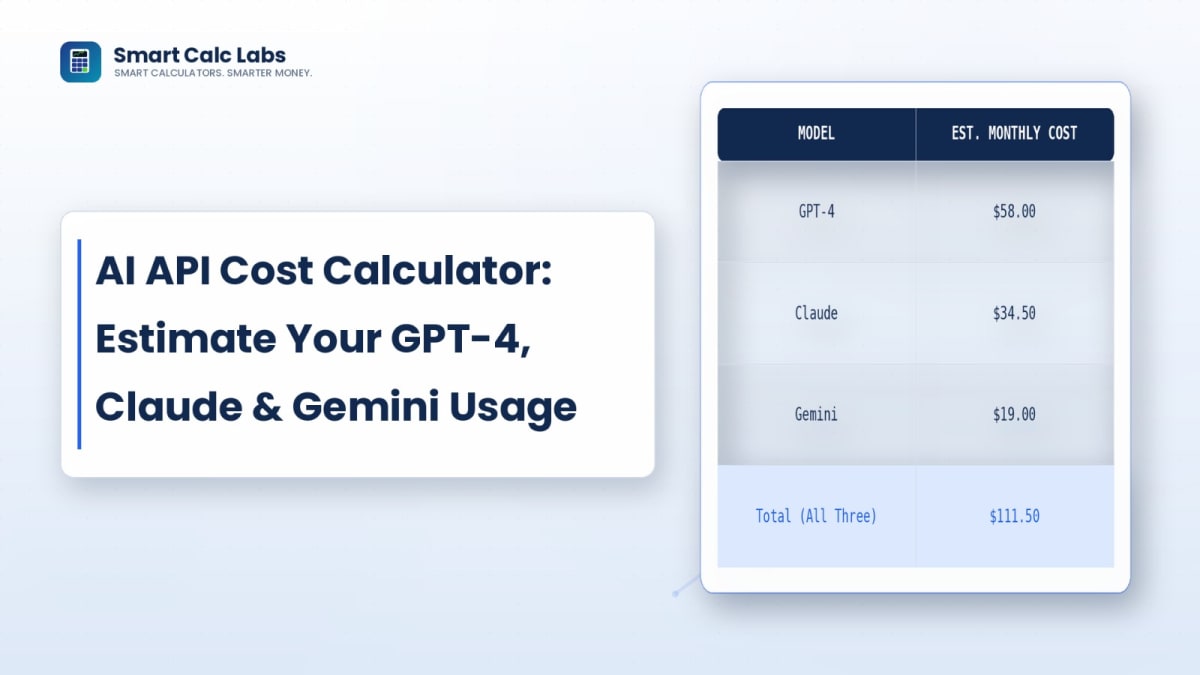
Whether you are budgeting unit economics for a high-growth SaaS startup, evaluating whether to replace personal $20/month AI subscriptions with developer keys, or engineering a production RAG pipeline, our interactive AI API Cost Calculator allows you to simulate exact token usage, model choices, prompt caching benefits, and batch processing discounts in real time.
How LLM API Pricing Works: Tokens, Input, and Output
Every commercial language model provider—including OpenAI, Anthropic, Google, and DeepSeek—bills based on tokens processed. In standard English, one token corresponds to approximately 4 characters or roughly 0.75 words. For instance, a 1,500-word blog post or technical article represents approximately 2,000 tokens.
However, all modern API providers split billing into two distinct counters:
- Input (Prompt) Tokens: What you send to the model. This includes your system prompt instructions, few-shot examples, retrieved external context (in RAG setups), and the cumulative multi-turn conversational history.
- Output (Completion) Tokens: What the neural network generates in response. Output tokens are priced 3× to 10× higher than input tokens across every major provider.
Why this massive price disparity? Processing input is highly parallelizable; GPUs can ingest thousands of prompt tokens simultaneously in a single forward pass. Generating output, however, is strictly autoregressive: the model must generate one token, feed it back into memory, recalculate internal self-attention across the whole sequence, and emit the subsequent token sequentially. This serial decoding consumes substantially more GPU memory bandwidth and computation.
Official 2026 AI API Pricing Comparison Snapshot
All prices below are standardized in USD per 1,000,000 (1M) tokens across official developer endpoints:
| Model Name | Provider | Tier | Input / 1M | Output / 1M | Cached Input / 1M |
|---|---|---|---|---|---|
| OpenAI GPT-4o | OpenAI | Workhorse | $2.50 | $10.00 | $1.25 (50% off) |
| OpenAI GPT-4o Mini | OpenAI | Budget | $0.15 | $0.60 | $0.075 (50% off) |
| OpenAI o3-mini | OpenAI | Reasoning | $1.10 | $4.40 | $0.55 (50% off) |
| Anthropic Claude 3.5 Sonnet | Anthropic | Workhorse | $3.00 | $15.00 | $0.30 (90% off) |
| Anthropic Claude 3.5 Haiku | Anthropic | Budget | $0.80 | $4.00 | $0.08 (90% off) |
| Google Gemini 2.0 Flash | Budget | $0.10 | $0.40 | $0.025 (75% off) | |
| DeepSeek-V3 | DeepSeek | Ultra-Budget | $0.14 | $0.28 | $0.014 (90% off) |
| DeepSeek-R1 | DeepSeek | Reasoning | $0.55 | $2.19 | $0.14 (75% off) |
The Mathematical Calculation Formula
To project your monthly expenditure accurately, use the standardized token formula implemented in our online AI API Cost Calculator:
Standard Request Cost = ((Input Tokens / 1,000,000) * Input Rate) + ((Output Tokens / 1,000,000) * Output Rate)
Monthly Spend = Standard Request Cost * Total Monthly Requests
When factoring in advanced developer discounts such as Prompt Caching and the Batch API, the adjusted formula becomes:
Uncached Input Cost = ((Input Tokens * (1 - Cache Rate)) / 1M) * Input Rate
Cached Input Cost   = ((Input Tokens * Cache Rate) / 1M) * Cached Rate
Total Per Request   = (Uncached Input Cost + Cached Input Cost + Output Cost) * (IsBatch ? 0.50 : 1.00)
Two Secret Weapons to Cut API Costs in Half: Caching & Batch Mode
1. Prompt Caching (Save up to 90% on Input)
In real-world applications, prompt tokens are rarely 100% unique. A customer support bot typically re-transmits the exact same 1,500-token system instruction, company policy, and brand voice guidelines on every single turn. A code reviewer sends the same repository guidelines. A document analyst re-submits the same 20-page PDF across multiple conversational follow-ups.
With Prompt Caching, the provider stores the KV-cache of your prompt prefix directly in GPU memory. When a new request arrives matching that exact prefix:
- Anthropic: Claude 3.5 Sonnet input drops from $3.00/1M to just $0.30/1M (90% savings).
- OpenAI: GPT-4o cached input drops from $2.50/1M to $1.25/1M (50% savings).
- DeepSeek: Cached tokens cost an incredible $0.014/1M.
2. The Batch API (Guaranteed 50% Off Everything)
If your workload does not require synchronous sub-second user responses (for example: daily news summarization, offline dataset classification, nightly compliance audits, bulk text vectorization, or model evaluation benches), you should never call the standard realtime REST endpoint.
Both OpenAI and Anthropic offer dedicated Batch endpoints that process your requests asynchronously within a 24-hour SLA in exchange for a guaranteed 50% flat discount on both input AND output tokens, as well as significantly higher rate limits.
Real-World Workload Case Studies
Case A: The AI Customer Support Agent
Workload: 30,000 conversations/month. Average payload contains 1,800 input tokens (system instructions + FAQ context + conversation history) and 350 generated output tokens.
- Running on GPT-4o: 54M input ($135.00) + 10.5M output ($105.00) = $240.00 / month.
- Running on GPT-4o Mini: 54M input ($8.10) + 10.5M output ($6.30) = $14.40 / month.
- Running on Gemini 2.0 Flash: 54M input ($5.40) + 10.5M output ($4.20) = $9.60 / month.
Takeaway: For structured customer support, deploying GPT-4o Mini or Gemini Flash saves over $2,700 per year while achieving faster response latency.
Case B: Document RAG Knowledge Extraction
Workload: 4,000 PDF documents processed per month. Each query ingests 10,000 input tokens of chunked document text and synthesizes a 1,000-token executive brief.
- Claude 3.5 Sonnet (Uncached): 40M in ($120.00) + 4M out ($60.00) = $180.00 / month.
- Claude 3.5 Sonnet (80% Prompt Caching): 8M uncached in ($24.00) + 32M cached in ($9.60) + 4M out ($60.00) = $93.60 / month (48% total bill reduction).
- DeepSeek-R1 (Reasoning): 40M in ($22.00) + 4M out ($8.76) = $30.76 / month.
API vs. $20/Month Subscriptions: Which is Cheaper for You?
A common dilemma for developers and power users is whether to keep paying $20/month for flat web subscriptions like ChatGPT Plus, Claude Pro, or Cursor, or instead connect an API key to an open-source client like LibreChat, TypingMind, or Open WebUI.
If you use AI primarily for writing assistance, light research, and occasional problem solving (averaging 5 to 15 queries daily), your total monthly API consumption will rarely exceed $2.50 to $6.00 per month on models like GPT-4o or Claude 3.5 Sonnet. That represents a 70% to 85% discount compared to a $20 flat subscription!
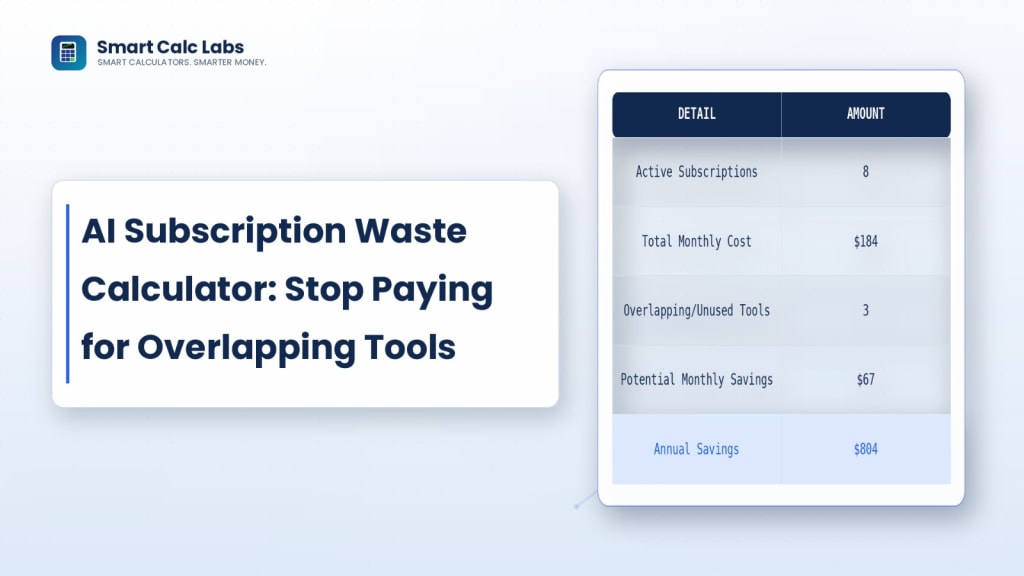
To check how much you might be overpaying across your active AI SaaS tools, test our companion tool: the AI Subscription Waste Calculator.
5 Architectural Best Practices to Prevent Runaway AI Invoices
- Model Routing & Cascading: Implement a classifier router (or tools like RouteLLM). Direct 80% of simple categorization, formatting, and intent-detection requests to budget models ($0.15/1M), and reserve expensive reasoning models only for coding, mathematics, or nuanced ambiguity.
- Set Hard Budget Caps: Configure both soft email notifications and hard automated cutoff limits in your OpenAI, Anthropic, and Google Cloud billing dashboards. Never deploy an API key to a public application without setting daily rate limits per IP address or user ID.
- Enforce Strict
max_tokensLimits: Because output tokens are up to 10× more expensive than input, unconstrained models generating verbose 2,000-token explanations for simple questions will quietly drain your budget. Cap max output tokens at conservative values appropriate for the task. - Prune Multi-Turn Chat Context: In chat interfaces, conversational context grows linearly. A 20-message dialogue re-submits thousands of historical tokens on every new prompt. Implement sliding-window truncation or periodically summarize earlier conversation turns into a brief 50-token memory block.
- Structure System Prompts for Cache Hits: Always organize your API message payloads with static text first (System guidelines, background documents) and dynamic text last (User query, timestamps). Changing a single word at the beginning of a prompt invalidates the entire cache prefix down the line.
Frequently Asked Questions
What is a token and how is it measured?
A token is a fragment of a word. In the English language, 1 token is roughly 4 characters or about 0.75 words. For example, 1,000 tokens translates to approximately 750 words. Code, foreign languages, and JSON syntax consume more tokens per character than standard English text.
Why are output tokens so much more expensive than input tokens?
Input processing runs in parallel across GPU cores in a single forward pass, whereas output generation is strictly sequential (autoregressive). The model must emit one token at a time, holding GPU memory active for the entire duration of the response generation, making it computationally more resource-intensive.
How does prompt caching work?
Prompt caching stores the pre-computed attention keys and values of common prompt prefixes in the provider's GPU memory. When subsequent API calls send the exact same prompt prefix, the provider skips recalculating the weights and passes savings of 50% to 90% directly to you.
What is the Batch API?
The Batch API allows you to submit asynchronous jobs that do not require immediate responses (such as bulk data categorization or overnight report generation). In exchange for a 24-hour completion window, providers grant a flat 50% discount on both input and output tokens.
Can I set spending alerts to prevent unexpected bills?
Yes. All major providers allow you to configure soft spending alerts that email you when thresholds are reached, as well as hard caps that automatically pause API requests until you explicitly approve additional funds.
Conclusion: Model Your Budget Before Deploying
AI pricing is transitioning from a commodity cost into a critical architectural design factor. By matching the right model tier to each specific task, enabling prompt caching, and batching background workloads, modern engineering teams can easily achieve 60% to 80% cost reductions while maintaining premium user satisfaction.
Ready to benchmark your exact pipeline? Enter your estimated input tokens, output tokens, and monthly volume into our free AI API Cost Calculator now to see an instant side-by-side comparison across OpenAI, Anthropic, Google, and DeepSeek.