Every time you ask ChatGPT to draft an email, request Claude 3.5 Sonnet to debug a complex script, or prompt Midjourney to render a digital painting, thousands of high-performance GPUs surge with electricity across hyperscale data centers. While interacting with artificial intelligence feels ephemeral and weightless, the physical infrastructure sustaining modern generative AI has a tangible environmental footprint measured in kilowatt-hours of electrical grid power, metric tons of carbon dioxide, and millions of gallons of evaporated cooling water.
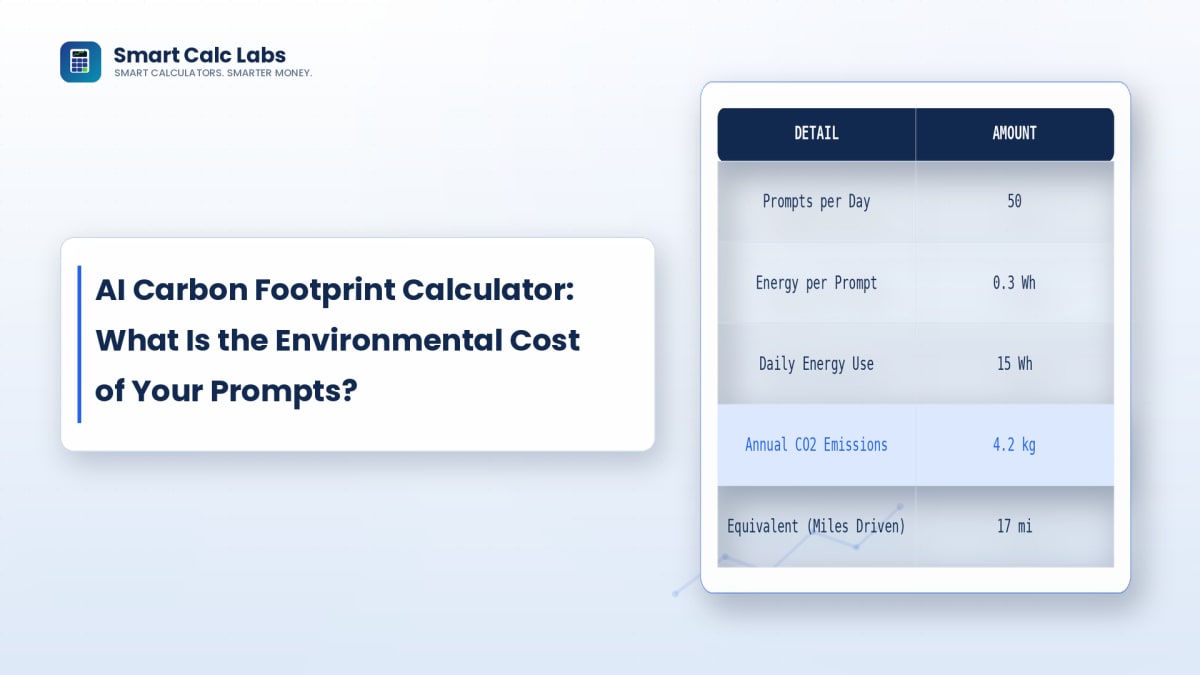
As AI adoption surges globally, measuring this environmental cost has shifted from an academic curiosity to an urgent sustainability imperative. Using our free, research-backed AI Carbon Footprint Calculator, developers, enterprise teams, and conscious individuals can instantly quantify the energy consumption, greenhouse gas emissions, and water depletion attributable to their specific AI workloads.
Why Does AI Consume So Much Energy? The Physics of Generative Compute
Unlike a traditional Google search—which retrieves pre-indexed web pages using lightweight database queries—generative AI models must dynamically construct entirely new content from scratch. When you submit a prompt, a neural network containing hundreds of billions (or trillions) of numerical weights performs billions of matrix multiplications across clustered Nvidia H100 or Blackwell GPUs.
This process breaks down into two distinct phases:
- Model Training (One-Time Cost): Training a frontier model like GPT-4 or Gemini 1.5 Pro requires thousands of GPUs running continuously for months. For example, researchers estimate that training GPT-4 emitted approximately 500 to 1,000 metric tons of CO₂ equivalent—comparable to the lifetime emissions of dozens of gasoline cars. However, this massive footprint is amortized across billions of lifetime user interactions.
- Inference (Continuous Operational Cost): Every prompt you submit is an "inference" pass. Because the global public generates billions of prompts daily, inference accounts for over 80% of an AI model's lifetime energy consumption. This is where your personal or enterprise daily footprint originates.
2026 Scientific Energy Benchmarks: How Much Power Does a Prompt Use?
In 2023 and 2024, early academic estimates varied wildly due to differences in testing boundaries. By 2026, peer-reviewed research by Sasha Luccioni (Hugging Face), Alex de Vries (Joule), and corporate disclosures from OpenAI and Google have converged on standardized per-query energy consumption ranges:
| Model Class | Representative Models | Energy / Query | Water Footprint | Everyday Equivalent |
|---|---|---|---|---|
| Distilled / Efficiency LLM | GPT-4o-mini, Gemini 2.0 Flash, Claude 3.5 Haiku | 0.15 – 0.35 Wh | 1.0 – 3.0 mL | 1–2 minutes of an LED bulb |
| Frontier Multi-Modal LLM | OpenAI GPT-4o, Claude 3.5 Sonnet | 1.00 – 2.00 Wh | 4.0 – 10.0 mL | 15% of a full smartphone charge |
| Deep Reasoning Models | OpenAI o1, o3-mini, DeepSeek-R1 | 12.00 – 30.00 Wh | 25.0 – 60.0 mL | 1 to 2 full smartphone charges |
| Diffusion Image Generation | Midjourney v6, DALL-E 3, FLUX.1 | 2.50 – 5.00 Wh | 15.0 – 30.0 mL | 30–40% of a smartphone charge |
| Generative AI Video (5 sec) | Runway Gen-3, Kling, OpenAI Sora | 50.00 – 120.00 Wh | 100.0 – 250.0 mL | Boiling 1–2 cups of water in a kettle |
The Explosive Footprint of "Reasoning" Models
The latest breakthrough in AI architectures—exemplified by OpenAI o1, o3-mini, and DeepSeek-R1—relies on "test-time compute." Instead of generating an immediate reply, the model engages in recursive chain-of-thought deliberation, generating thousands of hidden "thinking" tokens before emitting a single word of visible output. As a result, a single reasoning query can consume 15× to 50× more electrical power than a standard text prompt. Reserving reasoning modes exclusively for complex mathematical proofs, architecture designs, and nuanced code debugging is one of the most effective personal sustainability practices.
The Hidden Water Crisis: Why AI Servers Drink Millions of Gallons
While carbon emissions dominate headlines, AI data centers exert massive localized pressure on freshwater resources. High-density GPU racks generate intense heat. To prevent thermal throttling, hyperscale data centers utilize evaporative cooling towers, which spray water over air intakes to dissipate heat via evaporation.
Pioneering research conducted by Dr. Shaolei Ren and his team at the University of California, Riverside ("Making AI Less Thirsty") revealed that data centers consume water both directly and indirectly:
- Direct On-Site Evaporative Cooling: Water physically evaporated on data center roofs to cool chip clusters (~0.3 to 1.5 mL per prompt).
- Indirect Thermoelectric Generation: The off-site water consumed by regional fossil-fuel or nuclear power plants to generate the electricity driving the facility (~5 to 30 mL per query).
Combined, a prolonged 20-question conversational session with an unoptimized model can evaporate the equivalent of a 500 mL bottle of freshwater. In arid regions like Arizona or Utah, where massive data centers operate alongside residential communities, this water consumption creates acute municipal strain.
Regional Energy Grids: Why Location Determines 80% of Emissions
The carbon footprint of 1 kWh of electricity is not constant—it depends entirely on how the regional power grid produces that power. As modeled in our AI Carbon Footprint Calculator, grid carbon intensity spans a wide spectrum:
- 100% Renewable / Matched PPA Data Centers: ~40 g CO₂ / kWh (embodied infrastructure & standby power). Facilities located in the Nordics (hydro/geothermal) or paired with dedicated solar/wind contracts generate minimal operating emissions.
- European Union Average Grid: ~230 g CO₂ / kWh, driven by nuclear, wind, and strict carbon cap policies.
- United States Average Grid (EPA eGRID): ~385 g CO₂ / kWh, balancing a mix of natural gas, nuclear, coal, and renewables.
- Coal-Dominant Grids: ~700–800 g CO₂ / kWh. When an AI workload runs in a region heavily reliant on unmitigated coal power, the carbon emissions per query double compared to the US national average.
How to Calculate Your AI Carbon Footprint: The Mathematical Formula
Our calculator computes your annual environmental impact using the following formulas:
Daily Energy (Wh) = Daily Queries × Energy Per Query (Wh)
Annual Energy (kWh) = (Daily Energy × 365) / 1,000

Annual Carbon (kg CO₂e) = Annual Energy (kWh) × (Grid Carbon Intensity (g/kWh) / 1,000)
Annual Water (Liters) = (Daily Queries × 365 × Water Per Query (mL)) / 1,000
Relatable Equivalents:
- Smartphone Charges:
Annual Energy (Wh) / 12 Wh (typical phone battery) - Miles Driven in Gas Car:
Annual Carbon (g CO₂) / 400 g (EPA average per mile) - Tree Seedlings Needed:
Annual Carbon (kg CO₂) / 21.7 kg (carbon sequestered per tree/year)
6 Practical Strategies to Slash Your AI Carbon Footprint
- Right-Size Your Models (Avoid Over-Computation): Do not use GPT-4o or Claude 3.5 Sonnet for spellchecking, simple text extraction, or basic summaries. Distilled models like GPT-4o-mini and Gemini 2.0 Flash consume 85% less energy and provide virtually identical performance on straightforward tasks.
- Turn Off Reasoning Mode for Routine Inquiries: Treat reasoning models (o1, DeepSeek-R1) like heavy machinery. Only engage them when solving complex logic, math, or advanced engineering problems.
- Write Specific, Constrained Prompts: Vague prompts trigger multi-turn clarification conversations and verbose output completions. Clear, constrained prompts achieve the desired result on the first attempt, saving both GPU cycles and API budget.
- Run Quantized Models Locally: If you own a modern laptop with an Apple M-series chip or dedicated GPU, running open-source models (e.g. Llama 3 8B or Mistral 7B via Ollama) draws only 15 to 30 Watts directly from your home outlet, avoiding transmission losses and hyperscale evaporative cooling.
- Prune Context Windows & Cache Prompts: In chat interfaces, long histories re-submit thousands of tokens. Using prompt caching and keeping chat threads focused prevents repetitive GPU re-evaluations.
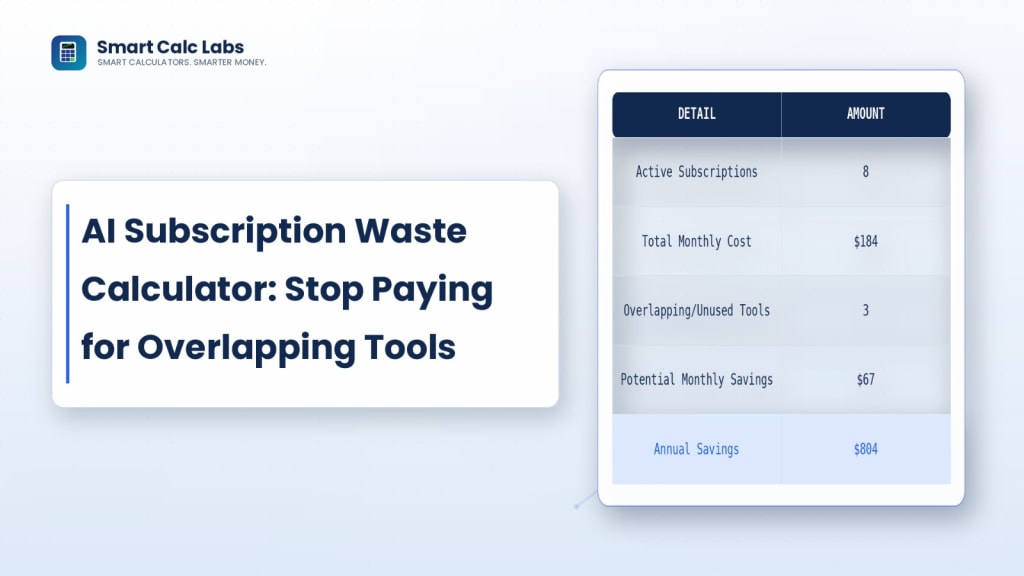
- Track Unit Economics and Subscription Waste: If you subscribe to multiple AI services you rarely use, you may also be wasting money. Audit your subscriptions with our companion AI Subscription Waste Calculator and optimize developer API costs with the AI API Cost Calculator.
Frequently Asked Questions
Does a single ChatGPT query really use a bottle of water?
Direct evaporative cooling on data center servers consumes roughly 0.5 to 2.0 mL per standard query. However, when you include the indirect water consumed by thermoelectric power plants to generate the electricity supplying the data center, the total lifecycle water withdrawal across a typical 20–30 prompt conversation equals roughly one 500 mL bottle of water.
Is generating an AI image worse for the environment than text?
Yes. Text models predict tokens sequentially, whereas diffusion image models (like Midjourney or DALL-E) start with pure static noise and run dozens of complex mathematical de-noising steps across millions of pixels simultaneously. Generating one high-resolution image consumes roughly the same energy as 15 to 25 standard text queries.
Why are tech giants' emissions rising despite clean energy goals?
Companies like Google and Microsoft have ambitious "Net Zero Carbon by 2030" commitments, yet their recent sustainability disclosures show greenhouse emissions rising 30% to 50% over baseline. This surge is directly driven by the explosive build-out of multi-gigawatt AI data centers, which require continuous, non-intermittent baseline power often supplied by natural gas.
Can AI have a net-positive environmental impact?
Yes, if deployed intentionally. When AI algorithms optimize global supply chain logistics, discover novel materials for perovskite solar cells, or improve smart electrical grid management, the carbon emissions prevented can vastly exceed the computational footprint of the models themselves.
Conclusion: Empowering Sustainable AI Adoption
Artificial intelligence is one of humanity's most transformative computational tools, but it is physically tethered to our electrical grids and water sheds. By understanding per-query energy consumption and adopting conscious usage habits, developers and consumers can harness generative AI responsibly without unnecessary environmental waste.
Calculate your annual impact now using our interactive AI Carbon Footprint Calculator, and benchmark your numbers against sustainable best practices.