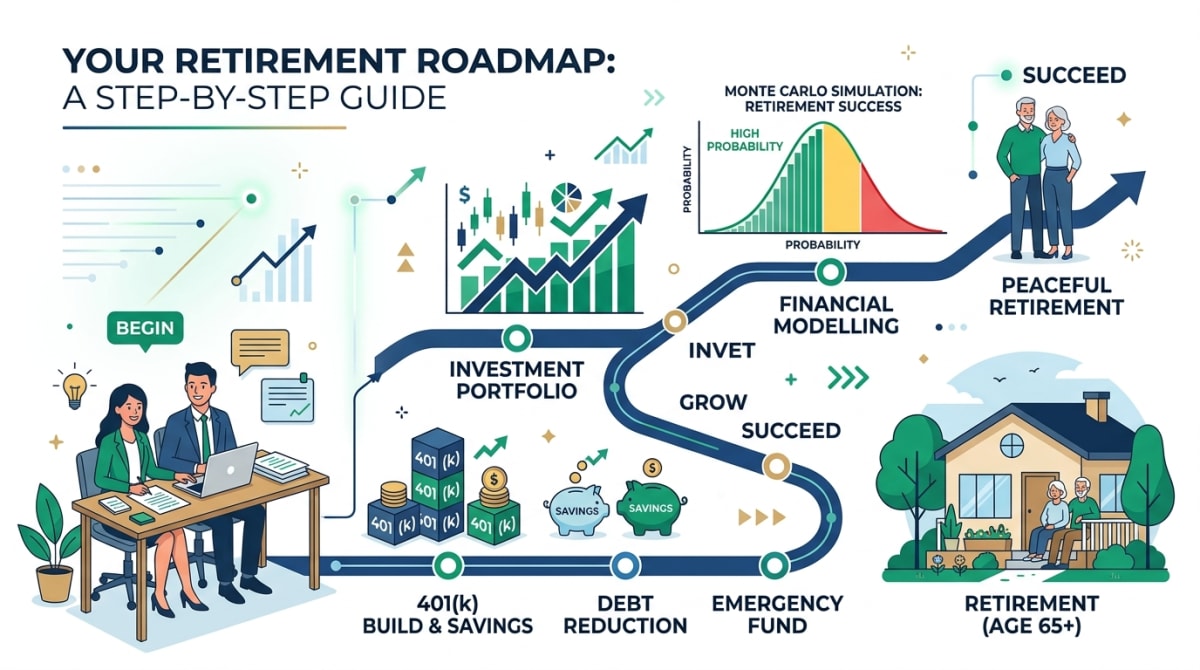
For many working adults, the phrase "retirement planning" conjures up intimidating spreadsheets, dense Wall Street jargon, and an underlying sense of anxiety. It is easy to assume that preparing for the future requires an economics degree or a seven-figure inheritance. In truth, sound personal financial planning for retirement is simply the disciplined process of deciding what kind of life you want to live in the future—and building a reliable, automated cash flow engine to fund that vision.
Whether you are in your twenties opening your very first workplace retirement account, navigating your peak earning years, or seeking near retirement financial planning to finalize your exit date, having a structured roadmap makes all the difference. Understanding the foundational mechanics of retirement and financial planning allows you to replace uncertainty with compound interest. In this comprehensive beginner's guide, we break down essential concepts—from workplace tax shelters and stochastic stress testing to post-retirement distribution sequencing—so you can build the best financial plan for retirement with clarity and confidence.
At its essence, defined financial planning is the deliberate bridge between your current net cash flow and your future freedom. It is not about timing the stock market or picking hot individual stocks. Real wealth creation is built on three steady levers: maximizing the spread between your income and expenses, harnessing automatic compound growth in tax-advantaged accounts, and protecting your downside against longevity risk, inflation, and healthcare emergencies.
Phase 1: Establishing Your Financial Baseline
Before deciding where you want to go, you must have an uncompromisingly honest view of where you currently stand. Every credible retirement financial planner starts by assessing two foundational metrics:
1. Calculating Your True Net Worth
Your net worth is the single most accurate scoreboard in personal finance. It is calculated by taking everything you own (assets: liquid savings, retirement accounts, taxable investments, home equity) and subtracting everything you owe (liabilities: mortgages, auto loans, student debt, credit card balances). Tracking this metric quarterly reveals whether your savings efforts are actually compounding your wealth or being offset by creeping consumer debt.
2. The Essential Spending Baseline
Rather than attempting to forecast what inflation will look like in thirty years, begin with today's real living expenses. Categorize your monthly budget into "essential survival needs" (housing, groceries, utilities, basic transportation, healthcare) and "discretionary lifestyle wants" (travel, dining, recreation). Under the popular retire ready financial planning framework, your target is ensuring your guaranteed income sources will cover 100% of your essential survival costs, freeing your investment portfolio to fund your lifestyle wants.
Phase 2: Mastering Workplace Retirement Vehicles & Tax Shelters
For the vast majority of working households, employer-sponsored retirement plans form the backbone of lifetime wealth accumulation. Navigating these accounts effectively is the cornerstone of financial planning for employees.
1. The Mechanics of Financial Planning 401k Plans
In the United States, a 401(k) is an employer-sponsored defined-contribution plan that allows workers to save and invest a portion of their paycheck before taxes are taken out. Working with a knowledgeable 401k financial planner ensures you understand the core mechanics:
- • The Employer Match (Instant 100% Return): Many employers match employee contributions up to a certain threshold (e.g., dollar-for-dollar up to 4% or 50 cents on the dollar up to 6%). Failing to contribute enough to capture the full employer match is literally leaving free compensation on the table.
- • 2026 Statutory Limits: For 2026, the employee elective deferral limit is $24,500. Workers aged 50 and older can make standard catch-up contributions of $8,000 (totaling $32,500), while under SECURE 2.0, individuals aged 60 to 63 benefit from an enhanced catch-up threshold of $11,250 (totaling $35,750).
- • Traditional vs. Roth 401(k): Contributions to a Traditional 401(k) reduce your taxable income in the current year, but withdrawals in retirement are taxed as ordinary income. In contrast, Roth 401(k) contributions are made with after-tax dollars; qualified withdrawals in retirement are 100% tax-free.
2. International Models: Financial Planning Superannuation
For savers in countries like Australia or multinational employees, financial planning superannuation operates on a mandatory institutional savings model. Under the Super Guarantee (SG), employers are legally obligated to deposit a statutory percentage of gross wages into a designated super fund. These funds compound in a low-tax environment (typically 15% on investment earnings) and can be accessed tax-free once reaching your preservation age (between 55 and 60 depending on birth year) and meeting a condition of release. Understanding how international superannuation coordinates with domestic accounts is vital for global citizens.
Phase 3: Investment Financial Planning & Asset Allocation
Saving money in cash is guaranteed wealth destruction over decades due to inflation. To grow purchasing power, you must engage in deliberate investment financial planning.
1. Equities vs. Fixed Income (Stocks vs. Bonds)
Equities (stocks) represent ownership in productive businesses and provide long-term capital appreciation that historically outpaces inflation. Fixed income (bonds, Treasury bills) represents loans to governments or corporations, providing predictable interest income and damping portfolio volatility during market panics. Your asset allocation—how much you hold in stocks versus bonds—is the single greatest determinant of your long-term returns and volatility.
2. Broad-Market Indexing vs. Active Speculation
Decades of empirical financial research demonstrate that over 90% of actively managed mutual funds fail to beat low-cost broad-market index funds over a 15-year period after accounting for fees and taxes. Adopting a low-cost, globally diversified index fund strategy (such as a total stock market fund paired with a total bond market index) eliminates individual company risk while drastically cutting annual management expenses.
3. The Power of Target-Date Funds
If managing your own portfolio feels overwhelming, Target-Date Funds (TDFs) offer an elegant, single-fund solution. You select a fund with a year close to your anticipated retirement (e.g., Target Retirement 2055). The fund begins heavily invested in growth equities when you are young and automatically "glides" toward conservative bonds and cash as your retirement date approaches, making it an ideal choice for retire easy financial planning.
Phase 4: Advanced Modeling with Monte Carlo Financial Planning
Traditional retirement calculators often rely on a dangerous flaw: they assume a steady, unvarying rate of return (such as 7% every single year). In the real world, financial markets are volatile and unpredictable. A portfolio that averages 7% over thirty years can still run out of money prematurely if severe bear markets strike in the first few years of retirement—a catastrophic phenomenon known as sequence of returns risk.
Modern retirement financial planning tools solve this dilemma through monte carlo financial planning. A Monte Carlo simulation models thousands of randomized potential market futures using historical return distributions, inflation spikes, and economic shocks.
| Probability of Success Score | Portfolio Health Assessment | Recommended Planning Action |
|---|---|---|
| Below 70% | High Risk of Capital Exhaustion | Increase annual savings, delay retirement by 1–3 years, or trim discretionary spending baseline. |
| 70% to 84% | Acceptable with Dynamic Guardrails | Adopt flexible withdrawal rules (e.g., Guyton-Klinger) to trim spending during severe market downturns. |
| 85% to 95% | Optimal Resilient Target Zone | Ideal balance between spending peace of mind and preserving wealth across multi-decade horizons. |
| Above 95% | Over-Saved / Under-Spending Risk | Retiree is sacrificing present quality of life; capacity exists for higher lifetime gifting or earlier retirement. |
Rather than seeking a 100% mathematical certainty—which often requires extreme over-saving—experienced financial planning specialists target an 85% to 90% probability of success, pairing the plan with dynamic annual adjustments.
Two investors can experience the exact same 6% average annual return over a decade, yet one can double their money while the other goes broke. If an investor is actively withdrawing living expenses during consecutive years of -15% market losses, those liquidated shares are gone forever and cannot participate in subsequent rebounds. This is why financial planning during retirement focuses heavily on cash buffers and withdrawal guardrails rather than mere average historical returns.
Calculate Your Retirement Feasibility in Seconds
Test your numbers with our private, client-side financial engines. Model your household budget, audit your net worth, forecast passive dividend income, and calculate inflation impacts without creating an account or exposing personal data.
Phase 5: Financial Planning After Retirement: The Decumulation Playbook
Saving for retirement is like climbing a mountain; decumulation—spending down your nest egg—is navigating the descent. Comprehensive financial planning after retirement requires shifting focus toward distribution mechanics:
1. Designing the "Retirement Paycheck"
When regular corporate paychecks stop, retirees must manufacture their own monthly income stream. This is achieved by aggregating guaranteed foundation checks (Social Security, pensions, immediate annuities) and bridging any remaining spending gap through systematic, tax-efficient portfolio distributions.
2. The Three-Tier Tax Sequencing Strategy
Savvy retirees do not withdraw funds at random. They coordinate their three tax buckets—Tax-Deferred (Traditional 401(k)/IRA), Tax-Free (Roth IRA/401(k)), and Taxable (brokerage accounts)—to maintain control over their annual taxable bracket. For instance, withdrawing just enough from traditional IRAs to fill lower 10% and 12% brackets, while utilizing Roth withdrawals to cover larger capital expenses, prevents triggering steep Medicare IRMAA surcharges or Social Security tax thresholds.
3. Old Age Financial Planning & Healthcare Reserves
A responsible strategy for old age financial planning anticipates late-life healthcare realities. Medicare does not cover non-skilled custodial long-term care (assistance with dressing, eating, or bathing). Ensuring you have dedicated liquid emergency reserves, Health Savings Account (HSA) balances, or hybrid long-term care policies protects your family and legacy from being depleted by extended assisted living expenses.
Phase 6: DIY vs. Hiring a Specialist: Navigating Your Planning Options
As you explore your financial planning options, one of the first strategic choices is whether to manage your finances independently or hire a licensed professional.
1. When Self-Service and Free Tools Suffice
For individuals with clean, straightforward financial lives (e.g., standard W-2 salaries, routine 401(k) indexing, debt-free homeownership, and no complex business holdings), utilizing reputable consumer resources like aarp financial planning calculators and SmartCalcLabs tools provides ample analytical power to achieve your targets without paying ongoing advisory fees.
2. When to Hire a Retirement Financial Planner Specialist
Conversely, seeking professional financial planning consulting or hiring a dedicated financial planner retirement specialist becomes invaluable when facing multifaceted complexities:
- • Coordinating complex defined-benefit pension buyouts or lump-sum rollover elections.
- • Executing multi-year partial Roth conversion ladders across shifting federal tax brackets.
- • Managing business exits, commercial real estate sales, or concentrated company stock options.
- • Establishing generational estate structures, trusts, and special needs beneficiary planning.
3. How to Find the Best Financial Planners for Retirement
If you decide to search for a retirement financial planner near me, retirement financial planners near me, or the top financial planning retirement near me, avoid commissioned salespeople who sell proprietary insurance products. Instead, look for:
-
✓
Strict 100% Fee-Only Fiduciary Commitment: A true fiduciary must legally put your best financial interests first at all times. Search for professionals affiliated with the National Association of Personal Financial Advisors (NAPFA) or the Garrett Planning Network for independent financial planning retirement advice.
-
✓
Specialized Gold-Standard Credentials: Look for a retirement planning financial planner holding the Certified Financial Planner (CFP®), Retirement Income Certified Professional (RICP®), or Chartered Financial Analyst (CFA) designations. A qualified financial planner investment and retirement planning expert provides transparent, fee-for-service or hourly financial planning consulting services.
-
✓
Comprehensive Wealth Architecture: The best financial planning retirement near me or nationwide should not be limited to picking mutual funds. Demand holistic plans integrating tax mitigation, healthcare costs, debt amortization, and estate succession to achieve true retire wealthy financial planning.
Frequently Asked Questions (FAQs)
How much money should a beginner save for retirement each month?
A widely accepted industry standard is aiming to save 15% of your gross annual income toward retirement (including any employer matching contributions). If saving 15% is not feasible immediately, start with whatever captures your full employer 401(k) match, and systematically increase your contribution rate by 1% each year as you receive salary raises.
What is the difference between a financial planner and a financial advisor?
While the terms are often used interchangeably in marketing, a "financial advisor" is a broad term that can encompass stockbrokers, insurance agents, and bankers. A Certified Financial Planner (CFP®) or fiduciary financial planner specializes in comprehensive, holistic planning—integrating budgeting, tax strategy, insurance protection, retirement cash flow, and estate planning under a legal fiduciary duty.
Should I pay off my mortgage before retiring?
Entering retirement without a primary mortgage significantly reduces your monthly living expenses, which lowers the required portfolio withdrawal rate and sequence of returns risk. However, if you locked in a historically low fixed interest rate (e.g., 2.5% to 3.5%), you may generate higher after-tax returns by holding guaranteed Treasury bills or diversified index funds rather than rushing to prepay low-cost debt.
What is a Monte Carlo simulation and why is it superior to linear spreadsheets?
A linear spreadsheet assumes your investments grow at a constant rate (e.g., 7% every year). A Monte Carlo simulation tests your portfolio against thousands of realistic market sequences—including early severe crashes, high inflation years, and extended flat periods—to calculate your true probability of not exhausting your savings over 30 to 40 years.
How does superannuation differ from a 401(k)?
A 401(k) is an optional, employer-sponsored system in the United States where employees choose whether to participate and how much to defer. Superannuation is Australia’s universal, mandatory system where employers are legally mandated to pay a set percentage of an employee's salary into a superannuation fund, taxed concessional at 15% during accumulation.
When should I start planning for retirement?
The best time to start was on your very first working paycheck due to the compounding value of time. The second best time is today. Even individuals entering their 50s can build substantial financial resilience through accelerated catch-up contributions, debt elimination, and strategic Social Security optimization.
Conclusion: Start Building Your Financial Freedom Today
Retirement financial planning is not a one-time transaction or a stressful arithmetic test. It is an evolving, empowering roadmap that translates the hard work of your career into lasting personal freedom, security, and peace of mind. By establishing your baseline net worth, maximizing workplace tax shelters, stress-testing your assumptions, and seeking independent fiduciary advice when necessary, you take complete control of your financial destiny.
Whether your dream is to retire early, travel the globe, or simply enjoy financial security in your community, the path begins with one deliberate step.
Empower your journey with our private, free financial calculators on SmartCalcLabs Calculators. Structure your monthly cash flow with our 50/30/20 Budget Planner, audit your total assets with the Net Worth Calculator, estimate future required distributions using the RMD Estimator, and visualize the impact of inflation over time with the Inflation Impact Tool.