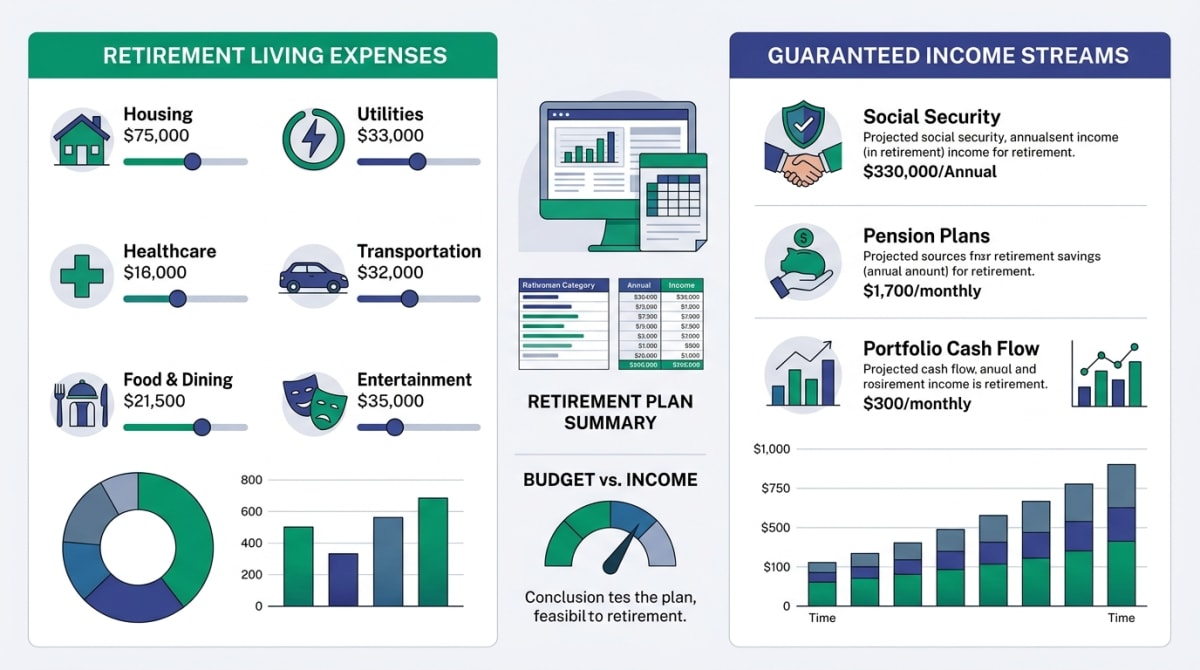
Ask three different retirees how much money you need to retire comfortably, and you will receive three completely contradictory answers. One will insist that you cannot survive without $2 million; another will claim they live happily on Social Security and a modest nest egg; and a third will tell you that the number does not matter at all compared to your monthly cash flow. The truth is that there is no universal "magic number." What dictates a secure, worry-free retirement is not a round portfolio balance, but the deliberate alignment of your day-to-day spending with a resilient, tax-optimized income engine.
Transitioning from the accumulation phase—where your primary financial task was consistently saving and investing—to the decumulation phase requires an entirely different psychological and analytical framework. Utilizing a dedicated retirement budget planner alongside an integrated retirement income planner allows you to replace anxiety-inducing guesswork with mathematical clarity. By deconstructing your future expenses, categorizing your income sources, and understanding the natural phases of retirement spending, you can determine exactly how much you really need to fund the lifestyle you envision.
A $1.5 million portfolio cannot support an uncalibrated $120,000 annual lifestyle during a prolonged market downturn. Conversely, an $800,000 portfolio combined with guaranteed Social Security and pension income can comfortably sustain an $85,000 lifestyle for thirty-five years. True retirement readiness is not measured solely by your gross net worth, but by how reliably your guaranteed income floor covers your non-negotiable living costs.
How Much Do You Really Need? Benchmarks vs. Real-World Math
When people begin planning for retirement, they inevitably encounter industry rules of thumb. While these benchmarks provide useful rough sketches during your early thirties or forties, relying on them as you approach your final five to ten years of work can lead to severe miscalculations. Let us examine the three most common frameworks and where their assumptions break down.
1. The 70% to 80% Income Replacement Benchmark
The traditional rule of thumb suggests that retirees need approximately 70% to 80% of their gross pre-retirement annual income to preserve their existing standard of living. The reasoning sounds logical on the surface:
- • You no longer contribute 10% to 15% of your pay to a 401(k), 403(b), or IRA.
- • You no longer pay FICA payroll taxes (6.2% Social Security and 1.45% Medicare on wage earnings).
- • Work-related expenses—such as commuting, professional wardrobes, dining out for business lunches, and professional memberships—vanish.
- • Many retirees have paid off their primary 30-year home mortgages by the time they retire.
However, this rule assumes a linear relationship between earnings and expenditures. If a household earns $350,000 per year in a high-cost-of-living metro, lives frugally, and saves 40% of its income, it does not need 80% ($280,000) in retirement. Conversely, a household earning $70,000 that routinely spends 100% of its paycheck may struggle significantly if forced to live on 70% ($49,000), particularly as out-of-pocket healthcare expenses accelerate.
2. The 25x Rule and the Trinity 4% Safe Withdrawal Rate
Pioneered by financial planner William Bengen in 1994 and further validated by the Trinity University study, the 4% rule states that a retiree with a diversified portfolio of 50% to 60% equities and 40% to 50% bonds can withdraw 4% of their initial balance in year one of retirement, adjust that dollar amount annually for inflation, and have an extraordinarily high probability of not running out of money over a 30-year horizon.
For example, if your baseline retirement budget requires $80,000 per year, and Social Security provides $35,000, your portfolio must bridge a $45,000 annual shortfall. Multiplying $45,000 by 25 yields a target nest egg of $1,125,000. While the 25x rule provides a practical anchor, it assumes a static, mechanical spending pattern that rarely reflects how actual human retirees spend money over thirty years.
The Architecture of a Realistic Retirement Budget
A reliable financial plan begins with a granular, bottom-up spending blueprint. Acting as your own retirement expense planner requires moving beyond vague generalities and categorizing every dollar into distinct tiers of necessity and flexibility.
1. Essential Non-Negotiable Expenses (The "Floor")
These are the nondiscretionary costs required to sustain your health, safety, and shelter regardless of economic conditions: housing (property taxes, homeowner’s insurance, HOA fees, maintenance), essential groceries, baseline utilities (electricity, water, gas, home heating, basic broadband), automotive and transportation costs, Medicare Part B and Part D premiums, supplemental Medigap or Medicare Advantage policies, out-of-pocket co-pays, and income taxes.
2. Discretionary Lifestyle Expenses (The "Upside")
These expenditures reflect what makes retirement enjoyable and fulfilling: travel and vacations, fine dining, recreation, golf and hobby club memberships, cultural events, technology upgrades, home renovations, and gifting to children or grandchildren. These line items can be throttled back or expanded dynamically based on market performance.
3. Unexpected Capital & Longevity Reserves (The "Shocks")
Retirees frequently fail to budget for episodic lump-sum expenses. Replacing a residential roof ($12,000–$25,000), purchasing a replacement vehicle, handling unexpected dental implants or major medical procedures, or financing late-life assisted living and home health care services must be insulated in separate reserves rather than siphoned haphazardly from monthly operating cash flow.
The Retirement Spending Smile: The Three Phases of Decumulation
One of the most persistent errors in conventional retirement modeling is assuming that expenditures rise smoothly with inflation in a straight line from age 65 to 95. In reality, empirical data analyzed by retirement researcher David Blanchett of Morningstar reveals that retiree spending follows a U-shaped curve often called the Retirement Spending Smile. A modern retirement spending planner accounts for three distinct behavioral and physiological phases:
| Retirement Phase | Typical Age Range | Primary Expense Drivers | Spending Trajectory vs. Year 1 |
|---|---|---|---|
| The "Go-Go" Years | Ages 60 to 72 | Extensive international travel, hobbies, active recreation, home improvements | 100% to 115% (Peak discretionary spending) |
| The "Slow-Go" Years | Ages 73 to 82 | Shorter domestic trips, simplified hobbies, home-centered leisure, dining out less | 75% to 85% (Real spending declines below inflation) |
| The "No-Go" Years | Ages 83+ | Prescription medications, home health aides, memory care, assisted living | 85% to 120%+ (Discretionary spending drops to zero; healthcare surges) |
Failing to account for this lifecycle can lead to two opposing tragedies: underspending during your healthiest, most vibrant "go-go" decade out of fear of running out of money, or suffering a catastrophic liquidity crisis in your eighties because late-life custodial care was left out of the equation.
According to the annual Fidelity Retiree Health Care Cost Estimate, an average 65-year-old retired couple will need approximately $165,000 to $175,000 in after-tax savings just to cover out-of-pocket medical expenses throughout retirement—excluding nursing home or long-term custodial care. Traditional Medicare does not cover custodial long-term care (assistance with eating, bathing, or dressing). Preparing for this requires a deliberate combination of Health Savings Accounts (HSAs), dedicated liquid reserves, or specialized long-term care insurance strategies.
Pressure-Test Your Retirement Numbers Privately
Before making irreversible decisions about claiming Social Security, drawing down your accounts, or reshaping your lifestyle, run your actual figures through our secure, client-side calculators. No account registration required, and no private financial data is ever collected or tracked.
Building Your Cash Flow Architecture: The Four Income Buckets
In retirement, you cannot pay your monthly property tax or grocery bill with unrealized capital gains. You need a reliable, predictable monthly "paycheck." A skilled retirement cash flow planner constructs this paycheck by harmonizing four distinct financial layers:
1. Guaranteed Inflation-Protected Foundation
The most resilient retirement strategies ensure that 100% of essential non-negotiable living expenses are covered by guaranteed lifetime income streams that do not depend on the stock market. This foundation includes Social Security benefits (with their annual Cost-of-Living Adjustments) and traditional defined-benefit corporate or municipal pensions. Coordinating your pension income planning with your Social Security claiming date ensures you do not inadvertently trigger unnecessary taxation or permanently reduce your surviving spouse's safety net.
2. The Cash Flow Buffer (1 to 3 Years of Liquidity)
The biggest mathematical threat to a recent retiree is sequence of returns risk—the danger of experiencing a severe market downturn in the first three to five years of retirement. If you are forced to liquidate equities during a 25% bear market to generate spending cash, those losses become permanent, permanently crippling your portfolio’s longevity. Maintaining one to three years of projected net portfolio withdrawals in high-yield savings, short-term Treasury bills, or money market funds creates a volatility buffer, enabling you to pause portfolio sales until markets recover.
3. Systematic Portfolio Withdrawals
Your investment accounts (Traditional IRAs, 401(k)s, Roth IRAs, and taxable brokerage accounts) fund the gap between your guaranteed income and your total spending. Rather than taking rigid, static distributions, modern financial planning favors dynamic withdrawal guardrails (such as the Guyton-Klinger rules), where distributions are modestly trimmed in bad market years and rewarded in boom years.
4. Pension & Annuity Integration
If your guaranteed pension and Social Security fall short of covering your nondiscretionary expense baseline, utilizing a pension budget planner helps determine whether purchasing a simple Single Premium Immediate Annuity (SPIA) or fixed index annuity makes sense to lock in an additional guaranteed income floor for life.
Digital Tools vs. Human Expertise: Navigating Your Planning Path
Today’s prospective retirees have unprecedented access to sophisticated digital software. Modern retirement income planning tools can model thousands of Monte Carlo trials, simulate historical stress tests (such as the 1929 Great Depression, 1970s stagflation, or the 2008 Great Financial Crisis), and track changing tax brackets.
However, there is a fundamental distinction between running a digital simulation and implementing an integrated lifetime financial strategy. While online calculators excel at aggregate probabilities, they cannot evaluate personal nuances such as family health histories, estate dynamics, emotional risk tolerance during steep market declines, or the complex interplay of state-specific pension exclusions.
When Digital Self-Service Tools Are Sufficient
If you have straightforward finances (e.g., standard 401(k) balances, no pension complexities, debt-free homeownership, and basic Social Security claiming questions), self-directed retirement income planning tools and interactive calculators are more than adequate to map out a clear, actionable savings and withdrawal trajectory.
When to Hire a Retirement Income Planning Specialist
Engaging an experienced retirement income planning specialist or certified retirement income financial planner becomes invaluable when your financial picture involves multidimensional coordination:
- • Pension Lump-Sum vs. Annuity Decisions: Evaluating the internal rate of return, corporate pension stability, and spousal survivor benefits when your employer offers an irrevocable buyout.
- • Multi-Year Roth Conversion Optimization: Strategically executing partial Roth conversions during your lower-income years before RMDs and Social Security push you into punitive tax brackets.
- • Medicare IRMAA & Social Security Tax Torpedo Mitigation: Preventing unexpected ordinary income spikes from triggering steep Medicare Part B/D surcharges two years down the road.
- • Blended Family & Estate Sequencing: Ensuring non-spousal beneficiaries of inherited IRAs navigate the SECURE Act’s strict 10-year liquidation rule without suffering confiscatory tax rates.
When vetting professional retirement income advisors, always demand a strictly fee-only fiduciary commitment (such as professionals carrying the Certified Financial Planner [CFP®], Retirement Income Certified Professional [RICP®], or Retirement Management Advisor [RMA®] credentials). Avoid commissioned salespeople who rebrand themselves as planners simply to steer your life savings into expensive, illiquid insurance vehicles.
Frequently Asked Questions (FAQs)
Is the 4% withdrawal rule still safe for retirees today?
The 4% rule remains a resilient historical benchmark for a 30-year retirement backed by a balanced stock/bond portfolio. However, many modern financial economists suggest adopting a flexible range between 3.3% and 4.2% depending on market valuations, current bond yields, and your personal willingness to trim discretionary spending during severe market downturns (known as dynamic guardrail withdrawals).
What is the difference between a retirement budget planner and a retirement income planner?
A retirement budget planner focuses primarily on outflows: categorizing essential versus discretionary expenditures, adjusting for inflation, and modeling healthcare or lifestyle shifts across retirement. A retirement income planner focuses on inflows: determining how to orchestrate Social Security, pensions, 401(k) withdrawals, Roth conversions, and taxable dividends to generate the monthly paycheck required to fund that budget tax-efficiently.
How do I budget for healthcare before I become eligible for Medicare at 65?
If you retire before age 65, bridge options include COBRA continuation coverage (typically available for up to 18 months), purchasing an individual policy through the Affordable Care Act (ACA) marketplace, joining a spouse’s employer plan, or using part-time consulting to access group benefits. If relying on the ACA exchange, carefully managing your taxable income can qualify your household for substantial premium tax credits.
Should I take a pension lump sum or the lifetime monthly annuity?
The answer depends on your health, family longevity, your spouse's need for survivor income, and current interest rates (lump-sum values decrease as interest rates rise). A monthly annuity provides longevity insurance and eliminates sequence of returns risk, whereas a lump sum rolled over into an IRA provides greater investment control, inflation upside, and legacy transfer potential for heirs.
What is the "tax torpedo" in retirement income planning?
The tax torpedo refers to the non-linear taxation of Social Security benefits. As your provisional income crosses federal thresholds ($25,000 for single filers; $32,000 for married couples), each additional dollar of traditional IRA withdrawal can cause up to 85 cents of your Social Security to become taxable. This effectively pushes retirees into a marginal tax bracket significantly higher than their statutory federal bracket.
How much cash should I keep in an emergency fund once I retire?
While working individuals typically keep three to six months of expenses in an emergency fund, retirees should aim for one to three years’ worth of net portfolio withdrawals in stable cash equivalents (high-yield savings, short-duration Treasury bills, or money market funds). This ensures that you never have to sell depressed equity holdings to pay for everyday living expenses during a market crash.
Conclusion: Turn Your Retirement Dream Into a Concrete Cash Flow Plan
Retirement peace of mind is never the product of luck or arbitrary portfolio targets. It is the natural outcome of matching your personal lifestyle expectations with a disciplined, tax-smart, and resilient cash flow architecture. By replacing vague rules of thumb with a structured spending model, protecting your essential expenses with a dependable income floor, and remaining flexible through the changing seasons of retirement, you can spend with confidence throughout every decade of your future.
Whether you plan to model your own strategy using modern digital software or engage a specialized retirement income financial planner to optimize your distributions, the time to begin stress-testing your numbers is today.
Take control of your financial future using the free, private financial calculators on SmartCalcLabs Calculators. Map your monthly expenses with our 50/30/20 Budget Planner, audit your complete household balance sheet with the Net Worth Calculator, estimate future passive cash flow with the Dividend Income Calculator, and model the purchasing power erosion of your fixed savings with our Inflation Impact Tool.