"3 to 6 months of expenses" is the advice everyone repeats, but it's a range wide enough to be almost useless — for some people 3 months is plenty, for others even 6 isn't enough. The right number depends on how stable your income actually is, not a rule of thumb. Here's how to land on a figure that fits your situation.
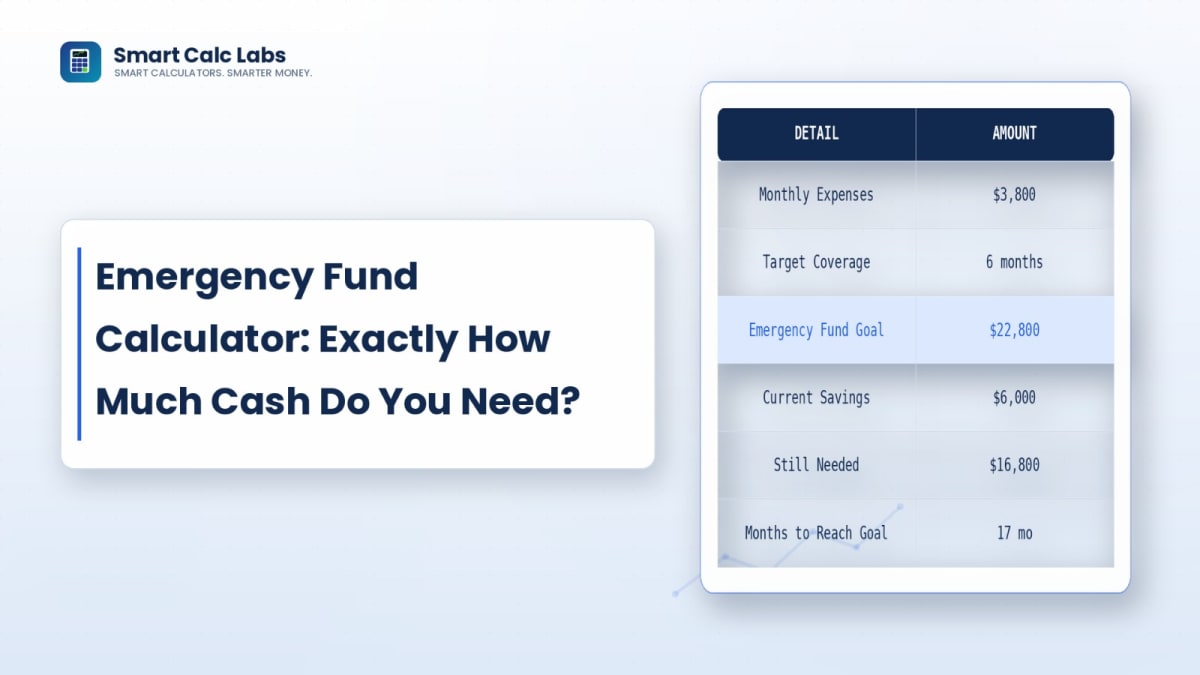
Use the Emergency Fund Calculator to plug in your actual monthly expenses and get your target — the reasoning below explains how to pick the right multiplier for your case.
Why "3-6 Months" Isn't One-Size-Fits-All
The 3-6 month range exists because risk isn't the same for everyone:
- 3 months tends to fit dual-income households with stable jobs — if one income stops, the other keeps covering most bills.
- 6 months fits single-income households, or anyone in a job market where re-employment typically takes longer (specialized roles, senior positions, smaller local job markets).
- 9-12 months is more realistic for freelancers, commission-based sales roles, gig workers, or small business owners whose income can drop to near-zero with no warning and no severance.
The multiplier should track your actual income volatility and re-employment timeline, not a number you read once in an article.
What Counts as an "Expense" Here
This fund is built on your bare-bones survival number, not your normal monthly spending. That means: rent/mortgage, utilities, groceries, minimum debt payments, insurance premiums, and transportation. It does not include your gym membership, subscriptions, dining out, or discretionary shopping — in a real emergency, those get cut first. Most people are surprised their true "survival number" is 20-30% lower than what they normally spend.
Where This Money Should (and Shouldn't) Live
An emergency fund fails at its one job if you can't access it fast, or if you're tempted to invest it somewhere volatile. The standard setup:
- High-yield savings account (HYSA): The default choice — FDIC insured, accessible within a day or two, and currently earning meaningfully more interest than a traditional bank's 0.01% APY.
- Not the stock market: If your emergency hits during a market downturn, you'd be forced to sell at a loss exactly when you need the cash most. This fund exists to avoid that kind of forced bad timing.
- Not your checking account: Money sitting in checking is too easy to spend on non-emergencies and earns close to nothing.
Mistakes That Undermine an Emergency Fund
- Counting retirement accounts as your emergency fund. Pulling from a 401(k) or traditional IRA before 59½ typically triggers a 10% early withdrawal penalty plus income tax — turning a $5,000 emergency into a much more expensive one.
- Building the fund before addressing high-interest debt. If you're carrying 24%+ APR credit card debt, most planners suggest a smaller starter fund (around $1,000) first, then aggressively paying down the debt, then building the full 3-6 month fund — since the debt is actively costing you more than the fund would earn.
- Letting the fund sit stagnant for years without recalculating. If your rent went up $400/month since you set your target, your old emergency fund number is now too low.
- Overfunding it. Once you hit your target (say, 6 months), extra cash sitting in a savings account is actually losing purchasing power to inflation over time — that's a signal to redirect new savings toward a specific goal or investing instead.
How to Build It Without Derailing Your Budget
- Calculate your bare-bones monthly number — not your full spending, just true survival costs.
- Run it through the calculator with your chosen multiplier (3, 6, or 9 months) to get your target.
- Check what that number does to your monthly budget using the 50/30/20 Budget Planner — if the required monthly contribution doesn't fit, extend your timeline rather than skipping other obligations.
- Open a separate HYSA specifically for this — mixing it with your regular savings makes it too easy to dip into for non-emergencies.
- Automate a fixed transfer each payday until you hit the target, then stop and redirect that money elsewhere.
Before You Rely on This
This calculation is only as good as the expense number you put into it — if you underestimate your true monthly costs, your "fully funded" emergency fund may fall short when you actually need it. Recalculate whenever your living situation, income, or dependents change.
Disclaimer: The content provided on SmartCalcLabs is for educational and informational purposes only. We are not certified financial planners or tax advisors. You should always consult with a licensed professional before making significant financial decisions, as your personal situation and risk tolerance are unique.
The Three-Tiered Liquidity Architecture: Balancing Yield and Capital Access
Retaining $25,000 to $60,000 in a traditional brick-and-mortar checking account paying 0.01% APY incurs a painful opportunity cost—subjecting your emergency safety net to severe inflation erosion over a multi-year horizon. Conversely, locking liquid reserves into volatile equity indices or illiquid private assets risks forced liquidations during sudden market drawdowns. The solution is a Three-Tiered Liquidity Architecture:
Tier 1: Immediate Operational Liquidity (1 Month of Essential Expenses)
Location: High-yield checking account or linked primary savings account.
Liquidity Window: Instantaneous (0 seconds via Visa debit card, Zelle, or immediate ATM cash withdrawal).
Designed to cover zero-notice disruptions: emergency dental procedures, urgent home plumbing failures, or immediate vehicle tow and repair charges without touching credit lines.
Tier 2: Core High-Yield Cash Buffer (2 to 3 Months of Expenses)
Location: FDIC/NCUA-insured High-Yield Savings Account (HYSA) or Treasury Money Market Fund (e.g., VUSXX, SPAXX).
Liquidity Window: 1 to 2 business days (ACH wire or electronic transfer).
Yields competitive benchmark yields (4.0% to 4.8% APY). Funds are fully insulated from stock market fluctuations and easily bridge a prolonged job search or extended medical leave.
Tier 3: Secondary Shield & State-Tax Shielded Ladder (2 to 3 Months of Expenses)
Location: Rolling 4-week or 8-week U.S. Treasury Bill (T-Bill) ladder via TreasuryDirect or brokerage account.
Liquidity Window: 7 to 14 days (or same-day secondary market sale).
Under 31 U.S. Code § 3124, interest on U.S. Treasury obligations is exempt from all state and municipal income taxation. For professionals in high-tax jurisdictions (California, New York City, New Jersey), T-Bill yields generate significantly higher after-tax cash flows than traditional bank deposits while maintaining backing by the full faith and credit of the federal government.
Frequently Asked Questions
Is 3 months really enough, or should I always aim for 6?
It depends on your income stability. Two stable incomes in a household generally makes 3 months reasonable. A single income, self-employment, or a volatile industry pushes that toward 6-9 months.
Should I pay off debt first or build my emergency fund first?
Most planners suggest a small starter fund (around $1,000) first to avoid new debt from minor emergencies, then focus on paying off high-interest debt, then build the full fund. Paying 24% APR while your savings earns 4-5% is a losing trade.
Can I count my Roth IRA contributions as part of my emergency fund?
Technically, Roth IRA contributions (not earnings) can be withdrawn penalty-free at any time, but relying on retirement space for near-term emergencies isn't ideal — it caps how much you can later re-contribute and complicates your retirement tracking. A dedicated HYSA is simpler.
Bottom Line
An emergency fund isn't about hitting a generic number — it's about matching your cash cushion to your actual income risk. Calculate your real survival expenses, pick a multiplier that fits your situation, and keep the money somewhere safe and accessible rather than chasing extra yield with it.