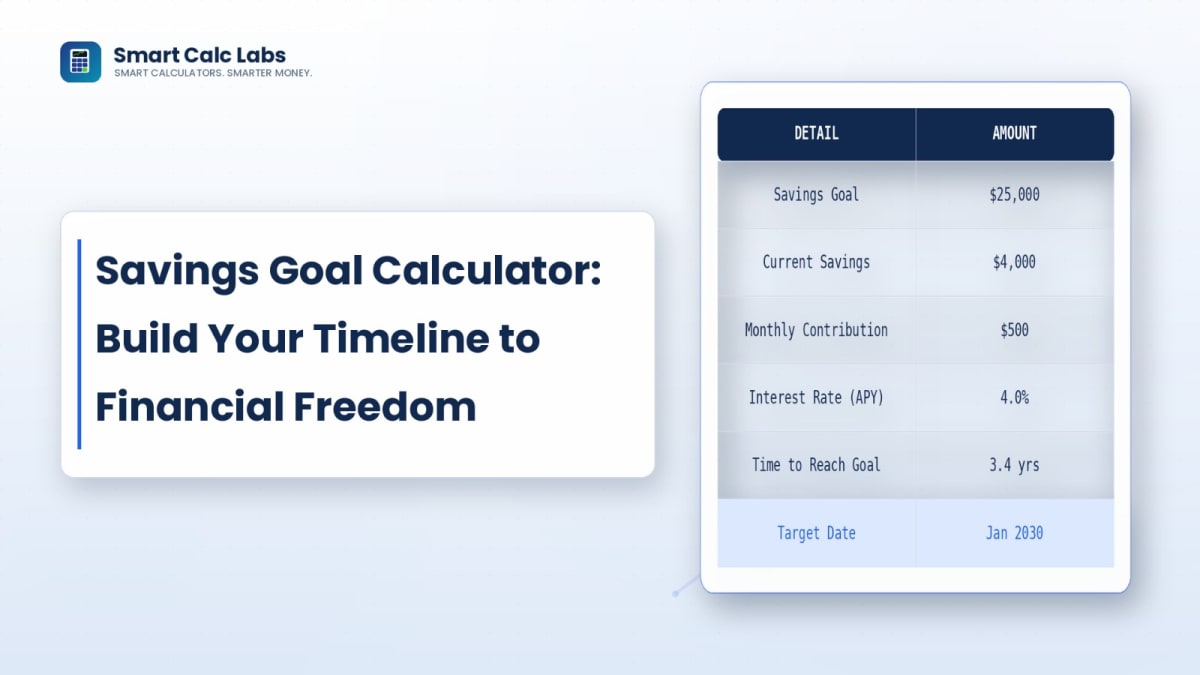
Most people fail to reach their savings goals not because they lack discipline, but because their goals are mathematically vague. Telling yourself "I'll save whatever is left over at the end of the month" is a strategy that almost always results in saving zero. Sustainable financial progress requires working backwards from a concrete dollar target and deadline to determine your exact required monthly deposit.
Whether you are accumulating a $60,000 house down payment, building a $15,000 emergency reserve, or planning a dream wedding, understanding the power of compound interest in high-yield savings accounts (HYSAs) can slash hundreds of dollars off your out-of-pocket contributions.
Use our free Savings Goal Calculator to calculate your required monthly deposit or timeline, or read on to master the compounding formulas, account APY rankings, and automated savings systems below.
The Two Critical Savings Questions
When approaching any financial milestone, you must solve one of two mathematical equations:
1. Target Date Mode (Fixed Deadline)
"I need $30,000 in 24 months. Exactly how much must I transfer into my savings account every single month to guarantee I hit the target?"
2. Fixed Budget Mode (Fixed Monthly Amount)
"My budget allows me to save $600 per month. How many months will it take me to save $25,000 at a 4.5% HYSA interest rate?"
The Mathematical Formulas Behind Savings Growth
When you deposit money monthly into an interest-bearing account, you are creating an ordinary annuity with compound growth:
PMT = [Target − Starting Balance × (1 + r)^n] × [r ÷ ((1 + r)^n − 1)]
n = ln[(Target × r + PMT) ÷ (Starting Balance × r + PMT)] ÷ ln(1 + r)
r is the monthly interest rate (Annual APY ÷ 12) and n is the total number of months.
Account Comparison: Where Should You Park Your Savings Goal?
Keeping your savings goal in a standard checking account earning 0.01% is leaving thousands of dollars in free interest on the table. Here is how different savings vehicles compare:
| Account Type | Typical 2026 APY | Liquidity & Access | Best Goal Horizon |
|---|---|---|---|
| High-Yield Savings (HYSA) | 4.00% – 5.00% | Instant (1–2 day transfer, FDIC insured) | Short-to-Medium (1 to 3 Years) |
| Certificate of Deposit (CD) | 4.25% – 5.10% | Locked until maturity (Early withdrawal penalty) | Fixed Deadline (6 to 24 Months) |
| Treasury Bills (4-Week to 52-Week) | 4.30% – 4.80% | High (State & local tax exempt) | Taxable Short-Term Goals |
| Index Fund (Broad Market) | 7.00% – 10.00% (Avg) | Market Volatility (Can drop 15%–30% in a bad year) | Long-Term Goals (5+ Years Only) |
| Traditional Brick-and-Mortar Bank | 0.01% – 0.05% | Instant | Not recommended for any savings goal |
The Compound Interest Advantage: Real-World Example
Let's look at a concrete case study of saving a $50,000 house down payment over 36 months (3 years) starting from $5,000:
| Strategy | Required Monthly Deposit | Total Principal Contributed | Free Compound Interest Earned |
|---|---|---|---|
| Traditional Bank (0.05% APY) | $1,249 / month | $44,964 | $36 |
| High-Yield Savings (4.50% APY) | $1,168 / month | $42,048 | +$2,952 (Free Cash) |
By simply placing the funds in a 4.5% HYSA instead of a traditional checking account, the saver earns nearly $3,000 in compound interest, lowering their required monthly budget burden by $81 per month.
4 Proven Strategies to Reach Your Savings Goals Faster
- 1. The "Pay Yourself First" Automation: Never wait until the end of the month to save what is left. Schedule an automatic bank transfer for your required monthly deposit to execute on the exact morning your paycheck direct-deposits.
- 2. Create Dedicated "Sinking Funds": Never pool an emergency fund, a vacation fund, and a down payment in one account. Use modern banks that offer separate sub-accounts or digital "savings envelopes" so you never accidentally spend from the wrong bucket. Use our 50/30/20 Budget Planner to allocate your monthly income buckets.
- 3. The 1% Micro-Escalation Rule: If your required monthly deposit feels slightly out of reach, start with 80% of the target and increase your automated transfer by 1% of your income every 30 days until you hit the required pace.
- 4. Protect Long-Term Targets Against Inflation: For goals further than 3 years out, remember that inflation increases prices over time. Use our Inflation Impact Calculator to add an inflation buffer to future targets.
5 Costly Savings Mistakes That Quietly Derail Goals
- Investing Short-Term Money in Volatile Stocks: If you need money within 24–36 months, placing it in the stock market exposes you to sequence of return risk. A 20% market dip right before your home closing can force you to postpone your dream.
- Neglecting Your Starter Emergency Fund: Saving for a vacation or car without having a starter $1,000–$2,500 emergency reserve means the first unexpected medical bill or tire blowout will force you to liquidate your goal. Use our Emergency Fund Calculator first.
- Ignoring the Tax Impact on Interest: Interest earned in a HYSA is taxed as ordinary income. In high-tax brackets, short-term Treasury Bills (which are exempt from state and local income tax) may provide higher net after-tax returns.
- Underestimating Incidental Costs: When saving for a car or home, don't just save for the purchase price. Account for property taxes, closing costs, sales tax, registration, and moving fees.
- Skipping Contributions Without Recalibrating: Missing a single monthly transfer doesn't just delay you by one month—it forfeits all future compound interest on that principal. Always re-run your numbers if you experience an income gap.
Frequently Asked Questions
How much should I save each month for a $20,000 goal in 2 years?
Assuming a starting balance of $0 and a 4.5% APY High-Yield Savings Account, you will need to deposit approximately $798 per month for 24 months. Over that period, you will contribute $19,152 in principal and earn $848 in compound interest.
What is a sinking fund?
A sinking fund is a dedicated savings account set up for a specific, expected future expense (e.g., holiday gifts, auto insurance renewal, annual property taxes, or vacation). Unlike an emergency fund, which is for unpredictable shocks, sinking funds prevent predictable large expenses from disrupting your monthly budget.
Should I pay off debt before saving for goals?
High-interest debt (such as credit cards at 20%+ APR) should almost always be paid off before saving for non-essential goals, because no safe savings account can beat a guaranteed 20%+ return. However, always keep a starter emergency fund ($1,000 to $2,500) before aggressively tackling debt.
Is money in a High-Yield Savings Account safe?
Yes, as long as the financial institution is an FDIC-insured bank (or NCUA-insured credit union). FDIC insurance protects your deposits up to $250,000 per depositor, per insured bank, for each account ownership category.
Calculate Your Exact Savings Plan Today
Turn your financial aspirations into a concrete mathematical roadmap. Enter your goal amount, timeline, and interest rate into our interactive Savings Goal Calculator now to see your exact required monthly deposit and interest earnings.