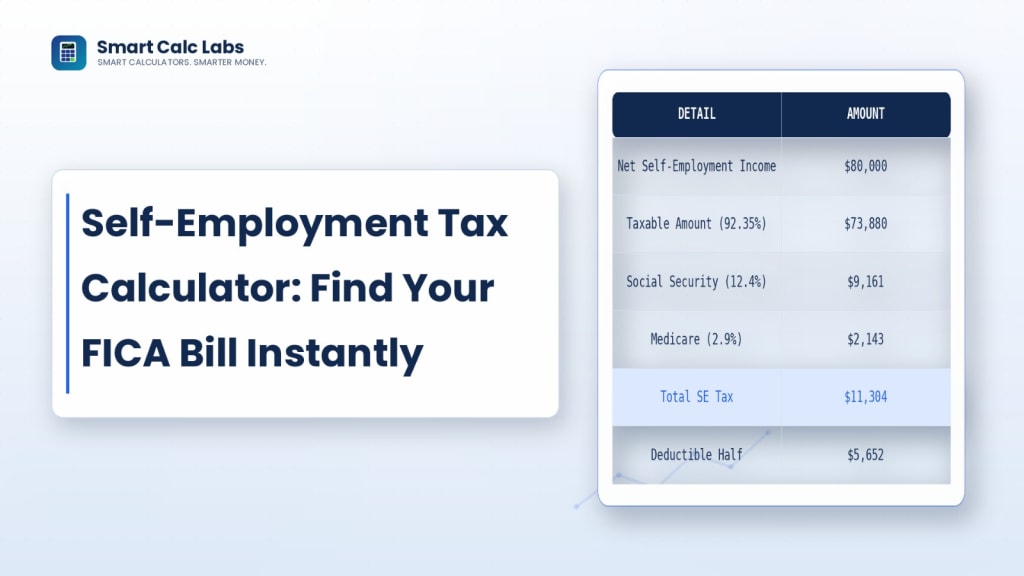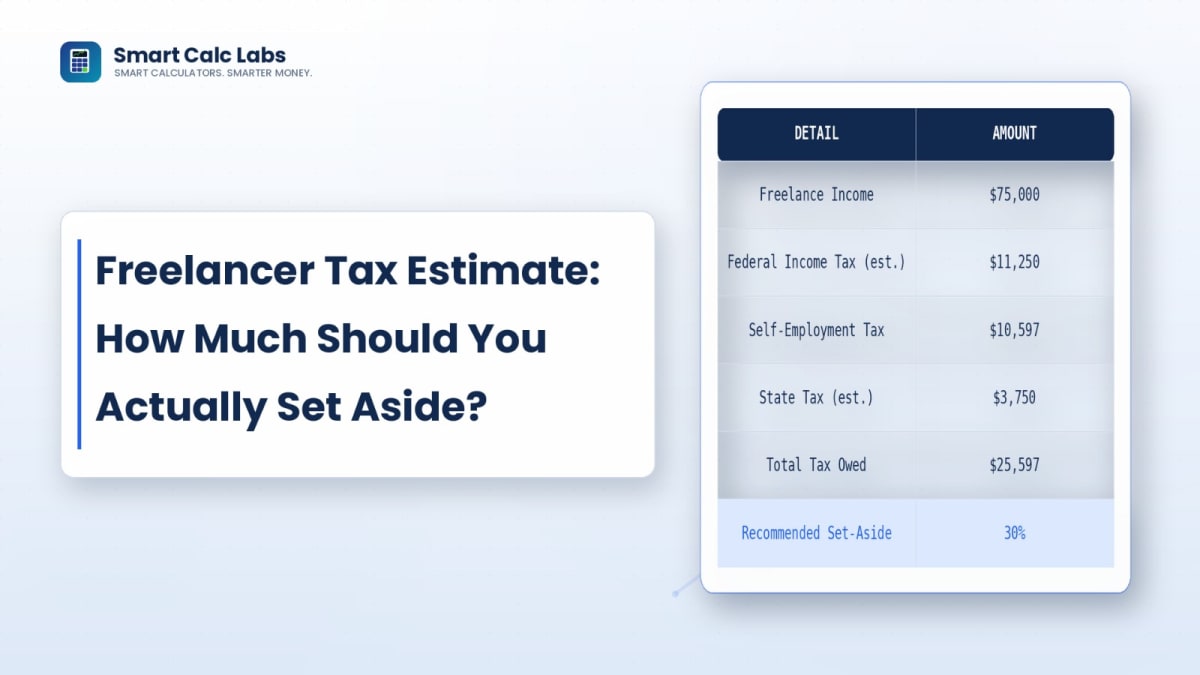
When transitioning from a W-2 job to freelancing or independent contracting, the biggest shock is almost always tax time. Employees only pay half of their FICA taxes (7.65%), while their employer silently covers the other half. As a freelancer, independent contractor, or sole proprietor, you are both the employee and the employer—meaning you are responsible for the full 15.3% self-employment tax on top of standard federal and state income taxes.
The traditional rule of thumb—"just set aside 30% of every invoice"—is a crude approximation that leaves low-earners oversaving and high-earners facing unexpected IRS penalties.
Use our free Freelancer Tax Estimator Calculator to calculate your exact 2026 tax bill, or read on to master the math of self-employment tax, 1040-ES quarterly deadlines, and legitimate tax write-offs below.
The 3 Layers of Freelance Taxation
Your freelance tax bill consists of three distinct layers stacked on top of each other:
1. Self-Employment (SE) Tax
Covers Social Security (12.4% up to $184,500 in 2026) and Medicare (2.9% uncapped). Applied to 92.35% of your net business profit.
2. Federal Income Tax
Applied to your taxable income after subtracting the 50% SE tax deduction, Standard Deduction ($16,100 Single / $32,200 Married), and 20% QBI deduction.
3. State & Local Income Tax
Varies by jurisdiction. Nine states (TX, FL, WA, NV, TN, WY, SD, AK, NH) have 0% income tax, while states like CA, NY, and NJ impose progressive brackets.
Step-by-Step Mathematical Calculation
Here is the exact step-by-step formula the IRS uses to calculate your 2026 tax liability:
Net Profit = Gross 1099 Invoices − Allowable Business Expenses
Taxable SE Base = Net Profit × 0.9235Social Security (12.4%) = min(Taxable SE Base, $184,500 − W2 Wages) × 0.124Medicare (2.9%) = Taxable SE Base × 0.029Total SE Tax = Social Security + Medicare (+ 0.9% Surtax if earned > $200k)
Above-the-Line SE Deduction = Total SE Tax ÷ 2AGI = Net Profit + W2 Wages − (Total SE Tax ÷ 2)
Qualified Business Income (QBI) Deduction (Section 199A) = 20% × Net ProfitTaxable Income = max(0, AGI − Standard Deduction − QBI Deduction)
2026 Federal Income Tax Brackets (IRS)
Once your Taxable Income is determined, it is taxed across progressive brackets:
| Tax Rate | Single Filers (2026) | Married Filing Jointly (2026) | Head of Household (2026) |
|---|---|---|---|
| 10% | $0 to $12,400 | $0 to $24,800 | $0 to $17,700 |
| 12% | $12,400 to $50,400 | $24,800 to $100,800 | $17,700 to $67,450 |
| 22% | $50,400 to $105,700 | $100,800 to $211,400 | $67,450 to $105,700 |
| 24% | $105,700 to $201,750 | $211,400 to $403,500 | $105,700 to $201,750 |
| 32% | $201,750 to $256,200 | $403,500 to $512,400 | $201,750 to $256,200 |
| 35% | $256,200 to $640,600 | $512,400 to $768,700 | $256,200 to $640,600 |
| 37% | Over $640,600 | Over $768,700 | Over $640,600 |
The Freelancer Tax Write-Offs Master Checklist
Every dollar of legitimate business deduction reduces both your 15.3% Self-Employment Tax and your Income Tax. Claiming a $1,000 deduction saves a freelancer in the 22% bracket approximately $373 in total taxes!
| Deduction Category | IRS Rules & Limits | Examples |
|---|---|---|
| Home Office | Must be used exclusively and regularly for business. Simplified: $5/sq ft (up to 300 sq ft = $1,500 max). Regular: % of rent, utilities, insurance. | Dedicated room, desk, office chair, lighting. |
| Software & Subscriptions | 100% deductible if used for business operations. | Adobe Creative Cloud, ChatGPT Plus, Figma, GitHub, QuickBooks, G-Suite, Web Hosting. |
| Hardware & Equipment | Section 179 permits 100% write-off in year of purchase. | Laptops, monitors, camera gear, microphones, tablets. |
| Phone & Internet | Deduct the reasonable business-use percentage (e.g. 50%–70%). | Monthly mobile carrier bill, high-speed fiber internet. |
| Business Travel & Client Meals | Travel is 100% deductible. Client business meals are 50% deductible. | Flights, hotels, conference tickets, client lunches. |
| Subcontractor Payments | 100% deductible (Issue 1099-NEC if paid > $600/year). | Freelance developers, copywriters, graphic designers, virtual assistants. |
2026 Form 1040-ES Quarterly Payment Deadlines & Safe Harbor
The IRS operates on a "pay-as-you-earn" system. If you expect to owe at least $1,000 in taxes for the year, you must submit estimated payments quarterly via IRS Direct Pay:
| Quarter | Income Earning Period | 2026 IRS Due Date |
|---|---|---|
| Q1 (1st Quarter) | January 1 – March 31 | April 15, 2026 |
| Q2 (2nd Quarter) | April 1 – May 31 | June 15, 2026 |
| Q3 (3rd Quarter) | June 1 – August 31 | September 15, 2026 |
| Q4 (4th Quarter) | September 1 – December 31 | January 15, 2027 |
🛡️ The IRS Safe Harbor Rule (Avoid Penalties):
To avoid underpayment penalties, ensure your total timely payments (quarterly estimated payments + W-2 withholdings) equal at least:
- 90% of your current year's actual tax liability, OR
- 100% of your prior year's tax liability (increased to 110% if your prior year AGI exceeded $150,000).
Worked Case Study: $85,000 Freelancer (Single Filer)
Let's walk through the exact 2026 tax calculation for Sarah, a freelance graphic designer who earned $85,000 in gross 1099 revenue and claimed $15,000 in legitimate business deductions:
| Tax Step | Calculation Details | Amount |
|---|---|---|
| Gross Revenue | Total 1099 Client Invoices | $85,000 |
| Business Deductions | Software, Home Office, Subcontractors | −$15,000 |
| Net Business Profit | Revenue − Expenses | $70,000 |
| Self-Employment Tax | ($70,000 × 0.9235) × 15.3% | $9,891 |
| Adjusted Gross Income (AGI) | $70,000 − ($9,891 ÷ 2 above-the-line deduction) | $65,055 |
| Standard Deduction | 2026 IRS Single Filer Deduction | −$16,100 |
| 20% QBI Deduction | 20% × $70,000 Section 199A Pass-Through | −$14,000 |
| Federal Taxable Income | $65,055 − $16,100 − $14,000 | $34,955 |
| Federal Income Tax | 10% on $12,400 + 12% on $22,555 | $3,947 |
| Total Combined Federal Tax | SE Tax ($9,891) + Income Tax ($3,947) | $13,838 (19.8% of Net) |
| Quarterly Payment (1040-ES) | $13,838 ÷ 4 Quarters | $3,460 / Quarter |
Notice that Sarah's effective total tax rate is 19.8% of net profit. If she had blindly set aside a flat 30% ($21,000), she would have unnecessarily locked up $7,162 of working capital.
Use our Freelancer Hourly Rate Calculator and Solo 401(k) Calculator to optimize your billable rate and retirement tax savings.
5 Costly Tax Mistakes Freelancers Make
- 1. Missing the 50% Above-the-Line SE Tax Deduction: You can deduct half of your 15.3% SE tax from your gross income on Form 1040. This lowers your adjusted gross income and saves hundreds in regular income tax.
- 2. Forgetting the 20% QBI Deduction (Section 199A): Most sole proprietorships and single-member LLCs are eligible for a 20% deduction on net profit, yet thousands of self-filers fail to check the box.
- 3. Paying Tax on Gross Revenue Instead of Net Profit: Never calculate taxes on total invoices sent. Always subtract all ordinary and necessary software, gear, and subcontractor costs first.
- 4. Waiting Until April to Pay the Entire Year's Tax: The IRS charges underpayment interest penalties for failing to make timely quarterly estimated payments, even if you pay the full balance on April 15.
- 5. Failing to Open a Solo 401(k) or SEP IRA: Contributing to a Solo 401(k) allows you to shelter up to $69,000 (2026 limit) in pre-tax income, slashing your income tax bracket dramatically.
Frequently Asked Questions
How much should I set aside for taxes as a freelancer?
Most freelancers should set aside between 20% and 30% of net profit (revenue minus business expenses). If your net income is under $50,000, setting aside ~20% is usually sufficient. If you earn over $100,000 or live in a high-tax state like California or New York, set aside 30%–35%.
Do I have to pay quarterly taxes if I also work a W-2 job?
Not necessarily. If your W-2 employer withholds enough federal tax to satisfy the IRS safe harbor rule (100% of prior year tax or 90% of current year tax), you do not need to make quarterly estimated payments for your side freelance income. You can simply submit a new Form W-4 to your employer to increase your per-paycheck withholding.
What is the 2026 Social Security tax wage cap?
For the 2026 tax year, the IRS Social Security wage base cap is $184,500. Any combined earned income (W-2 salary + 92.35% of freelance net profit) above $184,500 is exempt from the 12.4% Social Security tax, though the 2.9% Medicare tax continues uncapped.
Can I deduct health insurance premiums as a freelancer?
Yes! Self-employed individuals can claim the Self-Employed Health Insurance Deduction as an above-the-line adjustment to income, provided you and your spouse were not eligible for an employer-subsidized health plan.
Calculate Your Exact 2026 Freelancer Tax Bill
Never guess what you owe the IRS. Enter your projected freelance income and business write-offs into our free interactive Freelancer Tax Estimator Calculator now to see your exact quarterly payment vouchers and take-home pay.