Introduction: Why Understanding Your Paycheck Matters in 2026
When you accept a job offer with an agreed salary of $75,000, $100,000, or $150,000 per year, or an hourly wage of $35 to $60 per hour, the amount that actually lands in your bank account on payday is significantly lower. Between federal income tax withholding, FICA payroll taxes (Social Security and Medicare), state income taxes, and voluntary employer benefit deductions, the gap between gross salary and net take-home pay can be substantial—frequently between 20% and 35% of your total earnings.
Understanding how your paycheck is calculated is essential for building an accurate household budget, avoiding unexpected tax surprises at tax time, evaluating competing job offers across different states, and taking full advantage of tax-advantaged employer benefits like traditional 401(k)s and Health Savings Accounts (HSAs).
Use our free 2026 Paycheck Calculator to instantly estimate your bi-weekly, weekly, semi-monthly, or monthly take-home pay with 100% browser-side privacy.
The Core Formula: Gross Pay to Net Pay
The mathematical transformation from your top-line earnings to your bottom-line deposit follows a strict sequence governed by IRS withholding rules and state tax codes:
- Calculate Gross Pay for the Period:
- For salaried employees:
Annual Gross Salary ÷ Number of Pay Periods in the Year(e.g., 26 for bi-weekly, 24 for semi-monthly, 52 for weekly, 12 for monthly). - For hourly employees:
Hourly Wage × Regular Hours Worked + (Overtime Hours × 1.5 × Hourly Wage).
- For salaried employees:
- Subtract Pre-Tax Deductions: Pre-tax contributions (traditional 401(k)/403(b), Section 125 health insurance premiums, HSA/FSA contributions, commuter benefits) are deducted from your gross pay. This reduces your Federal and State Taxable Wages.
- Calculate FICA Payroll Taxes:
- Social Security Tax (OASDI): 6.2% of FICA-taxable wages up to the 2026 Social Security Wage Base limit of $184,500.
- Medicare Tax (HI): 1.45% of all FICA-taxable wages with no ceiling.
- Additional Medicare Tax: 0.9% on wages earned over $200,000 for single filers ($250,000 for married couples filing jointly).
- Calculate Federal Income Tax Withholding: Determined by your filing status (Single, Married Filing Jointly, Head of Household), standard deduction, W-4 elections, and the progressive 2026 marginal tax brackets.
- Calculate State and Local Income Taxes: Applied based on your state of residence/employment (ranging from 0% in nine states to over 13% in top brackets).
- Subtract Post-Tax Deductions: Roth 401(k) contributions, union dues, wage garnishments, or voluntary life insurance.
- Result = Net Take-Home Pay: The net cash deposited into your checking account.
2026 Federal Income Tax Brackets & Standard Deductions
For the 2026 tax year, the IRS has adjusted the standard deduction and tax bracket thresholds for inflation. Your federal income tax withholding is calculated progressively—meaning your income is divided into slices, and each slice is taxed only at its corresponding rate.
2026 Standard Deduction Amounts:
- Single / Married Filing Separately: $16,100
- Married Filing Jointly / Qualifying Surviving Spouse: $32,200
- Head of Household: $24,150
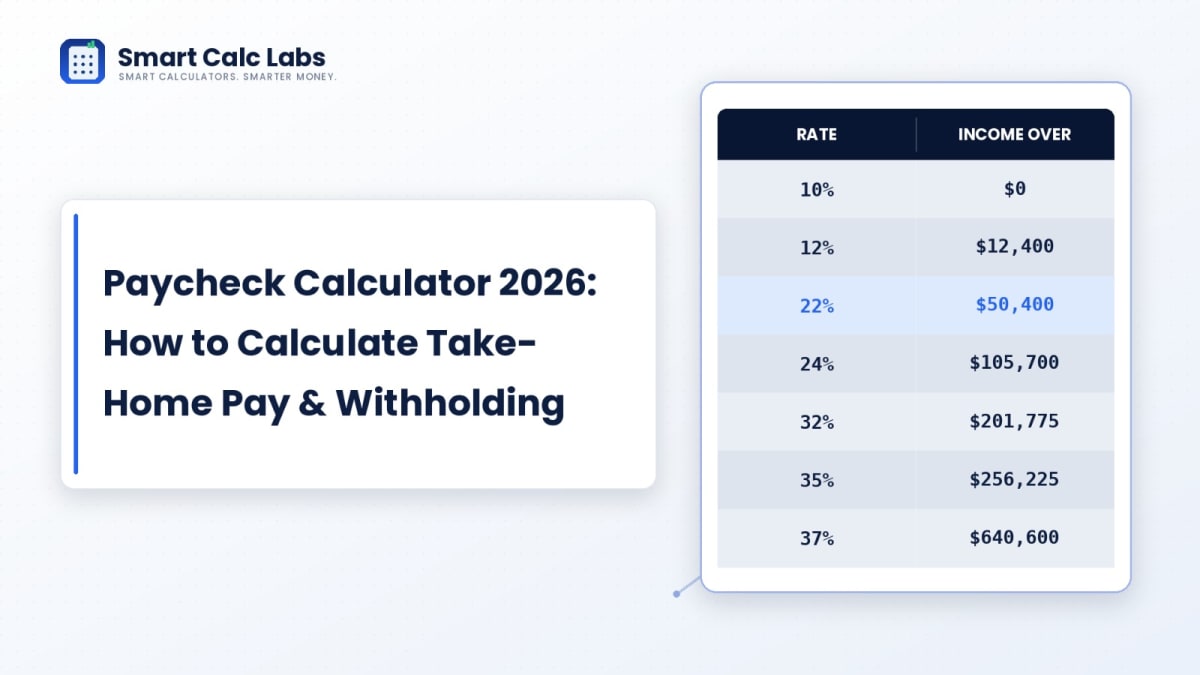
2026 Federal Tax Rates & Bracket Thresholds (Single Filers):
| Marginal Tax Rate | Taxable Income Bracket (Single) | Tax Calculation Formula |
|---|---|---|
| 10% | $0 to $11,925 | 10% of taxable income |
| 12% | $11,926 to $48,475 | $1,192.50 + 12% of amount over $11,925 |
| 22% | $48,476 to $103,350 | $5,578.50 + 22% of amount over $48,475 |
| 24% | $103,351 to $197,300 | $17,651.00 + 24% of amount over $103,350 |
| 32% | $197,301 to $250,525 | $40,199.00 + 32% of amount over $197,300 |
| 35% | $250,526 to $626,350 | $57,231.00 + 35% of amount over $250,525 |
| 37% | Over $626,350 | $188,769.75 + 37% of amount over $626,350 |
FICA Taxes Explained: Social Security & Medicare for 2026
FICA stands for the Federal Insurance Contributions Act. Unlike federal income tax (which uses graduated brackets and standard deductions), FICA taxes are flat payroll taxes collected from the first dollar you earn.
1. Social Security Tax (6.2%) & The 2026 Wage Base Cap
Employees pay 6.2% of their gross earnings toward Social Security, matched by a 6.2% employer contribution (totaling 12.4%). However, this tax is capped annually:
- 2026 Wage Base Limit: $184,500 (an increase from $176,100 in 2025).
- Maximum Annual Employee Withholding: $184,500 × 6.2% = $11,439.00.
- Once your year-to-date cumulative earnings reach $184,500, your employer stops withholding the 6.2% Social Security tax for the remainder of that calendar year, giving high-earners a noticeable boost in net take-home pay during late summer or autumn.
2. Medicare Tax (1.45% Uncapped + 0.9% Surtax)
Employees pay 1.45% of all wages toward Medicare, matched by 1.45% from the employer (totaling 2.9%). There is no wage cap on Medicare tax.
Under the Affordable Care Act, high earners are also subject to the 0.9% Additional Medicare Tax on compensation exceeding:
- $200,000 for Single / Head of Household filers
- $250,000 for Married Filing Jointly filers
- $125,000 for Married Filing Separately filers
How State Income Taxes Impact Take-Home Pay
State tax laws create major differences in net take-home pay across the country for workers earning the same gross salary:
1. The 9 States with Zero Wage Income Tax
Residents working in Alaska, Florida, Nevada, New Hampshire, South Dakota, Tennessee, Texas, Washington, and Wyoming pay 0% state income tax on earned wages. Every dollar deducted from their paycheck is strictly federal withholding and FICA.
2. Flat-Tax States
Several states levy a single flat tax rate across all taxable income levels. Notable flat-rate states for 2026 include:
- Pennsylvania: 3.07%
- Indiana: 3.05%
- Arizona: 2.50%
- Michigan: 4.25%
- Colorado: 4.40%
- Illinois: 4.95%
- North Carolina: 4.50%
- Georgia: 5.39%
- Utah: 4.65%
3. Progressive-Tax States
States such as California (up to 13.3%), New York (up to 10.9%), New Jersey (up to 10.75%), and Massachusetts (5% plus 4% surtax on income over $1M) feature graduated brackets that significantly increase withholdings for middle and upper-income households.
How Pre-Tax Deductions Supercharge Your Take-Home Efficiency
Many employees hesitate to increase their 401(k) or HSA contributions because they fear a massive reduction in their paycheck. However, because pre-tax contributions bypass federal and state income taxes, every dollar contributed costs you significantly less than one dollar of take-home pay.
Example: The Power of a 5% Traditional 401(k) Contribution
Suppose you earn $100,000 per year (Single filer, 22% marginal federal bracket, 5% state tax bracket) and choose to contribute 5% ($5,000/year or $192.31 bi-weekly) to your company's traditional 401(k):
- 401(k) Contribution per pay period: $192.31
- Federal income tax savings (22%): -$42.31
- State income tax savings (5%): -$9.62
- Actual reduction in take-home pay: $140.38
You add $192.31 into your investment account while your paycheck only decreases by $140.38. The remaining $51.93 represents immediate tax savings subsidized by the IRS and your state treasury!
Complete Worked Example: $75,000 Salary Bi-Weekly Paycheck
Let's examine the detailed step-by-step numbers for an employee earning $75,000 annually, paid bi-weekly (26 pay periods), filing Single, residing in Texas (0% state tax), contributing 5% to a 401(k), and paying $120 per paycheck for medical/dental insurance:
| Paycheck Component | Per Bi-Weekly Paycheck | Annual Total | % of Gross |
|---|---|---|---|
| Gross Salary | $2,884.62 | $75,000.00 | 100.0% |
| - 401(k) Pre-Tax Contribution (5%) | -$144.23 | -$3,750.00 | 5.0% |
| - Health & Dental Insurance Premiums | -$120.00 | -$3,120.00 | 4.2% |
| = Federal Taxable Gross Earnings | $2,620.39 | $68,130.00 | 90.8% |
| - Federal Income Tax Withheld | -$201.54 | -$5,240.00 | 7.0% |
| - Social Security Tax (6.2%) | -$171.41 | -$4,456.56 | 5.9% |
| - Medicare Tax (1.45%) | -$40.09 | -$1,042.26 | 1.4% |
| - State Income Tax (Texas 0%) | $0.00 | $0.00 | 0.0% |
| = Net Take-Home Pay | $2,087.35 | $54,271.18 | 72.4% |
In this scenario, the worker keeps 72.4% of their gross pay in take-home cash ($2,087.35 every two weeks), while setting aside $6,870/year in pre-tax retirement and healthcare benefits, and paying $10,738.82/year in total taxes (an effective overall tax rate of 14.3%).
Dual Income & Side Hustles: W-2 + 1099 Taxes
If you hold a W-2 job while doing freelance consulting or contract work on the side, your paycheck withholding interact directly with your self-employment obligations:
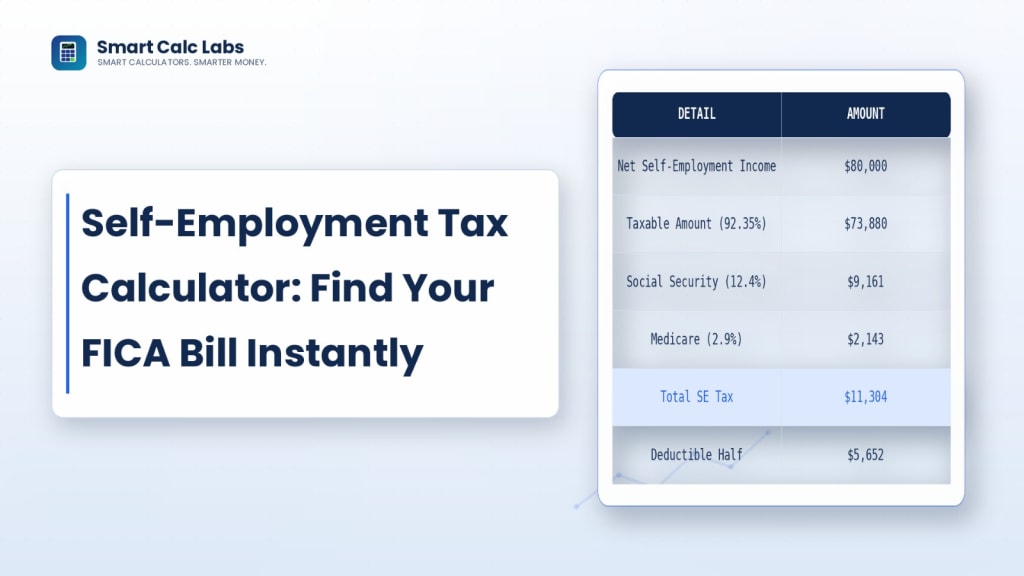
- Shared Social Security Cap: Your W-2 wages count toward the $184,500 Social Security cap first. If your W-2 salary reaches $184,500, your 1099 freelance earnings are 100% exempt from the 12.4% Social Security tax!
- Adjusting W-4 Withholding: You can use Line 4(c) on IRS Form W-4 to have extra federal tax withheld directly from your regular paycheck, eliminating the hassle of mailing quarterly estimated vouchers (Form 1040-ES) for your side business.
Check out our specialized companion tools to model contractor taxes and budget allocations:
- Self-Employment Tax Calculator — 1099 FICA & 1040-ES Estimator
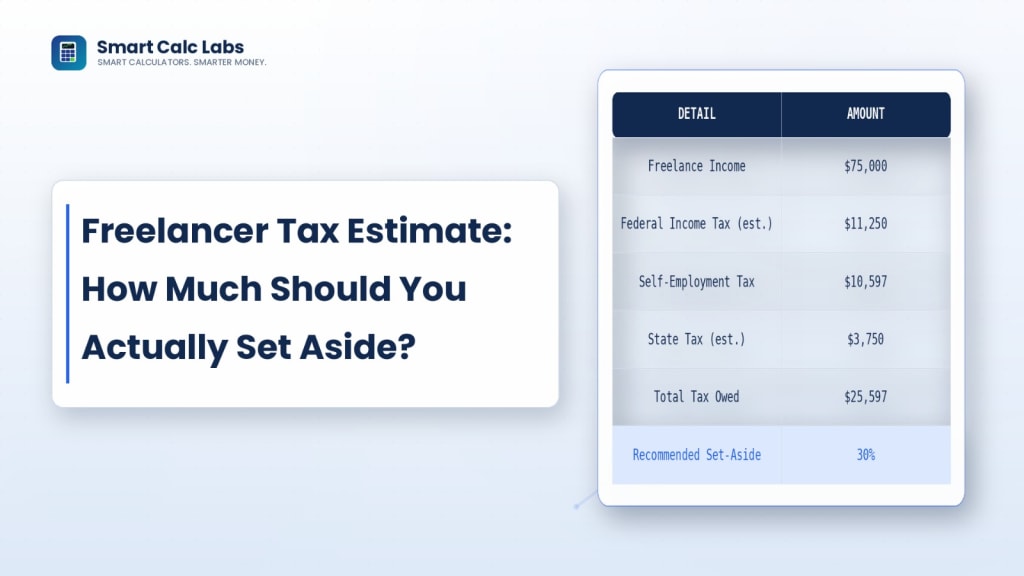
- Freelancer Tax Estimator — Global self-employment tax calculator
- 50/30/20 Budget Planner — Allocate your net take-home pay to needs, wants, and savings
- Solo 401(k) Contribution Calculator — Maximize self-employed retirement tax shelters
Frequently Asked Questions (FAQ)
1. How often should I review my paycheck withholding?
You should review your paycheck and submit an updated IRS Form W-4 to your employer whenever you experience a major life event: getting married or divorced, having a child, buying a home, taking on a second job or side business, or experiencing a major shift in annual income.
2. Why is my first paycheck of the year slightly lower or different?
First paychecks of a new calendar year frequently reflect updated annual health insurance premium rates, adjusted standard deduction and bracket thresholds from the IRS, new state tax rates, and the reset of Social Security wage base tracking (if you had capped out in the previous year).
3. What is the difference between bi-weekly and semi-monthly paychecks?
Bi-weekly pay occurs every two weeks (26 paychecks per year, resulting in two months each year with three paychecks). Semi-monthly pay occurs twice per month on specific dates, such as the 15th and the last day of the month (24 paychecks per year, resulting in larger individual paychecks than bi-weekly for the same annual salary).
4. Does a 401(k) contribution reduce my Social Security and Medicare taxes?
No. Traditional 401(k) and 403(b) contributions reduce your Federal and State Income Taxable Wages, but they do NOT reduce FICA payroll taxes (Social Security and Medicare). However, Section 125 pre-tax health insurance premiums and HSA contributions DO reduce both income taxes and FICA taxes.
5. How can I increase my take-home pay without getting a raise?
Strategies to optimize your net pay include: (1) Ensuring your W-4 accurately reflects your eligible tax credits (Child Tax Credit, clean energy credits), (2) Utilizing pre-tax commuter and dependent care FSA benefits to lower taxable income, and (3) Relocating to or working remotely from a state with zero or lower personal income tax.