Transitioning from a traditional W-2 job to self-employment, freelancing, or launching an LLC brings unmatched freedom—until your first tax filing. Unlike traditional employees whose employers pay half of their payroll taxes, self-employed professionals must pay both halves of Social Security and Medicare taxes, known as the 15.3% Self-Employment (SE) tax.
Whether you are running a full-time independent consultancy, driving rideshare, or operating a high-income 1099 side gig alongside your day job, our interactive Self-Employment Tax Calculator calculates your exact FICA liability, your 50% above-the-line deduction, and your quarterly estimated tax payment vouchers (Form 1040-ES) for the 2026 tax year.
2026 Self-Employment Tax Quick Facts
- Total SE Tax Rate: 15.3% (12.4% Social Security + 2.9% Medicare)
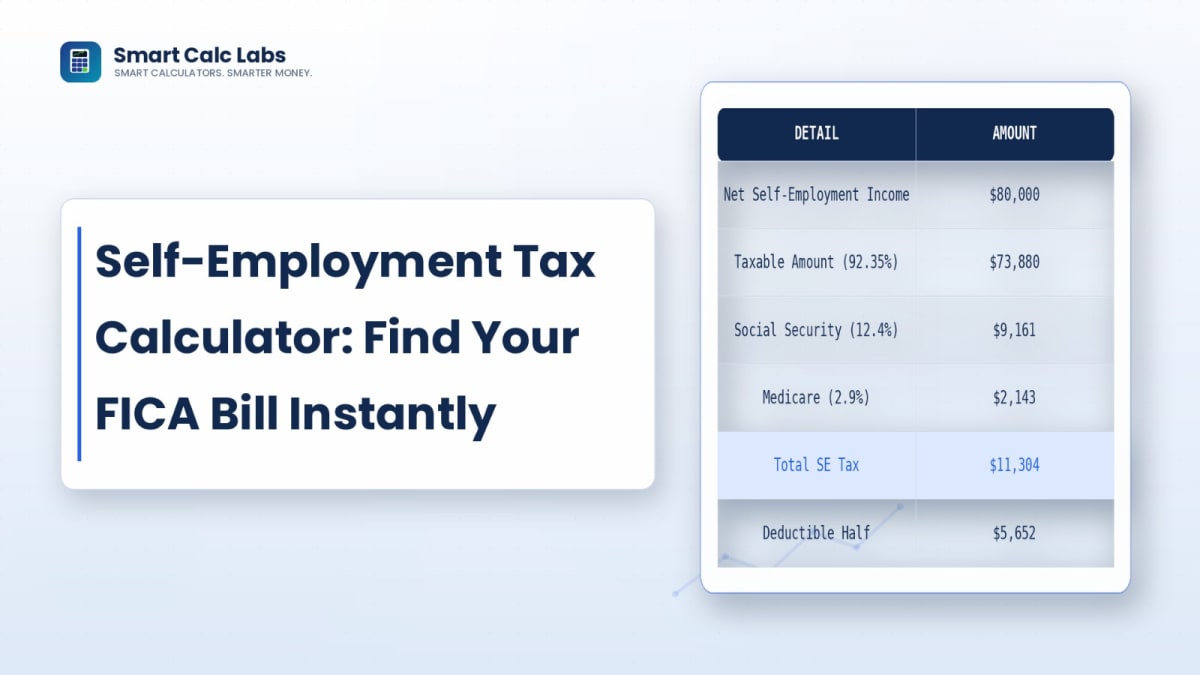
- Taxable Multiplier: 92.35% (you only pay SE tax on 92.35% of your net business profit)
- 2026 Social Security Wage Cap: $184,500 (earnings above this limit are exempt from the 12.4% rate)
- Medicare Tax Cap: None (2.9% applies to 100% of net self-employment earnings)
- Additional Medicare Tax: 0.9% on earned income above $200,000 (Single) or $250,000 (Married Filing Jointly)
- Above-the-Line Deduction: 50% of your SE tax reduces your Adjusted Gross Income (AGI) on Form 1040 Schedule 1
How Self-Employment Tax Works: The 15.3% Breakdown
When you work as an employee, your company withholds 7.65% from your paycheck for FICA taxes (6.2% for Social Security and 1.45% for Medicare) and pays matching 7.65% out of their own pocket. When you are self-employed, the IRS classifies you as both the employer and the employee under the Self-Employment Contributions Act (SECA), making you responsible for the entire 15.3%:
| Tax Component | Rate | 2026 Income Threshold | Maximum Tax (2026) |
|---|---|---|---|
| Social Security (OASDI) | 12.4% | $184,500 (Combined W-2 & SE) | $22,878.00 |
| Medicare (Hospital Insurance) | 2.9% | No Limit (Uncapped) | No Maximum |
| Additional Medicare Tax | +0.9% | > $200k (Single) / > $250k (MFJ) | No Maximum |
| Total Baseline FICA | 15.3% | First $184,500 of Taxable SE Income | $22,878 + 2.9% uncapped |
The 92.35% Rule: Why You Don't Pay Tax on 100% of Profit
Many self-employed taxpayers assume that if their business makes $100,000 in net profit, they owe exactly $15,300 in SE tax. In reality, the IRS applies a statutory adjustment factor of 92.35% (0.9235) under Internal Revenue Code Section 1402(a)(12).
Because traditional employers deduct payroll taxes as a business expense before computing taxable corporate profits, self-employed taxpayers receive a 7.65% reduction (100% - 7.65% = 92.35%) to create tax parity.
Step-by-Step Example: $100,000 Net Freelance Profit
Let's walk through the math for a single independent consultant earning $100,000 in net business profit in 2026:
- Determine Taxable SE Earnings: $100,000 × 0.9235 = $92,350.
- Calculate Social Security Tax: Since $92,350 is below the $184,500 cap, the full amount is taxed at 12.4%: $92,350 × 0.124 = $11,451.40.
- Calculate Medicare Tax: $92,350 × 0.029 = $2,678.15.
- Total Self-Employment Tax: $11,451.40 + $2,678.15 = $14,129.55 (an effective SE tax rate of ~14.13% on total profit).
- Above-the-Line Deduction: 50% of $14,129.55 = $7,064.78. This amount directly reduces Adjusted Gross Income (AGI) on Form 1040, lowering regular federal and state income taxes!
Dual Income: Holding a W-2 Day Job While Freelancing
If you work a regular full-time W-2 job and earn 1099 income from consulting, freelancing, or side hustles, you enjoy a critical tax advantage: the $184,500 Social Security cap applies to all your earned income combined.
Your W-2 salary takes priority and fills the $184,500 wage base first:
- Case A: W-2 Salary is $120,000; Side Gig Profit is $80,000. Your W-2 job uses $120,000 of the Social Security cap. You only have $64,500 remaining ($184,500 - $120,000). On your $80,000 freelance earnings (taxable: $73,880), only $64,500 is hit with the 12.4% Social Security tax. The remaining $9,380 is completely exempt from Social Security, saving you $1,163.12!
- Case B: W-2 Salary Exceeds $184,500. If your day job pays $185,000 or more, your employer has already maxed out your Social Security contributions for the year. You owe 0% Social Security tax on your 1099 profits—you only pay the 2.9% Medicare tax. This saves you thousands of dollars compared to a solo full-time freelancer earning the same net income.
2026 Quarterly Estimated Tax Deadlines (Form 1040-ES)
Because 1099 clients do not withhold taxes from your invoices, the IRS operates on a "pay-as-you-go" system. If you expect to owe $1,000 or more in federal taxes for the year, you must submit quarterly estimated tax payments using Form 1040-ES.
How to Avoid IRS Underpayment Penalties (Safe Harbor Rules)
Failing to submit sufficient quarterly payments can trigger IRS Form 2210 underpayment penalties (currently assessed at elevated interest rates). You can completely protect yourself from penalties by meeting either of the IRS Safe Harbor rules:
- 90% Current Year Rule: Pay at least 90% of your total tax liability for the current 2026 tax year across four equal quarterly installments.
- 100% Prior Year Rule: Pay 100% of the total tax shown on your previous year's return (2025 Form 1040 line 24).
- 110% High-Income Rule: If your prior year's Adjusted Gross Income exceeded $150,000 ($75,000 if married filing separately), you must pay 110% of your prior year's tax liability to qualify for safe harbor protection.
Proven Strategies to Lower Your Self-Employment Tax
1. Maximize Legitimate Business Deductions
Remember that self-employment tax is levied exclusively on your net profit, not your gross revenue. Every $1,000 in legitimate business deductions saves you $153 in SE tax in addition to saving $220–$320 in federal and state income taxes:
- Home Office Deduction: Simplified method ($5/sq ft up to 300 sq ft = $1,500) or actual expense method (prorated rent, mortgage interest, utilities, and internet).
- Vehicle Mileage: Deduct actual auto expenses or claim standard IRS business mileage.
- Health Insurance Premiums: Deduct 100% of health, dental, and qualifying LTC insurance premiums for yourself and your family as an above-the-line deduction.
- Software, Equipment & Section 179: Immediately expense computers, cameras, specialized tools, and SaaS subscriptions.
2. Claim the 20% Section 199A (QBI) Deduction
Under the Tax Cuts and Jobs Act, eligible sole proprietors, partnerships, and S-Corps can deduct up to 20% of their Qualified Business Income (QBI) from their taxable income. While QBI does not reduce the 15.3% SE tax, it dramatically cuts your federal income tax bracket burden.
3. Elect S-Corporation Status (Once Net Profit Exceeds $70k–$80k)
Sole proprietorships and single-member LLCs pay SE tax on 100% of their taxable net profit. However, by filing IRS Form 2553 to be taxed as an S-Corporation, you divide your company earnings into two streams:
- A "Reasonable W-2 Salary": Subject to standard FICA payroll taxes (15.3%).
- Shareholder Distributions: Distributed as company profit, which is 100% exempt from self-employment tax!
| Scenario ($120,000 Net Profit) | Sole Proprietorship / LLC | S-Corporation (60/40 Split) |
|---|---|---|
| W-2 Reasonable Salary | $0 (All business profit) | $72,000 (60%) |
| Shareholder Distribution | $0 | $48,000 (40% - No FICA!) |
| Self-Employment / Payroll Tax Due | ~$16,955 | ~$11,016 |
| Est. Corporate Accounting / Payroll Fees | $0 | -$1,500 / year |
| Net Annual Tax Savings | $0 Baseline | +$4,439 in your pocket |
4. Supercharge Retirement with a Solo 401(k) or SEP IRA
Self-employed individuals can contribute both as the "employee" (up to $23,500 in 2026) and as the "employer" (up to 25% of net adjusted compensation) into a tax-deferred retirement account. Model your maximum allowable contribution with our Solo 401(k) Contribution Calculator to slash tens of thousands off your current-year taxable income.
Frequently Asked Questions
Do I have to pay self-employment tax if my net profit is under $400?
No. If your net earnings from self-employment are less than $400 for the entire calendar year, you are not subject to self-employment tax and do not need to file Schedule SE. However, you may still have to file a federal income tax return if your total combined gross income exceeds the standard deduction threshold.
Is self-employment tax separate from federal income tax?
Yes. Self-employment tax (15.3%) replaces Medicare and Social Security payroll taxes. It is calculated on Schedule SE and added to your regular federal income tax (calculated on Form 1040). You pay both on your annual tax return or via quarterly estimated vouchers.
Can I deduct health insurance premiums if I am self-employed?
Yes. The self-employed health insurance deduction allows you to deduct 100% of your health, dental, and qualifying long-term care insurance premiums as an above-the-line deduction on Schedule 1, provided neither you nor your spouse was eligible for an employer-subsidized health plan.
How do I calculate my freelance hourly rate to account for self-employment tax?
Because 1099 contractors must cover 15.3% SE tax, uncompensated sick days, health insurance, and administrative hours, your billable hourly rate should generally be 35% to 50% higher than an equivalent W-2 hourly wage. Use our free Freelance Hourly Rate Calculator to reverse-engineer your required contract rate.
Bottom Line: Plan Ahead and Keep What You Earn
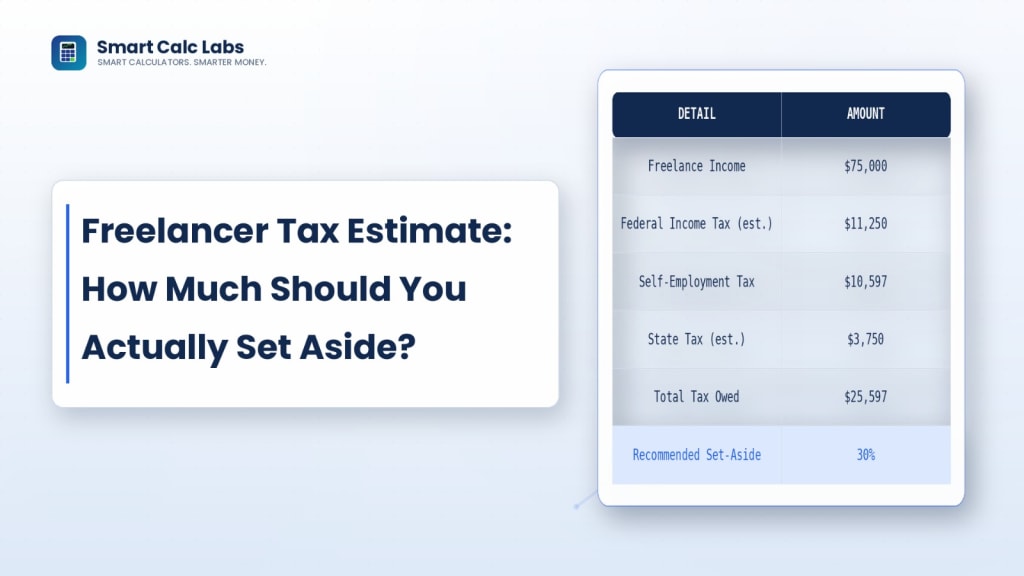
Self-employment tax represents a substantial portion of any contractor's or small business owner's overhead. By understanding the 15.3% rate, leveraging the 92.35% statutory deduction, utilizing dual-income Social Security offsets, and setting aside 25% to 30% of each invoice into a dedicated high-yield tax account, you can eliminate tax season anxiety and keep more of your hard-earned revenue.
Disclaimer: The figures, formulas, and legal thresholds provided on SmartCalcLabs are for informational and educational purposes only. Tax laws are complex and frequently subject to change. Always consult a Certified Public Accountant (CPA) or licensed Enrolled Agent (EA) regarding your specific business structure and tax filings.