Cash-flow problems are linked to roughly 82% of small business closures — and most of those businesses never ran a proper break-even calculation before launching or pricing a new product. Knowing your break-even point isn't a formality; it's the number that tells you whether an idea is a business or an expensive hobby.
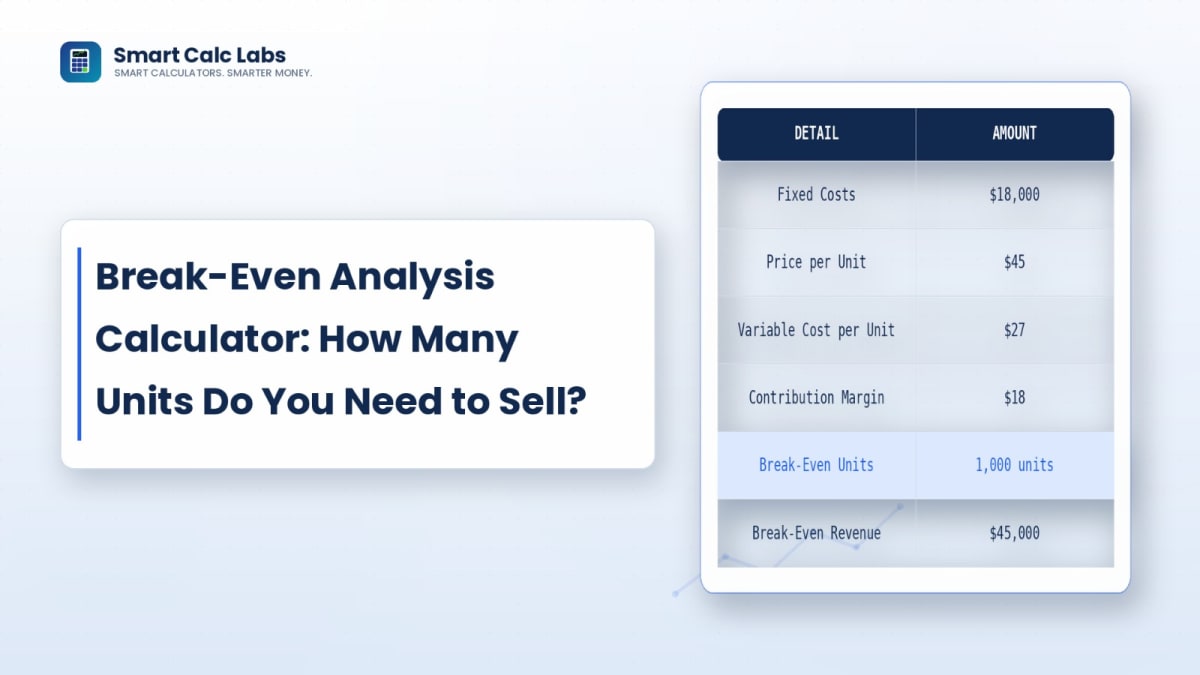
Enter your costs into the Break-Even Analysis Calculator — the reasoning behind the formula is below.
The Formula
Break-even point (in units) = Fixed Costs ÷ (Price per unit − Variable cost per unit). The denominator here is your "contribution margin" — how much of each sale actually goes toward covering your fixed costs, after paying for the direct cost of making that unit.
Example: if your fixed costs (rent, salaries, insurance) total $10,000/month, you sell a product for $50, and it costs $30 to produce (materials, direct labor), your contribution margin is $20. Break-even = $10,000 ÷ $20 = 500 units per month. Sell fewer than 500, and you're losing money every month regardless of how good the product is.
Why This Number Changes Everything About Pricing
Small pricing changes have an outsized effect on break-even volume because they hit your contribution margin directly. Raise that same $50 product to $55 (with cost still $30), and your contribution margin jumps to $25 — break-even drops from 500 units to 400. A 10% price increase cut your required volume by 20%. This is why break-even analysis, not gut feeling, should drive pricing decisions — a "small" discount to win a big customer can quietly push your break-even volume up by far more than 10%.
Fixed vs. Variable Costs: Getting the Split Right
- Fixed costs don't change with sales volume: rent, salaries, insurance, loan payments, software subscriptions.
- Variable costs scale directly with each unit sold: materials, direct labor, packaging, payment processing fees, shipping.
- The gray area that trips people up: costs like utilities or part-time labor that are semi-variable. When in doubt, estimate conservatively — overestimating variable costs gives you a more cautious (safer) break-even number.
Common Mistakes
- Forgetting owner's salary as a fixed cost. If you're not paying yourself a market-rate salary in the calculation, your break-even point is artificially low — the business isn't truly break-even until it can also pay you fairly.
- Using average costs across very different products. A business selling multiple products at different margins needs a break-even calculation per product line, or a weighted-average contribution margin — a single blended number can hide a losing product.
- Treating break-even as a one-time calculation. Rent increases, supplier price hikes, and wage growth all shift your break-even point — recalculate whenever a major fixed or variable cost changes.
- Confusing break-even with profitability goals. Break-even means you're covering costs, not making money. It's the floor, not the target — plan your actual sales goals well above it.
Using This Before You Launch
- List every fixed cost the business incurs regardless of sales volume, including your own reasonable salary.
- Calculate the true variable cost per unit, including materials, direct labor, and per-transaction fees like payment processing.
- Run the numbers through the calculator to find your required monthly or annual unit volume.
- Compare that volume against realistic market demand — if break-even requires selling more units than the entire addressable market could plausibly buy, the pricing or cost structure needs to change before launch, not after.
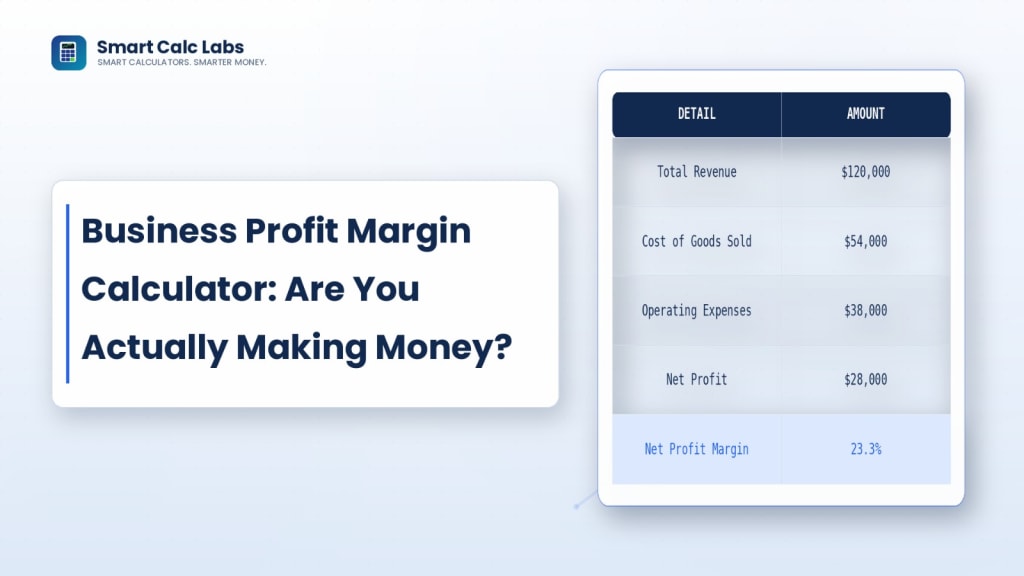
- Check your overall margins with our Business Profit Margin Calculator once you're past break-even and want to measure actual profitability.
Before You Rely on This
This calculation assumes a stable price and consistent per-unit costs. Real businesses face fluctuating material costs, seasonal demand, and discounting pressure that can shift the actual break-even point from month to month. Treat it as a planning baseline to revisit regularly, not a one-time answer.
Disclaimer: The content provided on SmartCalcLabs is for educational and informational purposes only. We are not certified financial planners or accountants. You should always consult with a licensed professional before making significant financial decisions.
Multi-Product Break-Even: Calculating Weighted Average Contribution Margin
In practice, very few enterprises sell a single product at a uniform price point. When an enterprise markets multiple stock-keeping units (SKUs) or tiered service packages, calculating a single unit break-even point is insufficient. Instead, you must calculate the Weighted Average Contribution Margin (WACM) based on your target sales mix percentage.
The sales mix represents the proportion of each product sold relative to aggregate volume. To determine portfolio break-even volume across multiple product lines, apply the following sequence of financial formulas:
1. Unit Contribution Margin (CM_i) = Unit Selling Price_i - Unit Variable Cost_i
2. Sales Mix Percentage (Mix_i) = Unit Volume_i / Total Portfolio Unit Volume
3. Weighted Average Contribution Margin (WACM) = Σ (CM_i × Mix_i)
4. Portfolio Break-Even Volume = Total Monthly Fixed Overhead / WACM
Consider a practical narrative scenario: A commercial specialty coffee roastery incurs $14,500 per month in fixed operating overhead (commercial warehouse lease, roasting equipment amortization, utility baselines, and core administrative payroll). The roastery sells three core product offerings:
- Standard Batch Drip: Retails at $4.50 per cup, variable cost (beans, milk, biodegradable cup, lid) of $1.20. Contribution margin: $3.30. Volume mix: 60%.
- Handcrafted Nitro Cold Brew: Retails at $7.00 per pour, variable cost of $2.20. Contribution margin: $4.80. Volume mix: 30%.
- Single-Origin 12oz Retail Bags: Retails at $19.00 per bag, variable cost (green bean sourcing, foil valve bag, label printing) of $7.50. Contribution margin: $11.50. Volume mix: 10%.
To calculate the roastery's composite WACM:
WACM = ($3.30 × 0.60) + ($4.80 × 0.30) + ($11.50 × 0.10) = $1.98 + $1.44 + $1.15 = $4.57 per blended unit.
Dividing the $14,500 fixed monthly overhead by $4.57 yields an aggregate monthly break-even target of 3,173 units. Applying the sales mix proportions, the business must sell exactly 1,904 drip coffees, 952 cold brews, and 317 retail bags each month simply to clear all operating expenditures.
The Contribution Margin Ratio (CMR) for Service and Digital Businesses
For SaaS businesses, digital agencies, and professional consultancies where discrete physical units do not exist, break-even is measured in gross revenue rather than physical units. This requires calculating the Contribution Margin Ratio (CMR):
Contribution Margin Ratio (CMR) = (Total Revenue - Total Variable Expenses) / Total Revenue
Break-Even Dollar Volume = Total Fixed Overhead / CMR
If an enterprise software platform generates $85,000 in monthly revenue with direct cloud compute, payment processing, and customer support variable costs of $17,000, its CMR is ($85,000 - $17,000) / $85,000 = 80.0%. If fixed administrative salaries and office leases equal $48,000 per month, the company must bill $48,000 / 0.80 = $60,000 per month in contracted revenue before generating its first dollar of operating profit.
Frequently Asked Questions
What's a realistic break-even timeline for a new business?
It varies enormously by industry and startup costs, but many small businesses target reaching break-even within 12-24 months of launch. Given that cash-flow issues are linked to a large majority of small business closures, having enough runway to survive until break-even — not just a break-even calculation on paper — is equally critical.
Should I include debt payments in fixed costs?
Yes — loan or equipment financing payments are fixed costs regardless of sales volume and belong in the calculation, just like rent or salaries.
How does break-even change for a service business with no physical product?
The same formula applies, just using billable hours or client engagements instead of "units." Variable costs might include contractor fees or software costs tied directly to each client, while fixed costs cover office space, core staff, and overhead.
Bottom Line
Break-even isn't a discouraging number — it's a clarifying one. It turns "will this business work" into a specific, testable target: sell this many units, at this price, and you cover your costs. Everything past that point is where profit actually starts.