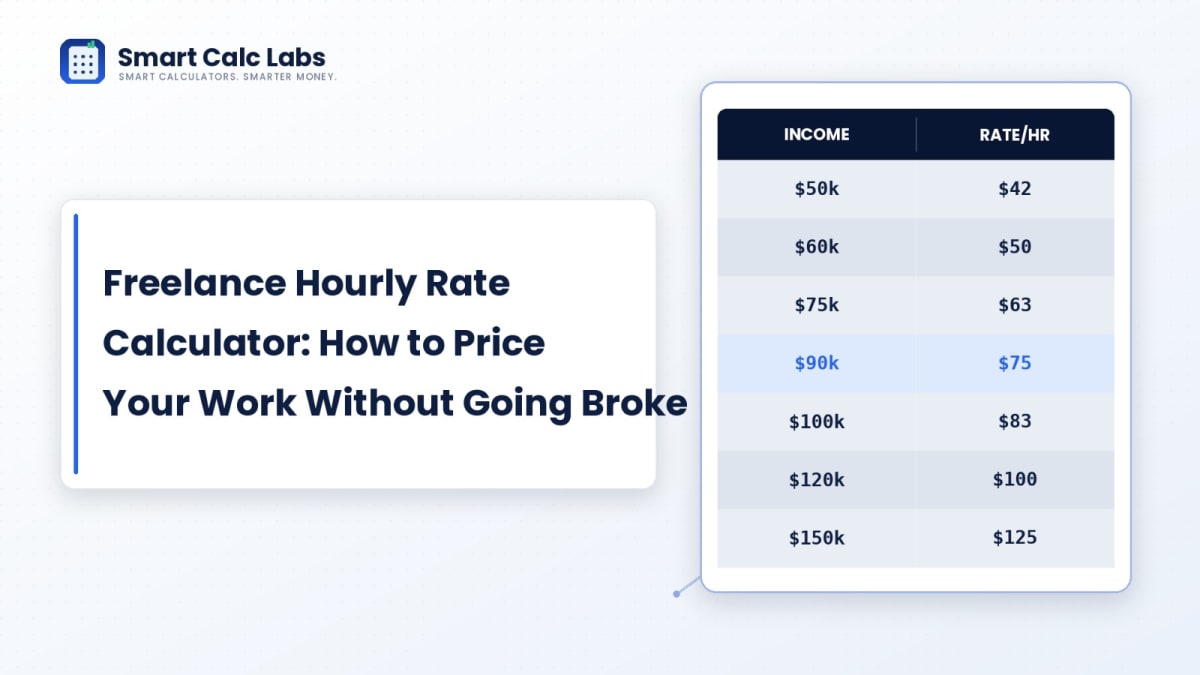
Freelancers who set their rate by copying a former salary divided by 2,080 hours (40 hours × 52 weeks) are almost always underpricing themselves — sometimes by 40% or more. That math ignores taxes, unbillable time, and benefits you no longer get for free. Here's the actual formula.
Enter your target income into the Freelance Hourly Rate Calculator — the reasoning behind each adjustment is below.
Why 2,080 Hours Is the Wrong Denominator
A full-time employee's 2,080 annual hours (40 × 52) assumes every one of those hours is billable — which is never true for a freelancer. Real-world freelance utilization (the share of total working hours that are actually billed to a client) commonly runs in the 60-75% range once you account for:
- Unpaid admin time: invoicing, proposals, emails, bookkeeping
- Sales and marketing time spent finding the next client
- Vacation, sick days, and holidays — none of which are paid unless you build them into your rate
- Gaps between contracts or slow periods with no billable work at all
If only 25 of your 40 working hours in a week are actually billable, your effective billable capacity is roughly 1,300 hours per year, not 2,080 — a 37% reduction that has to be priced into your hourly rate.
The Self-Employment Tax Freelancers Forget to Price In
Unlike a W-2 salary, freelance income is subject to a 15.3% self-employment tax (Social Security and Medicare) on top of regular income tax. A former employee's $75,000 salary and a freelancer's $75,000 in gross billings are not equivalent — the freelancer needs meaningfully more gross revenue to net the same take-home pay once self-employment tax is layered in.
Health Insurance: The Cost Employees Don't See
When you're employed, your employer typically covers a large share of your health insurance premium. As a freelancer buying coverage on your own through the ACA marketplace, a mid-tier Silver plan currently averages roughly $650-$790/month for an individual, and subsidy eligibility has narrowed significantly for moderate-to-higher earners following the end of enhanced pandemic-era subsidy provisions. That's potentially $8,000-$9,500/year in premiums alone that a salaried job would have partially or fully covered — a cost that has to be built into your rate, not treated as a personal expense that's separate from your pricing.
The Full Formula
Target hourly rate = (Desired annual take-home pay + self-employment tax + health insurance + business expenses + retirement savings) ÷ realistic billable hours per year.
Example: A freelancer targeting $70,000 take-home, needing to cover roughly $12,000 in combined SE tax and income tax adjustment, $9,000 in health insurance, $3,000 in business expenses (software, equipment), and working 1,300 realistic billable hours per year, needs to bill roughly $95,000 in total gross revenue — which works out to about $73/hour, not the $34/hour a naive $70,000 ÷ 2,080 calculation would suggest.
Common Mistakes
- Using a former salary divided by 2,080 hours. This ignores unbillable time, self-employment tax, and lost benefits entirely — it's the single biggest reason freelancers underprice their work.
- Not accounting for realistic utilization. Assuming 40 billable hours a week when the honest number (after admin, sales, and gaps) is closer to 20-30 leads to chronic underpricing.
- Forgetting paid time off doesn't exist unless you build it in. Every week of vacation or sick time is unbilled revenue that has to be recovered through your hourly rate the rest of the year.
- Pricing to match a former employer's salary instead of true cost of doing business. The correct comparison isn't "what did I make as an employee" — it's "what do I need to bill, given everything an employer used to cover, to reach the same take-home pay."
Putting It Into Practice
- Set your target annual take-home pay — what you actually want to keep after taxes and expenses.
- Estimate your realistic annual billable hours honestly, not optimistically — most freelancers land between 1,200-1,600 hours, not 2,080.
- Add self-employment tax, health insurance, and business expenses on top of your take-home target using the calculator.
- Cross-check the tax portion using our Self-Employment Tax Calculator for a more precise figure based on your actual income level.
- Revisit the number annually as your expenses, health insurance costs, and target income change.
Before You Rely on This
This calculation depends heavily on your estimate of realistic billable hours, which varies by industry, experience level, and how much active marketing or sales work your freelance business requires. Treat the output as a floor to price above, not an exact number the market will automatically pay — client demand and competition still play a role in what rate you can actually charge.
Disclaimer: The content provided on SmartCalcLabs is for educational and informational purposes only. We are not certified financial planners or business consultants. You should always consult with a licensed professional before making significant financial decisions.
The Non-Billable Hours Reality: Auditing Administrative Overhead and True Capacity
The most catastrophic financial miscalculation freelance contractors and agency founders make is assuming an 8-hour workday yields 8 billable client hours. In professional service firms, design studios, and freelance development practices, sustainable billable utilization rarely exceeds 55% to 65% of total hours worked. The remainder is consumed by mandatory business overhead.
The 1,100-Hour True Utilization Framework
A standard full-time corporate employee logs approximately 2,080 gross working hours annually (40 hours × 52 weeks). Here is how true billable hours degrade for a self-employed professional who operates a compliant business:
- Mandatory Time Off (240 Hours): 3 weeks of planned vacation (120 hrs), 8 statutory national holidays (64 hrs), and 7 sick, emergency, or mental health recovery days (56 hrs). Net available hours: 1,840.
- Administrative & Bookkeeping Overhead (180 Hours): Invoicing clients, reconciling bank statements, issuing 1099 contracts, submitting quarterly estimated federal/state taxes, and chasing accounts receivable (~3.5 hrs/week).
- Business Development & Pipeline Acquisition (260 Hours): Drafting client proposals, conducting exploratory discovery calls, networking, portfolio refreshes, and outbound marketing (~5 hrs/week).
- Client Communications & Unbilled Project Scope (200 Hours): Answering ad-hoc emails, Slack messaging, project management tool maintenance, and client status reporting (~4 hrs/week).
- Professional Continuing Education & Tech Upgrades (100 Hours): Software updates, tool onboarding, security maintenance, and course certifications (~2 hrs/week).
- Total Non-Billable Business Overhead: 740 hours annually.
- True Sustainable Billable Capacity: 1,840 - 740 = 1,100 billable hours per year (~21.2 billable hours per week).
The Mathematical Cost of the 2,080-Hour Fallacy
To demonstrate the real-world consequence of this dynamic, consider a senior UX consultant targeting a net personal take-home salary of $100,000. Factoring in self-employment taxes ($14,130), personal health insurance premiums ($7,200), business software subscriptions ($4,800), and legal/accounting fees ($3,000), their required gross business revenue is $129,130.
• Flawed Rate Calculation (2,080 hrs): $129,130 / 2,080 = $62.08 / hour
• Realistic Rate Calculation (1,100 hrs): $129,130 / 1,100 = $117.39 / hour
Billing at $62/hour forces the consultant into 70-hour workweeks to hit their revenue target, leading directly to burnout. Billing at $117/hour ensures the business remains fully solvent while working sustainable 35-to-40 hour weeks.
Frequently Asked Questions
What's a realistic billable utilization rate for a new freelancer?
Many new freelancers start closer to 50-60% utilization while they're still building a client base and systems, climbing toward 70-75% as their pipeline stabilizes. Very few freelancers sustain much higher than that long-term without burning out.
Should I charge different rates for different types of clients?
Some freelancers do — charging more for rush work, difficult scopes, or clients requiring extensive revisions, and holding a standard rate for straightforward, well-scoped work. The floor calculated here should apply to your lowest acceptable rate across any client type.
How often should I recalculate my rate?
At least annually, or whenever a major cost changes — a health insurance premium increase, a jump in your tax bracket, or a significant shift in your realistic billable hours.
Bottom Line
Your hourly rate needs to cover far more than your former salary divided by working hours — self-employment tax, your own health insurance, unbillable admin time, and time off all have to be priced in. Calculate the real number once, and treat it as the floor you price from, not the ceiling.