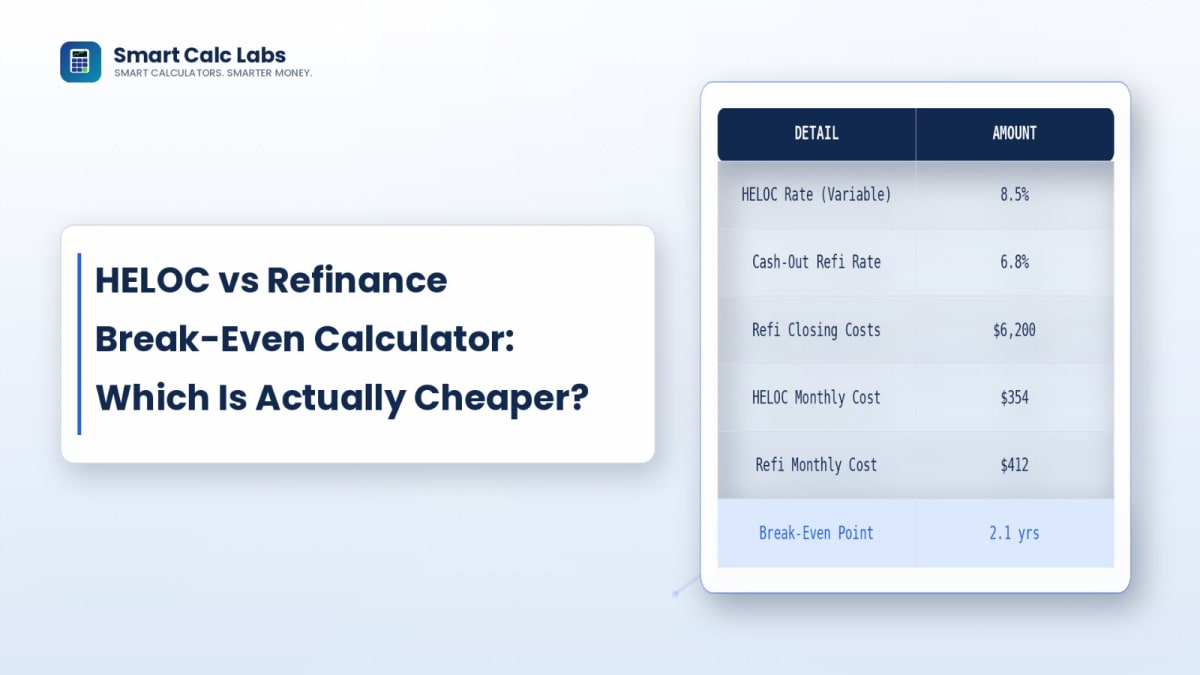
With the average HELOC rate around 7.2%-7.5% and 30-year mortgage rates around 6.6%-6.8% as of August 2026, tapping your home equity isn't a simple "which rate is lower" decision — a cash-out refinance can carry a lower rate but forces you to refinance your entire mortgage, including whatever low rate you may already be locked into.
Run your numbers through the HELOC vs Refinance Calculator — the reasoning behind the comparison is below.
The Trap Most People Miss: Your Existing Rate
If you locked in a mortgage at 3-4% during 2020-2021, a cash-out refinance means giving up that rate on your entire loan balance, not just the cash you're pulling out. Refinancing a $300,000 balance from 3.5% up to today's roughly 6.7% to access $50,000 in equity means paying the higher rate on the full $350,000 — not just the new money. This is usually the single biggest factor in the decision, and it's exactly why HELOCs have become more popular relative to cash-out refinances in the current rate environment: a HELOC lets you borrow against equity without touching your existing mortgage rate at all.
How the Two Options Actually Compare
- HELOC: A revolving credit line, currently averaging around 7.2%-7.5% (variable), secured against your home. You only pay interest on what you draw, not the full approved limit. Closing costs typically run 2%-5% of the credit line.
- Cash-out refinance: Replaces your entire mortgage with a new, larger one at current rates (around 6.6%-6.8% for a 30-year term as of August 2026). You get the equity as a lump sum at closing, but you're refinancing your whole loan balance, with full mortgage closing costs (typically 2%-5% of the new loan amount).
- Home equity loan (fixed-rate alternative to a HELOC): Currently averaging around 7.3%-8.1%, a lump-sum second mortgage with fixed payments — useful if you want predictability without touching your first mortgage.
Where the Break-Even Point Comes From
The break-even calculation weighs closing costs against the ongoing rate difference. A cash-out refinance often has higher upfront closing costs than a HELOC (since you're closing on an entirely new mortgage), but if your existing rate is already high, the new blended rate might still work in your favor over time. A HELOC has lower upfront costs and preserves your existing mortgage rate, but its variable rate means your payment can rise if the Fed raises rates — a real risk given some analysts currently expect a possible rate hike later in 2026 rather than further cuts.
When Each Option Tends to Win
- HELOC usually wins if: your current mortgage rate is well below today's market rate, you need flexible ongoing access to funds (like a phased home renovation), or you want to minimize upfront closing costs.
- Cash-out refinance usually wins if: your current mortgage rate is close to or above today's market rate anyway (so there's little rate to protect), you want one predictable fixed payment instead of a variable rate, or you're borrowing a very large amount where a HELOC's variable-rate risk becomes harder to stomach.
- Home equity loan usually wins if: you want a HELOC-style second-lien loan but prefer the payment certainty of a fixed rate over a variable one.
Common Mistakes
- Comparing only the headline interest rate. A HELOC's variable rate can rise; a refinance's fixed rate applies to your entire balance, not just the new funds. The "lower rate" option on paper today isn't always cheaper over the full term.
- Ignoring the reset on your loan term. A cash-out refinance often restarts your mortgage at a fresh 30-year term, which can mean paying interest for longer overall even at a similar rate — factor this into total lifetime cost, not just monthly payment.
- Treating home equity like free money. Whichever option you choose, you're borrowing against your home. Using either for depreciating purchases (cars, vacations) rather than value-adding uses (renovations, debt consolidation at meaningfully lower rates) increases your risk without a clear return.
- Not shopping multiple lenders. HELOC and refinance rates vary meaningfully by lender — comparing at least 3 quotes can reveal a full percentage point of difference on otherwise identical terms.
How to Use the Calculator
- Enter your current mortgage rate and balance — this determines how much you'd be giving up with a refinance.
- Enter the amount of equity you want to access and current HELOC vs. refinance rate quotes.
- Compare total costs over your expected time horizon — a HELOC you'll pay off in 2 years and a refinance you'll carry for 20 produce very different break-even outcomes.
- Cross-check against your overall debt picture if the equity is meant to consolidate higher-interest debt.
Before You Rely on This
HELOC rates are variable and move with the Fed's benchmark rate — a rate that looks favorable today can shift over a multi-year draw period. Refinance rates are locked at closing but depend on market conditions at that moment. Get current, personalized quotes from at least a few lenders rather than relying solely on national averages for your final decision.
Disclaimer: The content provided on SmartCalcLabs is for educational and informational purposes only. We are not certified financial planners or mortgage professionals. You should always consult with a licensed lender before making significant financial decisions.
Frequently Asked Questions
Why would anyone choose a HELOC if refinance rates are lower?
Mainly to protect an existing mortgage rate that's below today's market. If your current rate is 3.5% and today's refinance rate is 6.7%, a HELOC lets you access equity without disturbing that low rate on your primary balance — even though the HELOC's own rate may be higher than the refinance rate.
Can HELOC rates change during my draw period?
Yes — most HELOCs carry a variable rate tied to the prime rate, meaning your payment can rise or fall as the Fed adjusts its benchmark rate over your draw and repayment periods.
Is a home equity loan the same as a HELOC?
No. A home equity loan gives you a lump sum upfront at a fixed rate with fixed payments, while a HELOC is a revolving credit line with a variable rate where you draw funds as needed and pay interest only on what you've used.
Bottom Line
The "cheaper" option depends less on which headline rate is lower today and more on your existing mortgage rate, how long you'll carry the new debt, and whether you value a fixed payment over borrowing flexibility. Run your specific numbers rather than defaulting to whichever product currently has the lower advertised rate.