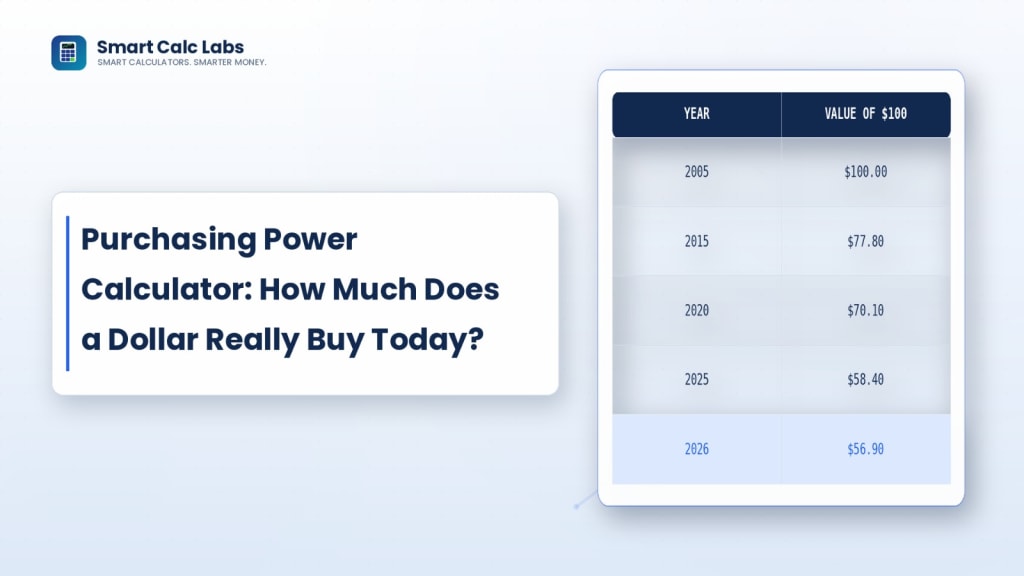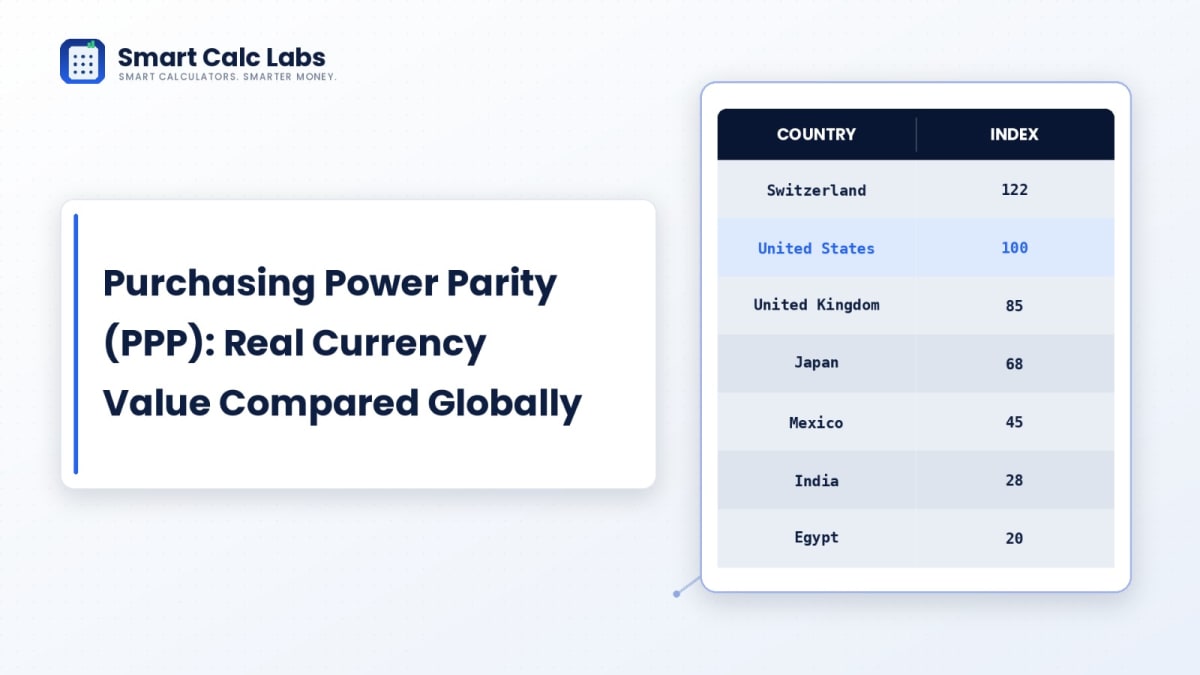
When you exchange $1,000 USD into Euros, British Pounds, or Japanese Yen at an airport kiosk or currency app, the rate you receive is the nominal market exchange rate. That rate reflects supply, demand, interest rate differentials, and global trade flows on foreign exchange markets. But it tells you almost nothing about what that money will actually purchase once you land.
To understand the true, underlying value of money across borders, economists rely on Purchasing Power Parity (PPP). While our free Purchasing Power Calculator models how domestic inflation erodes purchasing power over time, PPP examines how purchasing power shifts across geographical borders.
The Law of One Price and How PPP Works
At its theoretical core, Purchasing Power Parity is built on the Law of One Price. This principle states that in an open, friction-free global market without trade barriers, shipping costs, or tariffs, identical goods should sell for the exact same price everywhere when converted into a common currency.
For example, if a standardized basket of consumer goods costs $100 in the United States and an identical basket costs £80 in the United Kingdom, the implied PPP exchange rate between the US Dollar and the British Pound is:
If the actual market exchange rate is $1.35 per £1, PPP theory suggests the British Pound is nominally overvalued by 8% relative to the US Dollar (or conversely, the US Dollar is undervalued).
The Big Mac Index: "Burgernomics" in the Real World
Because measuring a comprehensive basket of thousands of items across dozens of countries is extraordinarily complex, The Economist created the Big Mac Index in 1986 as an accessible, lighthearted benchmark for PPP.
A McDonald's Big Mac is produced with virtually identical ingredients, supply chain standards, and preparation methods in over 100 countries. By comparing local burger prices in US dollar equivalents, the index provides an intuitive snapshot of global currency valuation:
| Country | Local Big Mac Price | Price in USD (Market Rate) | Implied Currency Valuation |
|---|---|---|---|
| United States (Base) | $5.80 USD | $5.80 | Baseline Benchmark |
| Switzerland | 7.20 CHF | $8.15 | ~40% Overvalued |
| Eurozone | €5.40 EUR | $5.85 | Fairly Valued |
| Japan | ¥480 JPY | $3.15 | ~45% Undervalued |
| South Africa | 50 ZAR | $2.75 | ~52% Undervalued |
Nominal Exchange Rates vs. Geographic Arbitrage
The gap between nominal exchange rates and PPP explains the phenomenon known as geographic arbitrage (or geo-arbitrage). When a professional earns income in a strong, high-purchasing-power currency (like USD, CAD, or GBP) but spends that money living in a country where local costs and wages are significantly lower (like Portugal, Mexico, Thailand, or Vietnam), their real standard of living multiplies dramatically.
An annual salary of $60,000 USD may provide a modest lifestyle in San Francisco or New York City, where rent and dining absorb most discretionary income. However, in a market where the local currency has lower PPP cost structures, that same $60,000 possesses the effective purchasing power of $150,000+ in local goods, services, housing, and healthcare.
Why PPP Doesn't Always Hold: The Non-Tradable Factor
While PPP provides a clean long-term framework, it rarely holds precisely in the short term due to critical real-world frictions:
- Non-Tradable Services & Real Estate: You can ship an iPhone or crude oil across oceans, but you cannot ship commercial real estate, restaurant haircuts, or local plumbing labor. Non-tradable goods reflect local labor costs and land values.
- Taxes and Tariffs: Value-Added Taxes (VAT), local import duties, and agricultural subsidies distort consumer prices between nations.
- Capital Flows & Speculation: Foreign exchange markets are heavily driven by central bank interest rate decisions, global risk sentiment, and sovereign debt flows rather than everyday retail consumer shopping.
Common Purchasing Power Mistakes
- Confusing nominal income with purchasing power parity. Earning $100,000 in Zurich, Switzerland does not make you wealthier than someone earning $80,000 in Raleigh, North Carolina once local living costs and Swiss prices are factored in.
- Assuming exchange rate dips mean an economy is getting cheaper for locals. When a foreign currency depreciates rapidly, imported goods (energy, electronics, food) become more expensive locally, triggering domestic inflation that eats away local wages.
- Failing to track your personal inflation alongside historical trends. Whether planning retirement abroad or domestically, you should model your future purchasing power trajectory with our Purchasing Power Guide and interactive calculators.
How to Use This for Financial Planning
- Stress-Test Long-Term Cash Savings: Use our Purchasing Power Calculator to see how much domestic price inflation will reduce the real purchasing power of your emergency funds or retirement nest egg.
- Evaluate International Relocation or Travel: Look at both nominal exchange rates and local consumer price indices (like the Big Mac Index or Numbeo PPP indices) to budget realistic cost-of-living requirements.
- Coordinate Investment Returns: Compare your portfolio's nominal yields with real inflation-adjusted growth using our Investment ROI Calculator to ensure your purchasing power increases over time.
Before You Rely on This
Purchasing Power Parity is a long-term macroeconomic framework and an illustrative indicator rather than an exact currency forecasting tool. Short-term foreign exchange rates can diverge from theoretical PPP levels for years or even decades based on geopolitical events, trade balances, and central bank monetary policy.
Disclaimer: The content provided on SmartCalcLabs is for educational and informational purposes only. We are not certified financial advisors, economists, or foreign exchange brokers. Consult a qualified professional before making major international tax, investment, or relocation decisions.
Frequently Asked Questions
What is the difference between nominal GDP and PPP GDP?
Nominal GDP converts a nation's economic output into US dollars using current market exchange rates. PPP GDP adjusts output for differences in local price levels, providing a more accurate comparison of actual physical production and domestic living standards.
Is the US Dollar currently overvalued or undervalued?
On a PPP basis, the US Dollar has historically traded at a premium (overvalued) relative to most emerging market currencies and several developed market currencies due to its status as the primary global reserve currency and strong capital inflows into US capital markets.
How does PPP affect multinational corporation salaries?
Global corporations often use Cost of Living Adjustments (COLA) and PPP indices to set localized compensation packages for international employees and expats, ensuring equivalent purchasing power across different regional offices.
Bottom Line
Purchasing power is the only true measure of wealth. Whether you are comparing how much a dollar bought in 1980 versus today, or evaluating how far your savings will stretch across different global economies, looking beyond nominal numbers to real purchasing power is what transforms raw data into actionable financial clarity.